

Like most Americans, I was forced to learn about “Bo” French this month when he decided to voice his opinion about the people of India. That’s the Republican nominee for Texas Railroad commissioner, which is not a role you probably knew existed, nor an electoral race the rest of us would be watching, if not for his comments about the browning of our country. America has been having a national debate about Indians ever since December 2024, when Elon Musk and Vivek Ramaswamy defended H-1B visas as a way to import top talent. MAGA nativists Steve Bannon and Laura Loomer attacked them, President Trump slapped a $100,000 fee on new H-1B petitions, and about 20 states sued. Since then, the economist Noah Smith and writer Richard Hanania have been cheerleading for Indians, while critics point out that Indians are displacing American tech workers. Personally, as someone who has lived in India for years, I am not blind to the flaws of Indian society, and there are certain behavioral norms, particularly toward women, that I would not want to see imported to America. For more on that, read about my online scrap with India’s top women’s rights official, Rekha Sharma. Nevertheless, I am mostly partial to the cheering.
Yes, the critics have a point, Indians are indeed taking American tech jobs. And then you have cases like the software company Cognizant, which gamed the H-1B lottery in favor of Indian workers. A jury found the company liable for discriminating against non-Indian employees, and the Labor Department has opened its first major H-1B fraud investigation. Nor is this an isolated case. The FBI busted three India-based call centers posing as Social Security officials, and the Department of Justice has sentenced eight defendants in a similar scheme targeting the elderly. No surprise there either. In many poor parts of India, scamming Americans and the rest of the West has become an important source of household income. There are also concerns about caste discrimination, and again, we find that if you import people from a region, they do not magically become American the second they step one toe inside America. Rather, they bring with them their own norms and values. So, we find the Indian caste system is now spreading on American soil. A 2016 survey of South Asian Americans conducted by Dalit civil rights organization Equality Labs found that 25% of Dalit respondents said they had faced verbal or physical assault based on their caste. In 2020, California sued the tech giant Cisco, accusing it of caste-based discrimination. And in 2023, Seattle became the first U.S. city to ban caste discrimination.
Here’s another concern. I love the gift of America’s natural landscape. I am a hardcore minimalist camper, survivalist, and fisherman. I respect the great outdoors. But India reveres nature in principle, and trashes it in practice. Don’t get me wrong, I love Indian nature too. I lived for months in the monsoon forests outside Goa, sleeping on the bare jungle floor. I lived about a year in a wooden cabin high in the Himalaya, hiking hours to shower under icy waterfalls, or trekking barefoot down a beaten mud path into town for fresh vegetables. I have a lot of fond memories of the natural beauty of Mother India. But consider the Ganga, or Ganges River, which Indians regard as sacred. Near where I used to live in Rishikesh, the current of the Ganga runs cool and fresh, as clear as the Caribbean waters I grew up with, and I waded into it often, stopping on my walk to and from yoga, even on brisk mornings when the water was bitingly cold. But later, when I was living downstream in Varanasi, I read water survey reports and remember finding that the river there was literally worse than sewage. If you shit in a bucket and sat inside it, I’m not sure it would be much worse than entering the Ganga near the Malviya Bridge, after she has passed along the ghats of Varanasi, and the city has poured its putrid bile directly into her veins, rotten human carcasses and cow shit and industrial urban waste and all. So I blanch a little when I read about Indians polluting North American forests or bodies of water, because I know how far this can go.
So yes, I have my concerns when it comes to Indian immigration. But what exactly did French say about Indians? Did he express concern about pollution, caste discrimination, sexual assaults, or tech jobs? No, he shared an image of Indian students celebrating at a University of Texas graduation, dressed in school colors, having the time of their lives, joyous and wholesome, one guy even wearing a cowboy hat. If this isn’t the kind of immigration you want — people who love America, and drink deep of the cup, and who seem fully assimilated — then what the hell do you want? As I have explained above, it’s reasonable to object to behavioral norms such as sexism or pollution, and it’s reasonable to object to ideologies such as Islam, but if the people are demonstrating American norms, what the fuck is the problem? Is it really just that they aren’t white? Is that all we’re supposed to care about? Even within white supremacist circles, the idea is supposed to be that whites are superior because of certain civilizational achievements or behavioral norms. Western liberal democracy, the Scientific Revolution, the Enlightenment, the Renaissance, the Western Canon, lower homicide rates. These are the kinds of things literate white racists cite. But French seems to think these things belong exclusively to white people, as if the currency of cultural treasure can never be exchanged. As I have written about the concept of cultural appropriation:
One of the ugliest pieces of racecraft ever conjured in the cauldron of the human mind is the notion that great works of art should be fenced off by race like rows of a garden from hungry deer. This means that if you are black, Shakespeare does not belong to you. You can look upon his roses of youth and violets of madness, but you had better keep your hooves on that side of the fence. Shakespeare belongs to white people, specifically white British men. When he writes of forbidden young love or the ruin of unchecked ambition or the delirium of indecision, he is not tapping into shared and universal experiences.
French is not a serious person, and he certainly doesn’t understand what can be learned from the vast wealth of Indian culture. A person like this has probably never even heard of the Ramayana, Advaita Vedanta, or listened in rapture to Ravi Shankar playing a sitar raga. He doesn’t know a fucking thing.


Genuinely, his only concern seems to be the color of their skin. I look at that photo and my first thought is, these guys look hella fun. That’s the beauty of America in a single photo, and it makes me proud to see people coming to the glory of what we’ve built, and wanting to thrive with us, and join the American family. Welcome, brothers, welcome. But in case you think maybe French meant something else, something more reasonable, consider the fact that he also thinks we should deport Native Americans! Deport them fucking where? Doubtless, he hasn’t thought very far beyond his own mouth. And Republicans are now split on whether to condemn or defend French. Karl Rove, a key architect of George W. Bush’s 2000 and 2004 presidential victories, called French a “bigot” and said he plans to vote for Democrat Jon Rosenthal over French. Sadly, but not surprisingly, Trump responded:
Karl Rove is so bad for the Republican Party, and completely wrong so often. He suffers from a major case of Trump Derangement Syndrome primarily because, for almost 10 years, I beat back and won against so many of the people and things that he wanted and espoused. Why does FoxNews and the WSJ keep his RINO Voice alive. The guy is a stone cold loser!

But now let’s turn the page to another kind of newcomer, and consider the question of immigration from a slightly different angle.
“It is completely ridiculous, it’s laughable, to say guys like myself, guys like Abdul El-Sayed, we hate America,” Hasan Piker recently complained. He was responding to critics who point out he has said, “America deserved 9/11.” Piker says he already explained what he “really meant” by that remark. El-Sayed, the Democratic nominee for the U.S. Senate in Michigan, is included because he campaigned with Piker at several university campuses in the state, and defended his appearances with Piker, and seems to even get annoyed when people ask him about it, as if the question is unfair. Okay, Piker made a mistake and took it back. Except he has also said:
The United States of America is the most dog-shit country on the fucking planet … The absolute worst fucking place on the planet. Just a horrific, monstrous, awful, dog-shit country that I fucking despise. The absolute fucking worst country ... I fucking despise this nation. I despise this country with my entire fucking heart.
And he has also bragged, “I say I hate America all the time … I say it with my fuckin’ chest.” And here’s a full minute Piker saying how much he hates America. Just this week, in fact, he said “pound for pound,” America conducts more terror around the world than al-Qaeda. And he celebrates Hamas, Hezbollah, the Houthis, and brutal dictatorships like China. So fuck this guy right alongside French. In fact, Piker seems like a significantly worse character than French. But as I recently wrote, Piker is just one person. The real concern ought to be why Piker has so many followers of the left, why the left doesn’t disavow him, why scummy figures like El-Sayed think they can campaign with Piker and not be asked about it. When asked to condemn such rhetoric, El-Sayed refused and became irritated with the question. And don’t forget, El-Sayed is the dirtbag who responded to the March 2026 attack on Temple Israel synagogue in Michigan by expressing concern for the attacker, saying, “Hurt people hurt people.” He apologized months later. Looking at figures like French and Piker, both sides really ought to be disgusted with themselves for associating with such people. But does French have a whip of a point? Will the browning of America truly change it in some meaningful way? Should we be concerned with people like Piker joining the American family? Does it single a true decline in what we used to be, or is that just another kind of American?

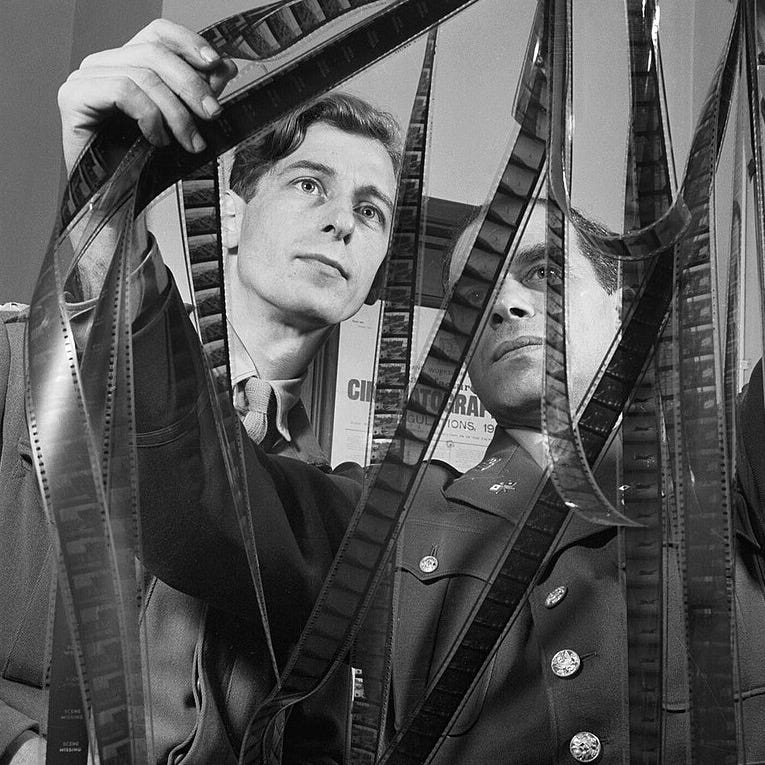
During World War II, the U.S. Army asked director Frank Capra to make a documentary film series. By the time he was brought into the Army in 1942, the Sicilian-born kid from Lincoln Heights, a working-class immigrant neighborhood just northeast of downtown Los Angeles, had become the most celebrated filmmaker in America and one of the most prestigious directors in the world. He won the Oscar for best director three times in the 1930s, making populist, optimistic comedies and dramas about regular folks standing up to the Man. Some of his hits included You Can’t Take It with You in 1938 and Mr. Smith Goes to Washington in 1939. But when the Army came knocking, they wanted something different. Gen. Marshall asked Capra to help explain the war to American soldiers. When Capra tried to decline, saying he had never made a documentary, Marshall replied, “Capra, I have never been chief of staff before. Thousands of young Americans have never had their legs shot off before. Boys are commanding ships today, who a year ago had never seen the ocean before.”
Capra agreed to take the assignment. But when he saw Leni Riefenstahl’s Nazi propaganda film Triumph of the Will, a bone-chilling masterpiece of documentary filmmaking, he knew he had to find a way to counter that kind of racist cinematic power. The result was Why We Fight, in which Capra made the radical decision to include Nazi speeches and footage. He understood that when dealing with evil, you don’t have to prove you’re the good guy. Sometimes, you just have to let the other guy talk. I have always taken this story as a lesson in free speech. People who hope to censor often fail to see that silencing your critics only paints them in dissident colors. If your enemy is truly vile, it’s a blunder to demonize them when you can accurately quote them instead. It was in Prelude to War and The Nazis Strike that Capra made the most use of repurposed Axis footage. And it worked. Audiences were appalled and Prelude won an Oscar for best documentary. One may think supplying Nazi content would have the opposite effect, which is why deplatforming attempts are popular today, but Capra had faith in his fellow Americans. And he was vindicated.
Except that method only works when operating within a shared moral frame. You show the audience what Hitler said and did, and the audience reliably supplies the condemnation because those words and actions violate the norms they already hold. But if the underlying norms change, the same content can stop functioning as an indictment, and can even begin to function as recruitment. In the 1940s, America was far more culturally homogeneous than it is today, particularly in terms of the public moral vocabulary. This was the result of the fact that Americans were 90% white, 90% Christian, and 97% citizens. This is not to say that any one of those features is better than being Asian, Buddhist, or a citizen of Japan. But it should hardly need saying that a uniform society will more readily reinforce its moral reflexes. Or to put it another way, in a multicultural society, you cannot always rely on shared cues to trigger the same moral response. As de Tocqueville warned in Democracy in America:
Obviously without such common belief no society can prosper; say, rather, no society can exist, for without ideas held in common there is no common action, and without common action there may still be men, but there is no social body. In order that society should exist and, a fortiori, that a society should prosper, it is necessary that the minds of all the citizens should be rallied and held together by certain predominant ideas; and this cannot be the case unless each of them sometimes draws his opinions from the common source and consents to accept certain matters of belief already formed.
In 1787, 53 years before de Tocqueville published those words, John Jay, a Founding Father and a principal architect of American democracy, made the same point in the second Federalist essay, “Concerning Dangers from Foreign Force and Influence”:
With equal pleasure I have as often taken notice that Providence has been pleased to give this one connected country to one united people—a people descended from the same ancestors, speaking the same language, professing the same religion, attached to the same principles of government, very similar in their manners and customs, and who, by their joint counsels, arms, and efforts, fighting side by side throughout a long and bloody war, have nobly established general liberty and independence.
Jay was wrong on the facts. Even in 1787, the country held Dutch, Germans, Scots-Irish, Quakers, Catholics, and Jews. But that’s the point. What he mistook for common blood was common conviction, and it was conviction that held. But we have chosen to ignore our Founder and our French friend who, whatever their errors, saw this truth plainly, and have instead chosen to walk a different path. Even before these great men commented on the topic, Benjamin Franklin wrote about his concerns over German immigrants in Pennsylvania in the 1750s. It’s almost laughable to us today to imagine this being a serious fear. But Franklin wasn’t dealing with the Germans of today. In his 1751 essay “Observations Concerning the Increase of Mankind,” and in a 1753 letter to his English friend Peter Collinson, he laid out his specific complaints, that the Germans were not assimilating, and that their birth rates and immigration numbers would lead to the displacement of Franklin’s own people. He worried they would swing elections as a unified voting bloc, and noticed they had no loyalty to Pennsylvania, such that during King George’s War in the 1740s, when Pennsylvania needed colonists to defend against the French and their Native allies, Germans refused to fight. Many did so for religious reasons, being pacifist Mennonites or Amish, and Franklin saw them as living off the sacrifices of English colonists. The comments about complexion and swarthiness are bigoted, but he was also fair in his assessment, adding also that their industrious and frugal nature could “contribute greatly to the improvement of a Country.”
Why should the Palatine Boors be suffered to swarm into our Settlements, and by herding together establish their Language and Manners to the Exclusion of ours? Why should Pennsylvania, founded by the English, become a Colony of Aliens, who will shortly be so numerous as to Germanize us instead of our Anglifying them, and will never adopt our Language or Customs, any more than they can acquire our Complexion.
He was proven right in his lifetime. Germans did form a voting bloc, one that contributed to Franklin himself losing his Pennsylvania Assembly seat in 1764, not because he was a bad assemblyman — he was one of the best, and had been chosen as speaker that year — but simply because Germans remembered his “Boors” remark. But in the end, Germans did assimilate. Within a couple of generations, they became English-speaking, blended into American life, and Franklin’s fears are now regarded in hindsight as nativist panic. Except that nativism is about shutting people out, whereas Franklin had wanted Germans to assimilate in. He wasn’t calling for them to be expelled, but for them to blend into the broader culture. And ultimately, they did.

J. Hector St. John de Crèvecoeur’s famous 1782 “Letters from an American Farmer” offered the more optimistic vision, one in which different European nationalities blended together:
What then is the American, this new man? He is either an European, or the descendant of an European, hence that strange mixture of blood, which you will find in no other country. I could point out to you a family whose grandfather was an Englishman, whose wife was Dutch, whose son married a French woman, and whose present four sons have now four wives of different nations. He is an American, who, leaving behind him all his ancient prejudices and manners, receives new ones from the new mode of life he has embraced, the new government he obeys, and the new rank he holds. He becomes an American by being received in the broad lap of our great Alma Mater. Here individuals of all nations are melted into a new race of men, whose labours and posterity will one day cause great changes in the world. Americans are the western pilgrims, who are carrying along with them that great mass of arts, sciences, vigour, and industry which began long since in the east; they will finish the great circle.
This is perhaps the earliest formulation of the melting-pot, and this dream of a “new race of men,” united not by the prejudices of blood and soil, as in Europe, but by chosen principles and self-interest, as Crèvecoeur goes on to say, is as fundamental to American liberty as the Constitution itself, for it means that, freed from Old World hierarchies and monarchies, people can come here holding nothing more than a desire to thrive in the “broad lap” of America. And I love that about this place. But both Franklin and Crèvecoeur were still exclusively talking about cultural gaps between different kinds of white European Christians. These gaps eventually closed, but that does not mean that all gaps will, or can. The reason Franklin was proven wrong in the long-run is that German immigrants were not arriving with the intent to undo the society they entered. They came for refuge and opportunity — to thrive with, not rule over. Similarly, when waves of Catholic immigrants came from Ireland in the 1850s, the Know-Nothing Party built an entire political platform around fear of the dilution of Protestant American culture. But again, these fears proved hysterical, the collapse never came, and Catholics assimilated over time. But, also again, the gap was between two white Christian groups, and so relatively narrow in scope, compared to what the world can offer. What, instead, would happen when completely different groups began to pour into America?

The country was already in the midst of finding out, as the California Gold Rush of 1849 drew thousands of Chinese to the West Coast. Up until this point, America had basically operated with open borders, and most of the people coming in were European, except for the nation’s population of African slaves. The wave of Chinese immigration that began in the 1840s was the first real influx of voluntary, non-European migration to America. And it quickly became clear that the Chinese had a different set of cultural values. For one thing, they prized the clan over the individual and disputes, credit, job placement, and welfare ran through associations known as huiguan rather than through courts, banks, or employers. Labor was contracted in gangs through a headman rather than negotiated on an individual basis, which looked to white workers like unfree “coolie” labor. Americans also opposed the opium dens, gambling, and filthy conditions found in Chinatowns. But mostly, what drove opposition to Chinese immigration was two factors: the fact that Chinese laborers took lower wages, undercutting white workers, and sheer racism.
The most beautiful, and heartbreaking, depiction of this chapter in American history, and of anti-Chinese sentiment, is found in the film Train Dreams, which I highly recommend. The film didn’t receive enough attention, in my opinion, but it was the most beautiful film I saw last year. A poem of a movie. The only other film I have seen in recent memory that I found as poetic and moving was the 2024 film Color Book, which I also highly recommend.
“Anti-Chinese sentiment,” as we now politely refer to this particular breed of racist hatred, culminated in the end of America’s open borders with the Chinese Exclusion Act of 1882. America’s ability to welcome nonwhite immigrants into the family had been tested for the first time (I’m not counting forcibly imported slaves as “immigrants”), and America responded like a Klansman finding out his daughter is dating a guy named Wei Chen. I ain’t racist, just don’t want it in my family. But looks can be deceiving, especially when looking with racist eyes, because although Chinese were not white, European, or Christian, the cultural gap was not really so great. When I lived in China, I used to enjoy reading New Yorker columnist Evan Osnos, their China correspondent, who once observed that Chinese and Americans today are closer than Soviets and Americans ever were. Politically, the gap may be as wide. But Soviet and American teenagers in 1975 shared no music, films, or brands, while Chinese teenagers today carry iPhones and worship NBA stars. The deepest divides aren’t racial or religious, but ideological, and race and religion matter only insofar as they track those gaps.
American attitudes on this question really began to shift thanks to two Zionist thinkers. In his 1908 play The Melting Pot, the Zionist playwright and friend of the great Theodor Herzl, a man named Israel Zangwill, popularized the phrase “melting pot.” The play tells the story of two Russians, a Jewish boy named David and a Christian girl named Vera, who meet as immigrants in America and fall in love. The twist is, Vera’s father was responsible for killing David’s family in a pogrom. But David chooses to embrace America as a place where European hatred can be transcended, and he and Vera plan to marry. Then in 1924, the Zionist philosopher Horace Kallen coined the term “cultural pluralism.” In 1965, Lyndon B. Johnson signed the Immigration and Nationality Act, which ended national-origin quotas and dramatically diversified immigration. This is celebrated, or lamented, depending on one’s view of immigration.
In America today, whites are now 58% of the population, Christians are 62%, and citizens are 93%. As Pew reported this month, these trends are expected to continue. By 2060, the U.S. Census Bureau projects whites will fall to 45%. By 2070, Pew projects Christians will fall to 46%. But again, I am not saying that a white Christian is better than an Asian Buddhist. That sort of racial arithmetic is repugnant and stupid. Not to mention, rather inconvenient for me given that more than half my family is black, my mother is a non-citizen, and my wife and daughter are Latinas. What I am saying, however, is that multiculturalism necessarily erodes monoculture. That’s almost definitional. To the extent that a society becomes more multicultural, it becomes less monocultural. Obviously. The real question, then, is whether a particular monoculture is beautiful, valuable, and worth preserving. If you believe that modern-day Japan or the America of the 1940s possess a distinctive culture worth keeping, then multiculturalism is a kind of death. However, if newcomers sign onto a shared civic code, what follows isn’t a funeral, but a renewal. This is why, much as I adore Japan and chose to make a life there, I could never shake my American soul or the idea that in a place where strangers can choose to be one people, society is better off. Not by blood, but by commitment. That’s the shared civic project I deeply prefer, and find most beautiful. That’s my America.
A nation can welcome newcomers only so long as it remains confident in what it is welcoming them into.
Still, the white Americans of the 1940s weren’t just people who shared a skin color. They were the proud heirs to particular histories, customs, and institutions. Their largest ancestral streams ran from the British Isles, Germany, and Scandinavia, each carrying its own assumptions into the American story. The English supplied much of the basic political and legal architecture: common law, representative assemblies, trial by jury, and a strong culture of voluntary association. Germans left their mark through the kindergarten movement, models of public schooling, and a culture of newspapers and almanacs that sustained literate communities. Scandinavians brought traditions of mutual aid and cooperative enterprise, and helped shape the civic culture of the Upper Midwest through debating societies and political associations. Dutch, Irish, Polish, and Italian immigrants brought energy and friction without displacing the basic constitutional frame. Blacks, brought here in bondage, produced some of the country’s greatest civic institutions: the black church as a center of organizing, black colleges that built a professional class out of nothing, and a tradition of nonviolent protest that did more than any other movement to force America to honor its own founding language. Jews, arriving in waves from Eastern Europe, built much of the country’s labor movement and its garment-district unions, founded institutions from Hollywood studios to the ACLU, and brought with them a rabbinic tradition of argument and textual scrutiny that shaped American intellectual and legal culture.

That is the glory of American diversity. And thankfully, we welcome newcomers like my grandparents, my mother, and my wife, not just to live among us but to join the great American family, confident that we have something real to offer them and that we will be enlarged by what they have to offer us. But a nation can welcome newcomers only so long as it remains confident in what it is welcoming them into. And I believe we have opened the door too wide, and have begun to lose our sense of self. As a result, we are now solemnly informed that the values we once regarded as universal are merely Western, or white, or in a more fevered telling, expressions of white supremacy, and that the scientific method, Enlightenment values, the legacy of Renaissance art, and other triumphs of European culture, as well as liberal norms of Western democracy, are now to be set beside other ways of knowing, as though evidence and superstition were cousins. Even free speech, meritocracy, peer-reviewed science, and math itself are now in peril as we increasingly push our values aside to make way for those who would not assimilate to them. This is a fatal mistake. Any gap of race, nationality, religion, or culture can be bridged, and all people can be welcomed into the family, provided they assimilate to a core set of values. But what we have today is something else. A genuinely pluralistic society has to tolerate not only profound differences in belief and custom, but profound disagreement about those differences. If the newcomer is free to practice customs his neighbor finds objectionable, his neighbor must be equally free to object. Otherwise, we have achieved the curious form of pluralism in which every difference is to be celebrated — except a difference of opinion. This is where Britain finds itself today. And that is mostly because Britain decided to accommodate people who had no interest in thriving with them, but only lording over them, as they increasingly are.
Import people without liberal values into a culture that no longer holds them, and they’ll have no one to learn them from.
I’m not arguing against ethnic diversity, still less for closed borders. I’m arguing against the childish conceit that either comes without costs. Cultures don’t encounter one another without changing one another. The question is whether we can still reproduce the liberal norms that made the whole experiment possible, and whether we still believe in them more than we believe in diversity for its own sake. The other night, I saw a video of Hasan Piker puking forth sheer hatred for America, and to be clear, I believe he has the right to say he hates America. Indeed, I would defend that right without hesitation. But free speech tells us what people can say when they’re here. Piker says he hates America and says it, in his words, with his “fucking chest.” What should trouble you isn’t his use of free speech, but the fact that plenty of Americans would now applaud. Capra’s audience would’ve hissed. But if the enemy were communists instead of Nazis, and Capra tried the same trick today, it wouldn’t work. And that’s fucking terrifying. To be fair, Piker was born in New Jersey, though raised in Turkey, and most of the people cheering him were born here too. Still, a country already losing faith in its own principles is in no position to welcome mass migration, especially not when each new arrival often only ends up learning what America believes from Americans who increasingly don’t.


It’s simple, really. Import people without liberal values into a culture that no longer holds them, and they’ll have no one to learn them from. Again, look at the Islamification of Britain. The progressive left is fond of the response, “Well, just enforce the laws when they get here,” failing to remember that in a democracy, laws can be changed. Rights survive on parchments only so long as they survive in the conviction of people who are asked to defend them. Otherwise, we’re nothing but an economic zone and Capra’s calculation no longer works out. Now instead of Capra’s films, if you play a video like the one above, many people will like and subscribe. And that’s the lesson we need to learn. Capra’s trick only works when the audience already shares the values his footage is supposed to offend.
If and where possible, we should try to limit the # of people coming to America who are less likely to assimilate to our core values of liberty and equality, and work very hard once immigrants are here to assimilate them to those.
But what do we do for existing citizens, whether they are born here or not, who explicitly reject those values or are politically and socially aligned with those who do? Some of these people are arguably part of a hate movement, calling for destruction of America or the blatant discrimination of groups of people they deem "oppressors." Do we have any options to express our intolerance of their illiberal and immoral intolerance? Can and must we treat their stated views and actions and uncritical associations as taboos that are socially unacceptable in polite society and our mainstream politics? If we don't draw that line, what will stop those hateful views from normalizing and destroying our and all liberal democracies?
I'll put a finer point on it: what are the self-limiting principles of "free speech culture?"
Great piece. It lays out clearly the case for and dilemma of mass immigration in an open society. People should read De Tocqueville he is still so relevant, even prescient. I was going to say reread, but probably most of our commentariat has never read him in the first place. Anyway, your article in forthright and simple prose makes the case and explains the dilemma beautifully. As we say in Hebrew, kol hakavod. (All honor).