

France is burning, yet many would sooner blame the Paris property market than the two ideologies feeding into the violence. They overlook threats from the left because they admire its admittedly noble ideals, and they deny threats from Islam because acknowledging them feels like bigotry. But survey the places in the world where Islam defines the social norms and holds political power, and name the one you would choose for your daughter. Of the 57 member states of the Organization of Islamic Cooperation, Freedom House only rates Senegal as free, a place where one in three girls are married as minors and more than 80% suffer genital cutting before age 5, and not one in 57 scores as high as gang-plagued Jamaica. Each is a fascist hell ruled by men who embody everything liberalism exists to defeat, each a receipt showing exactly what you get when Islam is the operating system for society.
But the problem is not simply political Islam. Look closer to home. It was not the Mormons who stormed the offices of Charlie Hebdo in 2015 and murdered 12 people for drawing cartoons. It was not atheists who, on their way out, found a wounded police officer named Ahmed Merabet lying on the pavement with his hands raised, and shot him in the head. It was not Quakers who walked into a church in Saint-Étienne-du-Rouvray during morning Mass, forced 85-year-old Father Hamel to his knees at his own altar, and cut his throat open while filming it. Nor was it Hindus who drove a 19-ton truck down the Promenade des Anglais on Bastille Day 2016, crushing 86 people, children among them. It was not the Amish who beheaded Samuel Paty outside his school for teaching a lesson on free expression, then posted a photograph of his severed head to Twitter. It was not Buddhists who, two weeks later inside the basilica of Notre-Dame de Nice, killed three worshippers and nearly decapitated one of them. We know who it was.
France is on fire, while the rest of us get a lecture on why the flames are misleading. These are students protesting poor school conditions, we are told. The real culprits are bad governance, the economy, and the police. The blame lies with them, not the people holding the petrol bombs. The screams of “Allah” and “Palestine” are unrelated to religion or politics. Above all, we must understand that these young scholars simply want to return to studying math. After they’ve burned down the school.
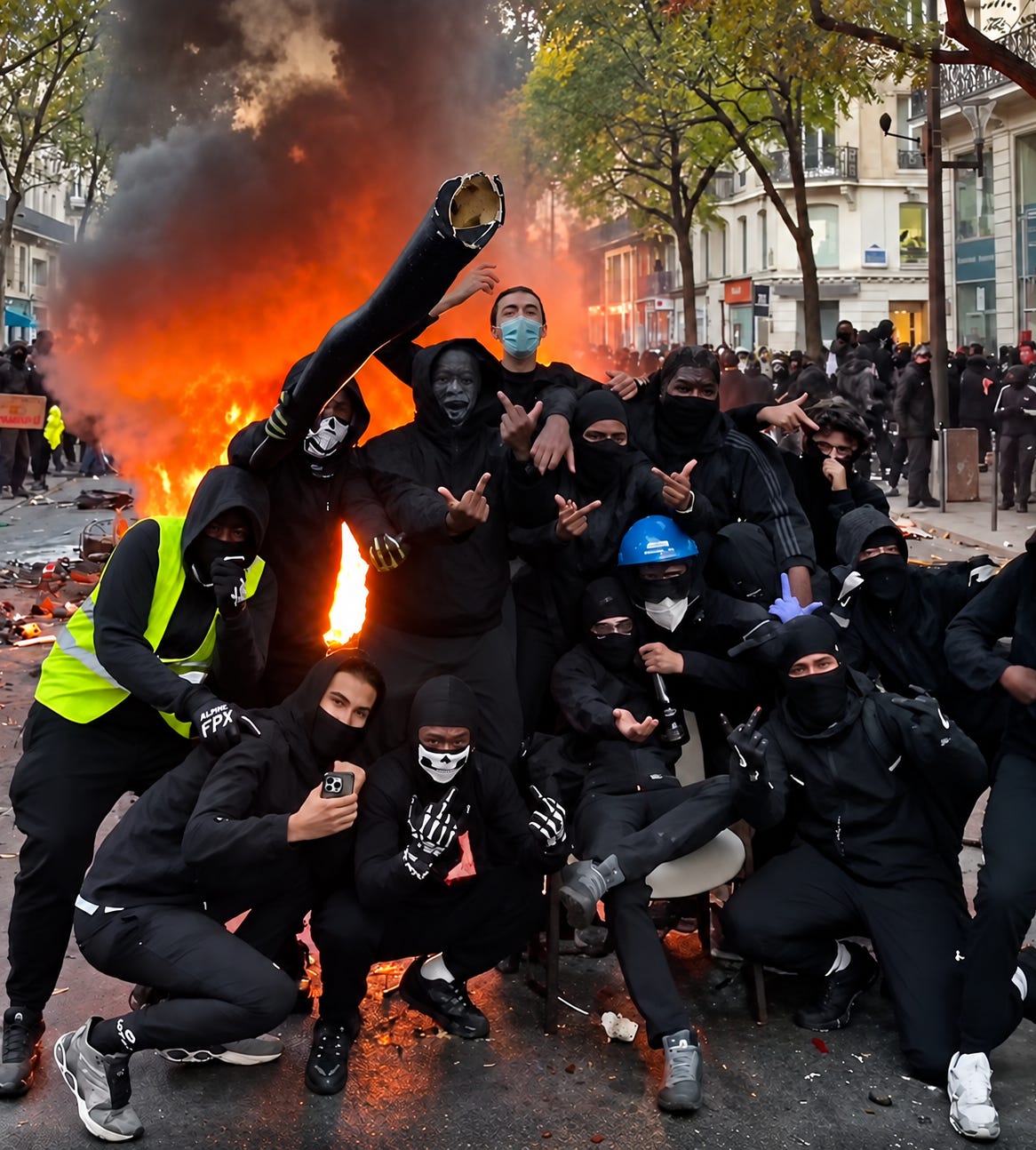
A friend recently sent me a post by the French essayist Philippe Lemoine, in which he describes “a very high level of general dissatisfaction in France at the moment, mostly due to anemic economic growth and inflation, especially with the price of gas.” As if the price of gas is the reason 1,500 businesses have been wrecked, or as if school conditions are why you see teens smashing shop windows and looting everything inside, then filming themselves in the burning street, stealing boxes of Ferrero Rocher chocolates, and gloating, “We have plundered everything in the name of Allah.”
As comedian Rob Schneider noted this week, “France has FREE health care, paid parental leave, paid family leave, FREE child care, FREE preschool, 5 weeks paid vacation, a 35 hour work week, generous unemployment and housing benefits, and heavily subsidized higher education. Everything the left says they want AND THEY’RE STILL PROTESTING AND BURNING SHIT DOWN.”
The reason for this is already there for anyone who cares to look. At a blockade in Beaugency, students were filmed chanting a rap song glorifying the jihadists Mohamed Merah and Salah Abdeslam. In Brive-la-Gaillarde, at a march backed by France’s largest communist-rooted union, the CGT, the union’s sound system reportedly played the same song. This month, a video circulated from outside a lycée in Mitry-Mory, northeast of Paris, showing a teenage boy who appears to gesture toward a group of police, then says, “In the name of Allah, we kill them!”
Maya Angelou said, “When people show you who they are, believe them, the first time.”
The real question is what exactly can be done about all this given that the people who want France’s destruction are already inside the city gates, they are already citizens, and they are already in positions of political power. Rima Hassan, a member of the European Parliament for La France insoumise, has said Hamas’s actions are “legitimate.” Perhaps one day, she’ll be the leader of the party, or maybe prime minister of France, and because she is nonwhite, her skin color will be held up as evidence that her victory is a triumph of liberal values.
In Les territoires conquis de l’islamisme, Bernard Rougier, a Sorbonne professor of Arab studies whose work examines Islamism in towns, even single apartment blocks, offers us an insight right in the title of his book, “The conquered territories of Islamism,” because these areas have been conquered, and are probably not coming back. In October 2020, Macron said France’s real problem is “séparatisme islamiste,” an ideology that sees its own laws and social norms as superior to the Republic’s. The problem, as I continually argue, is not immigration but immigration without assimilation, especially mass immigration, and there is a refusal among many Muslims to assimilate to French society because they consider assimilation a form of submission to the social and legal norms of infidels. The Muslim Brotherhood calls its strategy of working inside institutions, rather than attacking them, entrisme. Anthropologist Florence Bergeaud-Blackler, author of Le frérisme et ses réseaux, calls entrisme an attempt to subjugate without fighting. One way to do this is through informational warfare, often through music and social media. Gilles Kepel, a scholar of the Middle East and Muslims in the West, coined the term “jihadisme d’atmosphère,” or ambient jihadism, to explain how jihadism runs not through organized networks, but culture, in the songs of Freeze Corleone or Boro700, on social media through French leftist and Muslim political influencers, even in the global popularity of the Palestinian movement. The young man in the Mitry-Mory video is not a recruited jihadist, but he is breathing the air.
Then there’s the leftist side of the problem. In my recent essay on the French riots, I explained the roots of this, how communist and socialist teacher and student unions have helped drum this up the chaos in the name of antiracism and anti-colonialism. The original complaints about teacher shortages and bad schools were real, but these activists changed the nature of the movement. The Union Syndicale Lycéenne, which describes itself as antifascist, feminist, environmentalist, and collectivist, called for nationwide school blockades. These groups are correct that French barbarism in Algeria was a horror, and that does help explain why Algerians in France have such warranted animosity toward the country that has welcomed them in and given them a home. Lemoine also acknowledges the role of hard-leftist unions in all this, and adds, “What set them apart from traditional French social movements is how violent they were.” This is important, because one talking point I hear is that these riots are not unique, and that violent protesting is as French as beurre on a baguette.


But I think these riots are unique, and uniquely violent. In 2023, after a full week of chaos, France reported 808 officers injured. In 2005, France deployed 11,700 officers over three weeks and reported 224 injured. In the current riots, 997 officers were injured in a single day. I’ve heard people reference the yellow vest movement, arguing that this sort of violence has happened before. But on the worst day of those protests, Dec. 8, 2018, 1,723 people were arrested nationwide. A few days ago, on Oct. 17, about 2,400 were arrested. The targets are different too. The yellow vests vandalized the Arc de Triomphe and looted shops near the Champs-Élysées — and set fire to one prefecture. The current rioters burned the town hall in Limoges, broke into the town halls in Marseille and Lille, trashed the prefect’s residence in Bordeaux, burned a Lyon tourist office, and vandalized at least 300 Paris businesses. They’re not profiting financially or politically from such destruction. It just feels like raw hatred of French civilization.
The violence is so bad Laurent Nuñez, France’s interior minister, the cabinet member over the national police and gendarmerie, admitted that in some cities, police have “lost control.” He offered to resign, but President Macron refused, saying he needs Nuñez to keep the chain of command intact, or they might truly lose control. The situation is so bad now that the Paris police prefecture is inviting shopkeepers to hire private security.
“I keep seeing a lot of people who are depicting those kids as ‘Islamists’ and ideologically motivated actors,” writes Lemoine, “but I think it’s a complete misreading of the situation in my opinion. This isn’t an ‘Islamist uprising’ or whatever nonsense people are talking about. Their actions are opportunistic and driven by a nihilistic culture that is very similar to what you see in Black ghettos in the U.S., where anti-social behavior is totally normalized, with an added Islamic veneer due to their family background. This nihilism and their family background makes them susceptible to Islamist indoctrination, which is why terrorists were almost always delinquent before they turned to religion, but most of them aren’t ideologues and those who are don’t loot stores.”
Yes, banlieue nihilism is real, and I’m sure most of these kids couldn’t explain Islamist doctrine if you asked them. But it’s also more than that. There’s the inherited postcolonial grievance against the French state, with which I sympathize, and the Islamo-leftist media ecosystem a lot of these kids inhabit, which I like less. A May 2025 French government report on the Muslim Brotherhood said Islamist preachers and influencers use social media to depict French secularism as a weapon against Muslims and the French state itself as inherently Islamophobic. On TikTok, Instagram, Snapchat, YouTube, and Telegram, these voices portray France as hostile to Muslims, secularism as discrimination, and assimilation as a demand to abandon Islam. One TikTok preacher with 250,000 followers calls France an “Islamophobic state” and promotes the niqab. Hassan Iquioussen is a preacher whose YouTube sermons drew tens of millions of views. France ordered him expelled in 2022 after he gave speeches calling Jews “misers and usurers,” said “the Zionists were in collusion with Hitler,” that women should “stay home to take care of the children and their husband,” and Jews live “in ghettos, because they don’t want to mix with others, whom they consider slaves.” I find this more hilarious than anything. Certainly no reason to expel the guy. But a trip to Brooklyn couldn’t hurt.
Police have investigated students organizing the violence on Snapchat and using the protest slogan Bismillah c’est les ténèbres. In the name of Allah, it’s darkness. This is one of the main protest slogans of this movement. A call for darkness in the name of Allah. No doubt if they ran society, the result would be the Dark Ages. Given the Palestinian and Algerian flags, the screams to kill in the name of Allah, looters who yell at the camera that they do it in the name of Allah, and cries for darkness in the name of Allah, one might be forgiven for suspecting that Islam has something to do with this. But when the name of Allah is invoked, we must resist the vulgar temptation to imagine that religion could conceivably be involved. Never mind that other faiths are not. Never mind that poor Chinese and Vietnamese, who live in some of the same neighborhoods in the same poor conditions, are curiously not involved in these riots. In fact, now the rioters are targeting Chinese French. One young North African man said, “The Chinese in France have become too wealthy and are now part of the ruling class. They wear nice clothes and drive big cars. It’s unfair.”

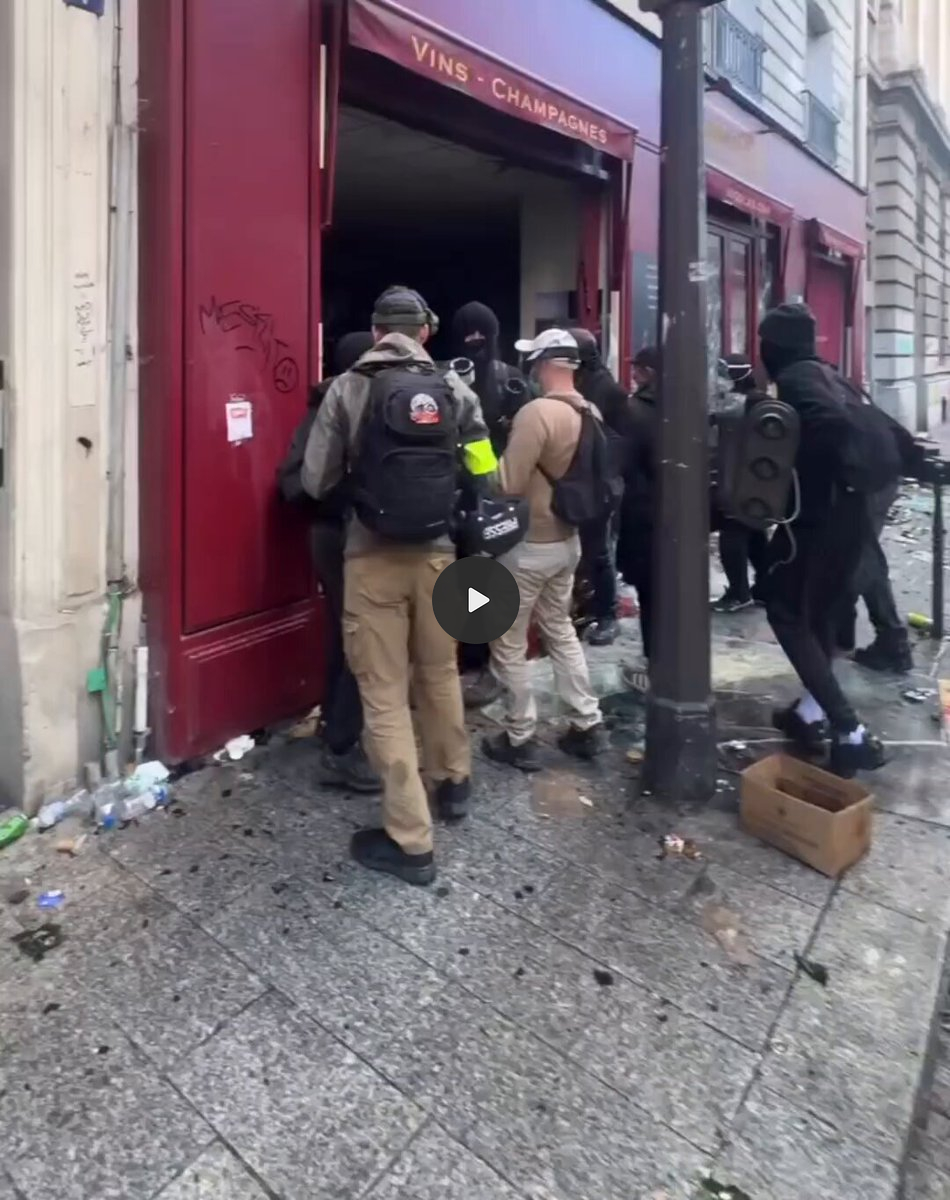
In 2023, Education Minister Gabriel Attal banned the abaya in schools and activist Elias d’Imzalène predicted the ban would fail, citing the riots after police killed Nahel Merzouk, a 17-year-old shot at a traffic stop, as proof that Muslim youth no longer want to “remain silent and bow down.” In 2024, he asked a Paris rally whether they were ready to “lead the intifada in Paris.” Also in 2023, as the riots spread, thousands of TikTok users livestreamed the looting and arson as it happened. Macron blamed Snapchat and TikTok, saying the platforms were being used to organize the violence. Some Muslim groups have found a different kind of revolution, fighting clothing restrictions through the courts. I admire those efforts. When schools began sending home girls in abayas, Action Droits des Musulmans challenged the ban before the Conseil d’État. Les Hijabeuses, a collective of hijab-wearing footballers, took the French Football Federation’s headscarf ban to the same court, but lost. In 2016, the Human Rights League persuaded the Conseil d’État to strike down the burkini ban.
Another friend recently asked me, “Watching what’s happening in France really makes you think about how a country isn’t really tested until some part of it is on fire. That’s when you find out who and what you’re actually surrounded by. If war broke out and your country was invaded, how many people around you would pick up a rifle to defend it, and how many would smile and even help the enemy because their allegiance lies elsewhere?”
What a delightfully depressing question. Are we watching France fail to defend itself against an invasion? Are French collaborators again holding the door open, as leftists have repeatedly done for Islamists in other countries? It’s hard to say, but I said this:
France has answered this question before. Many times. French collaborators helped the Spanish Catholics in the 1590s, foreign anti-revolutionaries in the 1790s, and the Nazis in the 1940s. It’s actually their famous snobbery that makes them this way. They’re ideologues, always have been, so they tend to be doctrinaire absolutists. Russia and Germany have it too, but less. It makes ideological loyalty stronger than loyalty to a shared community, which can lead to foreign domination being rationalized as the price one has to pay for defeating “evil” people domestically. You also see this on the American left, which is very influenced by French thinkers like Foucault, Derrida, Sartre, Bourdieu, Althusser, and Fanon. But Americans also inherited Rousseau from the French, and with it, a powerful tradition of revolutionary universalism. However, it was the British skepticism of grand theories, empiricism, and gradual reform, best embodied in the father of conservatism, Edmund Burke, that inoculated us against such quisling tendencies. Another way the American left reflects the French while the right reflects the English is that the French ideal is to be cultivé — cultured, intellectually sophisticated, in the know, fluent in the “right” terminology, whereas the English ideal is to be sensible — practical, measured, and possessed of sound judgment rather than approved vocabulary.
Lemoine has a point. Plenty of the people rioting in France are opportunists. A woman running off with stolen dresses has no political convictions, but this only tells us why she joined the riot. Not why the riots began. Not why the rioters are screaming the name of Allah, singing jihadist rap music, and flying the Palestinian flag. I’m not saying this explains everything about the riots. But the fact that people ignore, deny, or downplay it as a factor is disturbing. A stolen television is one thing. A burned town hall, a torched school, or an attacked police station is another. These are institutions through which France governs itself and passes its civic inheritance to the next generation. Ironically, every ransacked public building may strengthen the hand of Marine Le Pen and Jordan Bardella’s National Rally, whose promises of order and immigration control become more attractive by the hour. The radicals may find that, in trying to bring down the French Republic, they’ve only helped their enemies.
Lemoine is right about something else too. He ends his post with this: “It would take years to solve the problem even if we started now, which we won’t because our politics is completely broken, because it would require getting our budget in order, implementing reasonable economic policies, fixing our immigration and justice system, etc. We are cooked to be honest.”
Still, I remember a stretch of pavement on the boulevard Richard-Lenoir in January 2015, where two men who had just massacred a newsroom in the name of their god stood over a wounded police officer and shot him in the head. You might read this as further proof of all the reasons I just finished listing to be depressed, but I see a flicker of hope in the blood. Merabet, a Muslim, died defending the Republic. France is an idea as much as anything else, and as young men stand in burning streets invoking the same god against the same police, others are picking up the idea of France, some for the first time.
The issue is never the issue. The issue always The Revolution. Reds and Greens are a match made in hades who'll turn on each other after the rest of the world has been torched beyond recognition.
I must take strong issue with the phrase in the opening paragraph: “admittedly noble ideals”.
Leftism will never deserve such flattery.
When the Left isn’t lying about its objectives, it’s claiming a monopoly on goodness itself. Such claims are only backhanded insults against the Left’s critics, and to parrot these claims is to participate in the insult.
For example, Leftists will claim that being left-wing means “caring about poor people”. Not only are Leftists typically more interested in their own Messiah complexes than in actual poor people (they’re too misanthropic to want to touch actual poor people), but they compare poorly with the efforts and results that the Right delivers to the poor. The Left wants you to think that the Right hates the poor; the reverse is more true.
This article is otherwise very good, but we need to stop reflexively complimenting the world’s worst people. They don’t deserve it, and audiences are worse off for the psychological conditioning.