

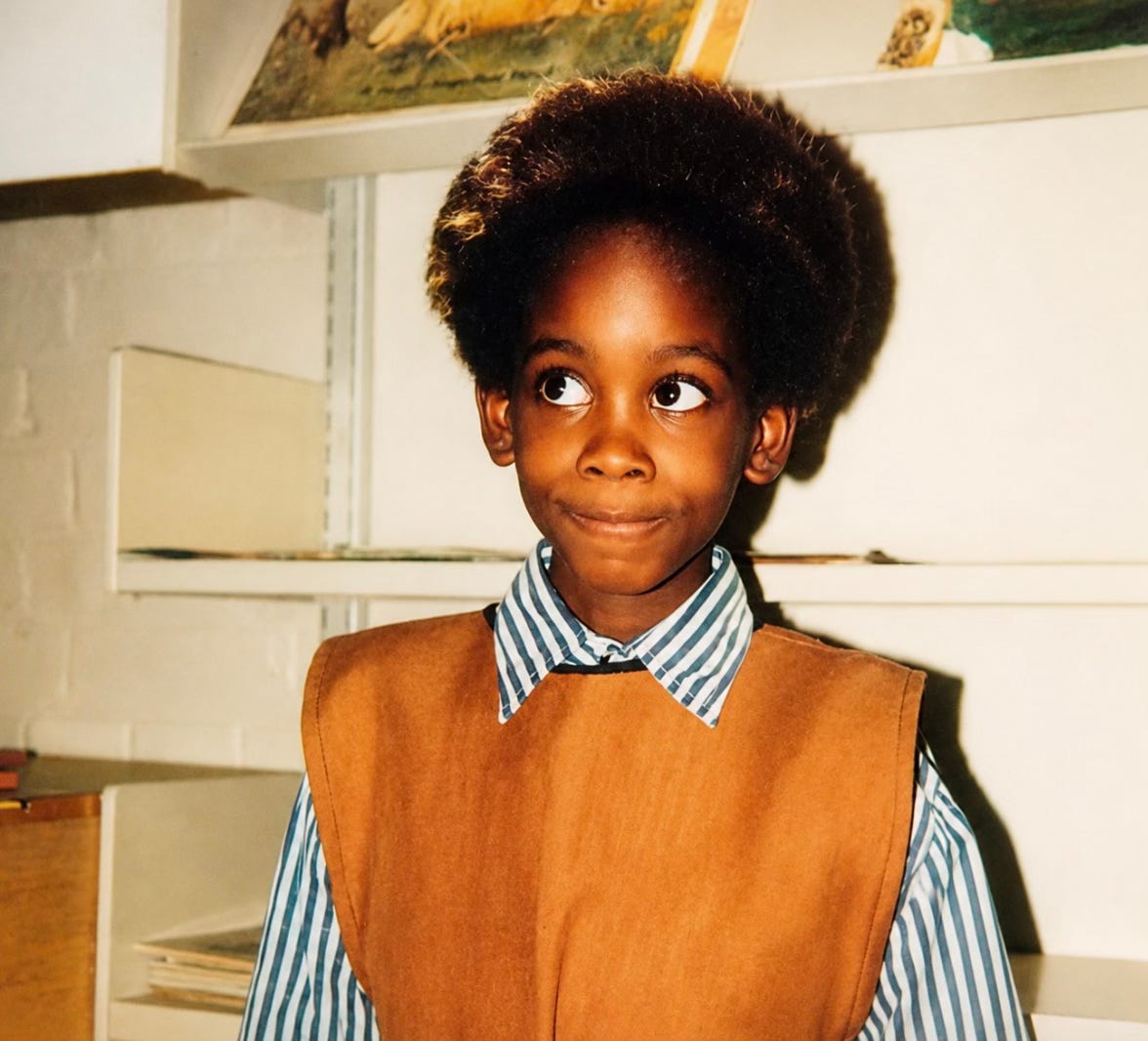
If you are unfamiliar with Jason Arday’s story, you can read my essay about the affair.
Jason Arday was found dead at his home three days ago. After a scandal involving plagiarism and the wild stories he told about himself, he apparently made the tragic decision to end his own life. He was only 41 years old. In the whirlwind of commentary that has exploded in the wake of this news, I find myself passing through a number of feelings. Sadness that his story ended like this. Anger that he chose to leave behind a wife and two children. And finally, something less firm. A bitterness over the fact that he surrendered the light of his life believing it was all over, when I truly believe he could have turned it all around.
He could have faced the public, palms up, and answered his critics in good faith. He had undeniably dug himself pretty deep, but remorse makes a fine shovel and talent an even better one. I have interviewed both Richard Hanania and Freddie deBoer, and both men have weathered reputational harm only to answer the storm by continuing to produce work that even their critics cannot ignore. If you keep your head down, and your shoulder to the wheel, most wagons can be moved.
I don’t even think Arday’s career in academia was over. Claudine Gay is an antiracist fraud who also committed plagiarism, but she walked away with $1.5 million in compensation, took a year off, and now reportedly makes $900,000 as a professor of political science and black studies. It truly cries out to heaven. Trauma surgeons who save lives every day don’t make that much. My point being that Arday, like Gay, benefited from black privilege and could have used it in his recovery. That privilege is already spilling over into the public record of his life as progressives rush to blame anyone but Arday himself for the things that Arday himself actually did.
Some now claim that people only targeted Arday, as opposed to the many other professors who plagiarize, because he was black. Racism absolutely played a role for certain people. Some of those people comment on my essays. But for the most part, the public targeted Arday because he was appointed to a professorship at one of the most prestigious universities in the world. That alone drew attention. He was also an egregious example of diversity hiring at a time when diversity hiring is already a polarizing topic. And finally, the incredible nature of the stories he told made it impossible for the media to look away.
Yet in his essay “The Media Lynched Jason Arday,” Ibram X. Kendi blames Arday’s death on reporters for reporting the story. “If you die from all the attacks,” Kendi writes, “the media still calls the attacks on you ‘accusations’ to wash their hands of the blood. Your lynchers announce your death as if they had no role in your lynching.”
Although roughly one-third of the victims of lynchings in America were white, the term has special meaning in the context of anti-black racism. It conveys a type of racist terrorism that ended by extrajudicially murdering a person for the sin of having darker skin. Often, their corpses were mutilated. In 1918, a black woman named Mary Turner spoke out against the lynching of her husband the day before. A white mob bound her feet, hanged her upside down from a tree, poured gasoline on her, burned her alive, cut her belly open with a butcher’s knife, and pulled her eight-month baby onto the ground, where one man crushed its head with his boot. That’s lynching.
Kendi cheapens the term for rhetorical effect by arguing that reporting on Arday’s story, or even having a laugh over the guy’s outrageous lies, is somehow comparable to putting a rope around his neck. I think Kendi is a fool who arguably does more damage to black Americans than actual white supremacists. But that doesn’t mean that I didn’t read his essay in good faith and reflect on whether journalists had actually pushed too far. I myself wrote about the scandal, highlighting the insanity of it all, laying the blame at the feet of Cambridge and the racist system that prizes diversity over merit, raises the unqualified high and then drops them when things get hot. And yes, I milked the absurdity of the story for comedic effect.

But after reading Kendi’s essay, I asked myself whether I went too far. What does going too far look like when covering a story of this nature? For Kendi, it seems that covering the story at all is too much, because Arday is black and therefore innocent. This is unsurprising. In 2019, Kendi claimed IQ tests are racist. That same year, Seattle educators said math is racist. In 2020, the Smithsonian National Museum of African American History and Culture, or “Blacksonian,” said rational thinking is whiteness. The pattern is clear. If black people perform poorly on IQ tests and math tests, the problem is the test. If black people find it difficult to make rational antiracist arguments, the problem is rational thinking.
You see the same failure to take accountability among narcissists. It’s always someone else’s fault. They’re always the victim. As I have written before, the Polish psychologist Andrzej Łobaczewski observed how an entire society can orient itself in such a way that its incentives generate an unusual prevalence of maladaptive personalities. During Nazi Germany, sociopathy rose far above the normal range of 2% to 3% of the population. Similarly, the modern West has incentivized narcissism among certain groups. These groups are never truly to blame, even when they quite literally commit immoral acts. When Palestinians carry out a genocidal slaughter, blame the victims. When black men murder Asian grandmothers, blame white people. When a black academic presents himself as a messianic Olympic athlete, blame journalists for covering the story. The crime isn’t doing it. It’s noticing.
If you’ve ever tried to argue with a narcissist, it’s an infuriating experience because you cannot pin them down on any point by using facts or logic. They will ignore inconvenient facts, flip things around on you, play the victim when they’re the aggressor, deny their own behavior, and if you lose your cool, they’ll say the fight began because you lost your cool. Trying to hold them to a point or have them take accountability is like trying to nail Jell-O to a wall. The only way to deal with a narcissist is what’s known as the “grey rock method.” You behave like a grey rock, making yourself so uninteresting that the narcissist gets bored and moves on. That means you don’t argue, get defensive, disclose personal details, show anger, or explain yourself. Also, keep encounters brief.
In other words, the more that people behave like Kendi, the more rational it is to limit contact with such people. There’s no real use in engaging progressive racists. I find this sad, because the young man in me who once wanted to become a Jesuit monk, the former Big Brother in me, the former teacher in me, all want to believe that through good faith and reason, we can get through to people. The Christian in me wants to believe that no soul is ever truly lost. But the psychology student in me knows better, and the history student in me is a goddamned pessimist about the human race.
If the media went too far, it was in crossing the line between accountability versus scapegoating. A society needs criticism, but even when attacking someone for what they did, we should leave the door open for them to come home. Or, as Sun Tzu said, offer them a “golden bridge of retreat” to save face. I don’t think we should always do this, of course. Some souls truly are lost. Some dogs have to be put down. But Arday wasn’t evil. As far as I can tell, he was good-hearted, though dishonest. Another question we should ask ourselves is whether public intellectuals like Arday or Kendi deserve different treatment than ordinary people. They’re trading on their credibility, so maybe they should be held to higher standards.
I have no qualms about delivering the uncensored truth, or even appropriate name-calling from time to time. But if we are trying to have a healthier, more mature, less divided discourse, the trick is to leave room for correction. This is the antidote to cancel culture. If every misstep is treated as unforgivable, people won’t admit when they’re wrong. That’s the importance of the golden bridge. You have to give your opponent an off-ramp. Yes, criticize them enough to defend the truth, but be measured enough to allow for reintegration. On that note, if even Kendi himself demonstrated good faith, then yes, I would listen. As a matter of fact, I’m probably one of the last people in the world who still takes him at all seriously, and I have long wished that he would return to his lost career as a compelling historian. I loved Stamped from the Beginning. But he chose to preach woke racism instead.
In covering the Arday story, The Atlantic ran an essay, “Icarus in the Faculty Lounge,” which I admit I have not read. But the title struck me. While the story of Icarus, who rose higher than anyone on fake wings and then plummeted to his death, definitely echoes that of Arday, I am rather reminded of the story of Arthur Miller’s Death of a Salesman. In the play, the main character Willy Loman builds his identity around a system that values him only for so long as he is useful. Then he discovers the institution has no loyalty to him, he is discarded, and he kills himself. I think this is a better literary reference for the story of Jason Arday. “He’s not the finest character that ever lived,” the play says at one point. “But he’s a human being, and a terrible thing is happening to him. So attention must be paid.”
Had Arday made an honest effort at reform, the howling winds of online hate would not have ceased. Anyone who has ever been canceled knows the haters never go away. I still have people who call me a Nazi, from time to time, and I’m sure this scandal would have followed Arday for the rest of his days. But he would have had those days, perhaps filled with the love of his wife and children, and had he reformed, what a lesson that would have been for society and for all the good faithful who are honest enough to see. It may be a naive dream, but we are such stuff as dreams are made on.

You can see it in his eyes. Jason Arday was clearly unwell. Have a look at his Wikipedia profile picture if you aren’t sure what I mean. What struck me before as a slimy smile and blank stare now seems more to me like the fragile mask of a wounded man. If you look into his eyes, it seems as if he’s holding back tears … or rage. But what you should also see is that there was always something clearly amiss here. As I wrote in my original essay, I blame Cambridge University for this. They took him on to wash themselves in his blackness, then left him twisting in the wind. One might even argue that his death is the best thing that could have happened for Cambridge, because now they get to point a finger at journalism and close the book on this story, and no one who is actually responsible for this man’s fate will be held to account.
I also blame Western academia for embracing the progressive racism of DEI, and for creating an incentive structure that prizes the woke phrenology of skin color and genitalia over talent and brilliance. But seeing the instant defense of Arday and the attack on journalists — after we already know The Guardian spiked its story of Arday, after we already know Arday hired a law firm to go after the journalist, and police told a journalist to stop covering the story — is a disgrace. But it also disheartens me, and makes me feel that maybe these people will never wake up and acknowledge any wrong on their side, and that the only rational thing to do is to grey rock them all.
But I’m too much of an optimist for that. I’d rather go down with the ship. One thing Arday and I clearly had in common is that he genuinely seemed to have faith in the possibility that we can change things. At the end of Death of a Salesman, Willy’s friend and neighbor, Charley, gives the greatest speech in the play:
Nobody dast blame this man. Willy was a salesman. And for a salesman, there is no rock bottom to the life. He don’t put a bolt to a nut, he don’t tell you the law or give you medicine. He’s a man way out there in the blue, riding on a smile and a shoeshine. And when they start not smiling back — that’s an earthquake. And then you get yourself a couple of spots on your hat, and you’re finished. Nobody dast blame this man. A salesman is got to dream, boy. It comes with the territory.
Very thoughtful and compassionate essay on a great tragedy in the history of DEI run amok.
This is exactly what I thought about this whole mess: the crime was “noticing” or trying to have a discourse about this. Scary stuff.