

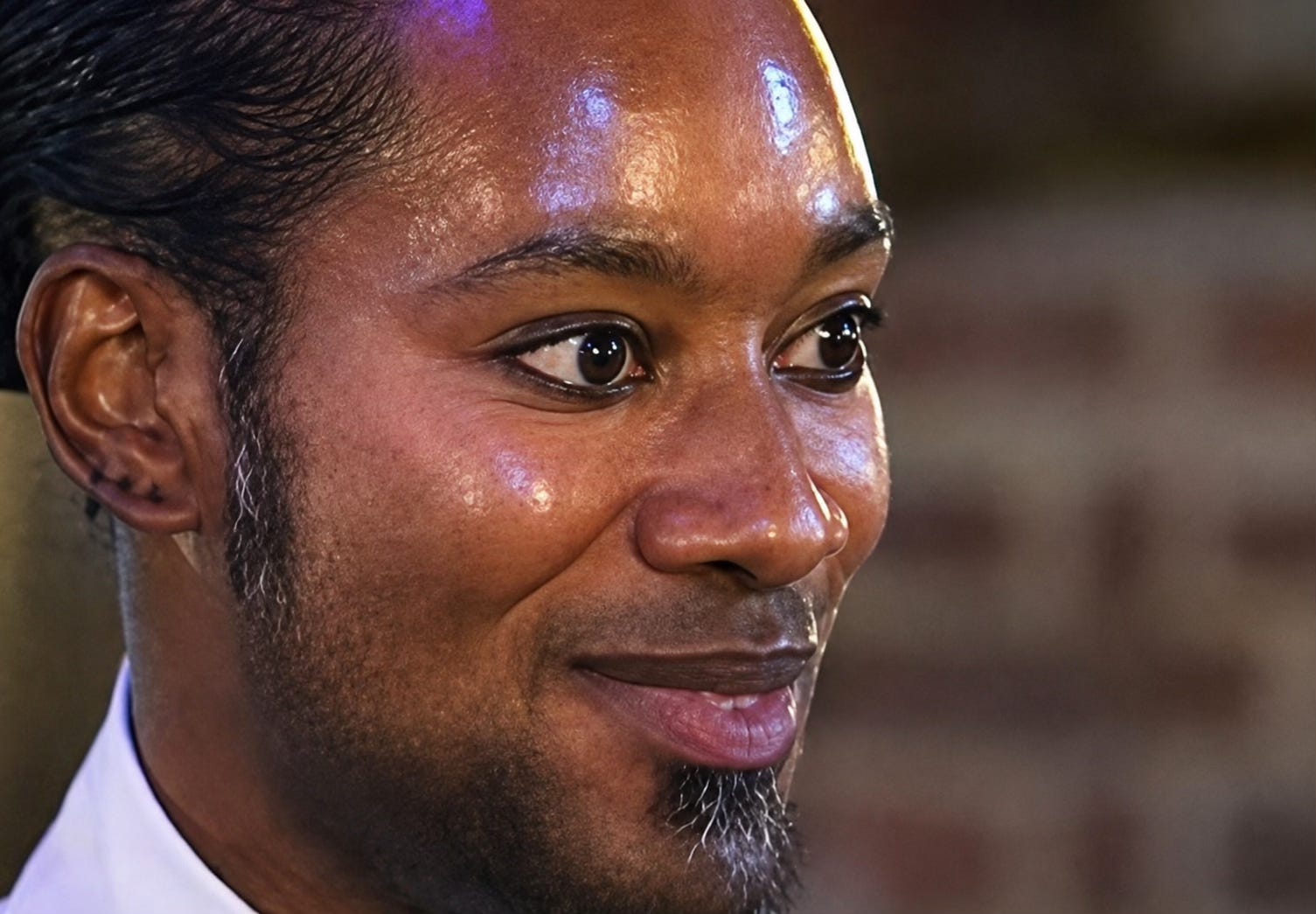
In 2023, Jason Arday became the youngest black professor in the history of Cambridge University. People at the time called him a diversity hire and said he only got the job because he was black. The responses to this were hostile. “He is still very accomplished and the rest of what you’re saying is a gross misunderstanding of academic research,” one Reddit commenter said. “For him to teach at Cambridge,” another replied, “he had to have his work accepted by the highest quality journals in his field.”
History almost never allows it, but this once, everyone was right. Arday was a diversity hire. He is still very accomplished. He did have his work accepted by the highest journals in his field. But in less than three years at Cambridge, Arday has made a mockery of the institution and resigned last week after becoming the single biggest story in the news cycle, partly because of the incredible things he wants you to believe about himself.
The Wizard of Oxbridge
Arday says he was diagnosed with autism at 3, mute until 11, illiterate until 18, partially deaf, epileptic after an attack, the survivor of a catastrophic teenage car crash that left him in a coma for months, on life support, with locked-in syndrome, the survivor of a brain tumor that erased his memory two weeks before his PhD defense (he passed), and a cancer survivor. He says he has raised millions for more than 70 or 80 charities, and installed water pumps in Africa with WaterAid, although WaterAid says it doesn’t send volunteers abroad. He says he appeared on the British documentary show Seven Up!, which aired two decades before he was born. He says he was an elite snooker player as a child, and later became a semi-professional football player. He ran 600 miles in six days, almost matching the world record, and 30 marathons in 35 days, fracturing his fibula midway and running the last nine on one good leg.
Arday’s academic accomplishments include getting his master’s in psychodynamic practice, as well as his counseling license, at Birkbeck College, University of London. Although Birkbeck says it has no record of this. He was also a visiting professor at Ohio State. But the school says this is false. He wrote a book with Palgrave Macmillan. But Palgrave says the book project never got past the proposal stage. He attended Liverpool John Moores University where, remember, he relearned his thesis in two weeks following brain surgery, and got his doctorate in education. His thesis — An Exploration of Peer-Mentoring among Student Teachers’ to Inform Reflective Practice within the Context of Action Research — argues that having teachers-in-training mentor each other is good because it replaces the hierarchical teacher-student model. He invokes Marxist philosopher Paulo Freire’s Pedagogy of the Oppressed (1972) repeatedly, including Freire’s notion that the teacher-student dynamic is inherently oppressive. Richard Dawkins recently wrote about the obscurantist, “gobbledygook” style that it’s written in, packed with basic grammatical errors such as “Key findings illuminated posit that there are also several challenges inherent in the enactment of peer-mentoring, more specifically trust, power and time.”
Writing for The Telegraph, Leaf Arbuthnot and Janet Eastham review Arday’s upcoming memoir, Great and Unfortunate Things, in these terms:
Characters in the book, by and large, fall into two camps: the evil idiots who are cruel to Arday and fail to grasp his potential, and the angels who help him, mentor him, and express their ardent certainty that he is extraordinary.
This division of the cast into angels and enemies is established early on, when Arday’s mother, Giff, is treated to a powerful prophecy by the South Asian midwife who has delivered him. “This boy is destined for great things,” the midwife tells Arday’s mother, looking into her eyes. “You hear? You take care of this child.”
…
Perhaps the most painful moment in which a character expresses their conviction that Arday is superior to the hoi polloi comes when Arday gets a job at Sainsbury’s, and becomes friendly with a fellow worker named Sam. “Jason, I want you to listen to me,” Sam tells him. “I see something in you: you’re fearless. Yes, you’re having to do this job now, but one day you’ll scale Mount Everest, whether anyone thinks you can or not.” This truth duly truth-bombed, Sam conveniently melts away, never to be heard from again.
Benjamin Ryan has reported that the title of the memoir itself is taken from the title of episode seven of the first season of “Spartacus: Blood and Sand,” which broadcast in 2010, about the ancient Thracian gladiator who led a slave uprising in Ancient Rome. Arday also takes his own origin story from the episode, Ryan says, and “dialogue that overlaps with not one but two prophesies about his destiny uttered in the prologue of Mr. Arday’s book.” The prophecy comes from Spartacus’ wife, who says, “You are destined for great and unfortunate things,” which does appear twice in Arday’s book. Once, when a midwife tells Arday’s mother, “This boy is destined for great things.” And later, when Arday is volunteering in Brazil and an aid worker tells him, “I can tell you’re destined to do great things. But I also believe you’re destined for very sad and difficult things as well.”
Education and Indoctrination

David Volodzko talks to Kevin Ray about the philosophy of teaching, how Paulo Freire’s “Pedagogy of the Oppressed” has changed education in America, the harms of woke pedagogy, the tragic death of Richard Bilkszto after enduring genocidal rhetoric at the hands of a DEI trainer, and more.
The plagiarism allegation in this tale concerns the work of Paula Zwozdiak-Myers, whose doctoral thesis also involved student teachers reflecting on their teaching. The Guardian reported that more than 100 passages in Arday’s thesis resemble Zwozdiak-Myers’s, but Liverpool John Moores investigated and found no misconduct. Retraction Watch reports that in one article, Arday claimed to have interviewed people for his research when those interview answers were actually taken from previously published studies. Times Higher Education journalist Jack Grove investigated the story, but Arday complained and British police then investigated Grove. Grove said an officer told him not to contact Arday again because he was affecting Arday’s mental health. Then Arday hired a defamation law firm and the Times killed the story. Then Cambridge responded to the allegations against Arday by saying he was the victim of a “vile campaign to undermine his credibility.”
And yet, last year, DEI strategist Arthur Chan shared a post that read, “Calling someone a diversity hire isn’t just reductive, it’s racist and oppressive. End of story.” The Canadian anti-racism organization Stop Race Based Hate has an explainer specifically titled, “Why is it racist to say, ‘They were hired for diversity?’” A few months ago, Care2 said, “‘Diversity Hire’ is just what bigoted racists say when a minority or other marginalized person achieves something they themselves could not.” And Theo EJ Wilson, host of History’s “I Was There” series, said in 2024, “‘Diversity Hire’ is the new coded N-Word. The children of slave masters saying the children of slaves ‘didn’t earn it’ is wild!!”
The great and unfortunate truth about Arday
There was a time when becoming a professor at so prestigious a university demanded brilliance. Now it seems to demand little more than ideological conformity and the right phenotype. But Arday is not a total fake. His scholarly output includes over 30 research works and books about racism, such as his 2019 article, “Dismantling Power and Privilege through Reflexivity: Negotiating Normative Whiteness, the Eurocentric Curriculum and Racial Micro-Aggressions within the Academy,” published in Whiteness and Education, and “Attempting to break the chain: reimaging inclusive pedagogy and decolonising the curriculum within the academy,” published in Educational Philosophy and Theory. (Also, “reimaging” not “reimagining.”) Arday is just responding to the incentives of Western academic life in a rational way. This isn’t good, but it’s rational. The real culprits are Cambridge, for helping set up the system in this way. And the journalists who dismissed his critics. And the folks who roll their eyes every time they hear “diversity hire” as if it’s inherently racist.
One thing I find perplexing is how all the grammatical errors went uncorrected in the peer review process. Either 1) no one bothered to read his work, which would be utterly shocking, 2) the reviewers looked past the grammatical errors as a sort of accommodation for his alleged disability (pretty funny because then what is academia even doing at this point) or 3) the reviewers were terrified of being labelled white supremacists for upholding any kind of standards. I feel like it was combination of 2 and 3. I would love to see some further reporting on how this all happened.
Arday's rise made me think of the old movie "Being There" with Shirley MacClaine and Peter Sellers where a simple minded gardner is elevated to a great philosopher.