

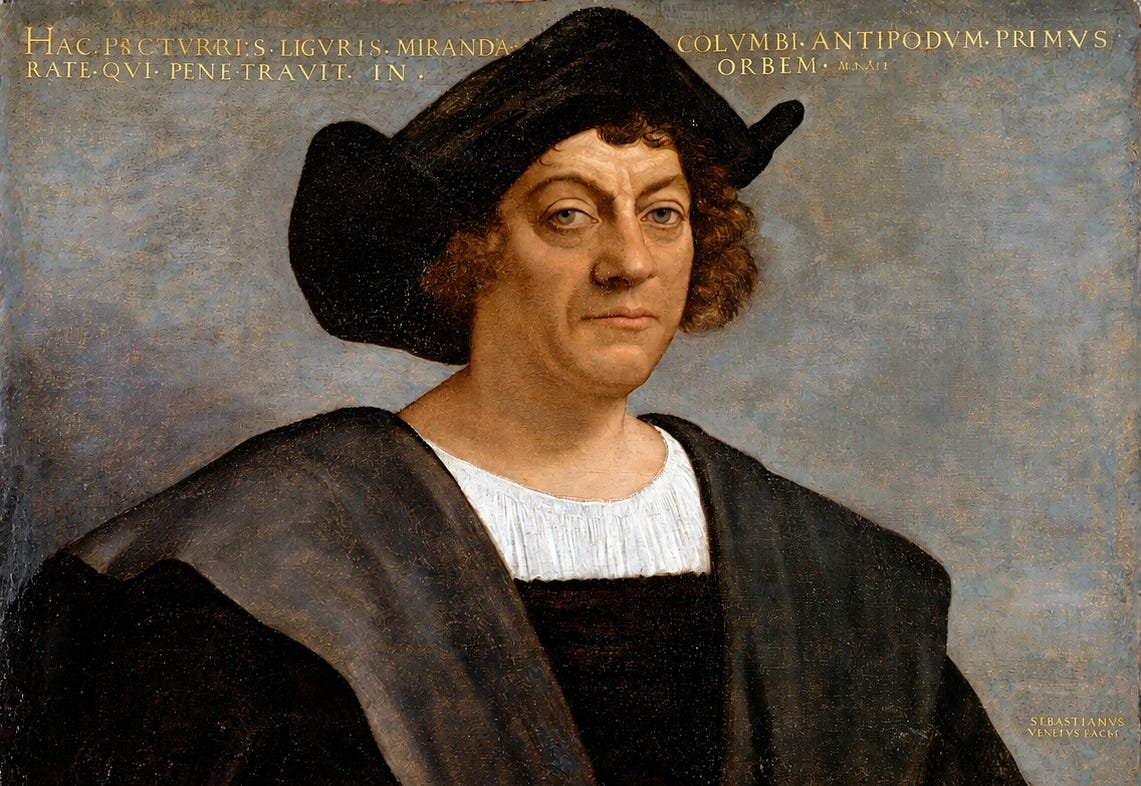
Although I was born here, it has taken me all my life to discover America. And while I don’t recall moving back, I do remember quietly judging my new classmates. My school had no uniforms and so the kids got to wear whatever they wanted, and combined with the unfortunate cult of American individuality, this had produced a student body that was less Norman Rockwell, more Jackson Pollock. Think neon windbreakers, highlighter-bright shirts, acid-washed jeans, and questionable haircuts. It was 1992, five centuries after Christopher Columbus sailed the ocean blue, and everyone seemed to be talking about the discovery of this New World. I was 12 years old at the time, and I’d only just discovered it myself.
Growing up in the Bahamas, we celebrated Columbus Day as an official national holiday known as Discovery Day. The islands have never had a large Italian community, but when Columbus made his voyage in 1492, the first shores he landed upon were the sugary white sands of San Salvador in the Bahamas. Today, there are barely more than 800 people living on the island. The place where they say Columbus touched down, on Long Bay, is now empty except for a few casuarina trees, a white stone plaque, and a tall white cross. The plaque was donated by Spain in 1992. But driving north from Sugar Loaf Settlement along Queen’s Highway, you’d miss it if you didn’t know where to look. And there are few people left on the island to even stop.
For many locals, Discovery Day was merely a day off work to be with the family. But there were also parades on San Salvador, sloop sailing regattas across the out islands, and live goombay music in Nassau where I lived. I barely recall most of it, but I do remember loving Discovery Day. Even more, I loved the story of Columbus, not least because my parents owned a cabin cruiser and we often took overnight trips, fishing off the stern, stargazing with Dad, falling asleep to the cradle-rock of the waves, and waking in the night to discover what it means to be at the mercy of a raging storm of invisibly black water. The thought of venturing 4,000 miles into unknown seas, through the North Atlantic hurricane belt, always filled me with terror and respect.
In 1992, two biopics about Columbus came out celebrating the 500th anniversary of his voyage, one starring Marlon Brando with the French actor Georges Corraface as Columbus, and the other, directed by Ridley Scott, starring Sigourney Weaver with the French actor Gérard Depardieu as Columbus (note the French-washing of Spanish history). Both films were flops, but I watched each with giddy delight. I still remember Depardieu jumping into the water and striding through the shallow waves, sword in hand, approaching the shore to the big choral swell of Vangelis’s “Conquest of Paradise.” But the anniversary sparked discussion in my homeroom class, and I soon learned I was not supposed to celebrate this chapter in Bahamian history. Back home, my grandmother’s baby brother, Philip Smith, was a member of parliament for San Salvador, and was proudly leading the celebrations there, staging a reenactment of the landing on Long Bay. Meanwhile, I was in America, being taught to hate it.
I didn’t understand. Hearing the reasons to dislike Columbus was like being told that Superman secretly liked to strangle cats. Many Americans were having the same experience because although opposition to Columbus Day had been around since the 60s, the 500th anniversary was when it went mainstream. Despite my initial confusion, I was a quick learner and, armed with my newfound talking points, I came home one afternoon and defiantly told my mother that her limited-edition AK Kaiser porcelain commemorative bowl, finely painted with images of the Niña, the Pinta, and the Santa María, as well as flowers, flamingoes, and fish of the islands, was a relic of genocidal racism. My Russian father let out a giant sigh and began quietly clearing our dinner plates. I accused Mom of supporting genocide. I compared Columbus to Hitler. I was probably lucky she didn’t break that stupid bowl over my head. Instead, she looked at me like I had just told her that the asparagus was sexist.
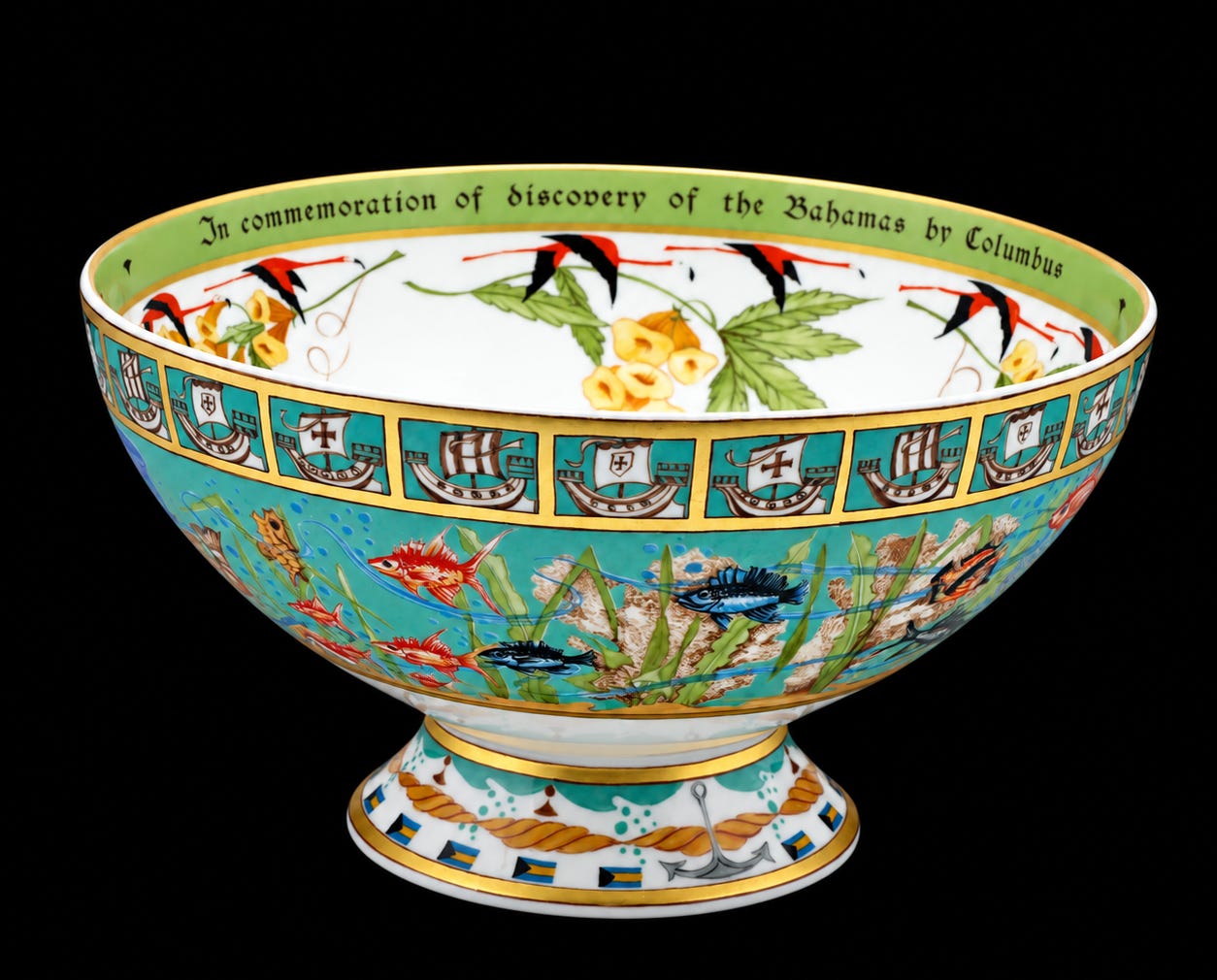
I’ve thought about that moment over the years, but my budding activism must have had a bigger impact on me than on my mother because I asked her about it the other day, and she has no memory of it whatsoever. But I certainly do. Especially since, over the years, I’ve come back to the faith of my youth and now I celebrate Columbus Day with pride. This year, our nation marks 250 years of Italian contributions to America. Most of the nation, anyway. That’s because these days, Columbus Day competes with Indigenous Peoples’ Day. Like Christmas, the holiday is now a battleground in the culture wars. Just a few days ago, in fact, President Trump issued a proclamation saying, “We are forever indebted to his courageous voyage, and we will never allow his legacy to be erased by radical extremists.” As it happens, some of those extremists are my friends, and a few of them were shocked to learn that I celebrate this day of colonial evil — at least, the ones who don’t read The Radicalist. So here are my thoughts.
Lord of the flies
On October 12, 1492, Columbus and his men reached an island that the local Lucayan people — part of the broader Taíno world — called Guanahani, which he renamed San Salvador. In his journal, which comes to us through a later summary by the Dominican friar Bartolomé de las Casas, Columbus noted that the islanders carried no weapons, and when he showed them swords, “they took them by the blade and cut themselves through ignorance.” They “should be good servants,” he said, and he decided to take six of them back to Spain. Two days later, he added, “with fifty men they can all be subjugated and made to do what is required of them.”
In 1493, Columbus came back with 17 ships and more than 1,000 men. He found La Navidad, the fort he had left on Hispaniola, burned and its 39 men dead. He began building a colony on the island, which today is divided between Haiti and the Dominican Republic, and he ruled with an iron fist. In 1494, Alonso de Ojeda, one of his captains, cut off a Taíno man’s ears over stolen clothing. In 1495, the Spanish rounded up about 1,500 Taíno and shipped 500 to Spain as slaves. Mothers who escaped fled into the forest and left their infants behind. Almost half the captives died on the crossing. Michele da Cuneo, an old friend of Columbus who joined the second voyage, described in a letter how the noble admiral gave him a captive Carib woman, and how he thrashed her with a rope until she stopped resisting and then raped her. In 1963, Samuel Eliot Morison, Columbus’s most celebrated American biographer, called Cuneo “a jolly dog” who liked “a good time.”
Also in 1495, Columbus and his brother Bartholomew marched against the Taíno with cavalry and war dogs, rounding up more slaves. Every Taíno aged 14 or older had to hand over enough gold dust to fill a hawk’s bell — the small brass bell falconers tied to a bird’s leg, about the size of a thimble. The quotas were nearly impossible to meet, since the island’s gold lay as dust in riverbeds and had to be panned grain by grain. Those who found a way to pay the fee were given a copper token to wear around their necks, and anyone caught without one had their hands cut off and bled to death. Many Taíno fled to the mountains, abandoning their farms. Famine followed. But Columbus was undeterred, writing, “Let us in the name of the Holy Trinity go on sending all the slaves that can be sold.”
When the Spanish went back for the last of the Lucayans in 1520, they could find only eleven.
In 1498, he returned on a third voyage and made his first landing in South America. On Hispaniola, Spanish settlers revolted against Columbus, and sent letters home complaining. The Crown dispatched Francisco de Bobadilla to investigate, and when he arrived in Santo Domingo in 1500, he wrote of “a kind of tyranny,” describing how one Spanish man caught stealing corn had his nose and ears cut off and was sold as a slave, as well as a Spanish woman who dared to say Columbus’s father had been a weaver — which was true, his father was a wool weaver from Genoa — and was paraded naked through the streets on a donkey, then had her tongue cut out. Bobadilla arrested Columbus and his brothers and sent them to Spain, where the monarchs freed them later that year. Unpaid settlers returning from Hispaniola told tales of what they had survived, mocking Columbus, the “Admiral of the Ocean Sea,” as the “Admiral of the Mosquitoes” for having discovered disease-ridden lands that ruined many a Castilian gentleman. But this was the least of the admiral’s sins. Columbus plausibly killed thousands, and enslaved at least 1,600. He never returned after 1504, but the machinery of death he created continued to harvest souls.
The people I grew up reenacting fared even worse. Within a few years of Columbus’s landing, Spanish slavers began raiding the Bahamas for labor to replace the dying Taíno of Hispaniola. When the Spanish went back for the last of the Lucayans in 1520, they could find only eleven. The islands stood empty for more than a century. Maybe if Columbus had gone a little softer on the innocent Lucayans, there’d be more people on San Salvador today to stop and read his plaque. But as it happened, the Bahamas I grew up in was built entirely by people who came after them.
The first Italian American
To the best of my knowledge, the name of Christopher Columbus mostly collected dust for the next two centuries. But starting in the 1730s, British writers began using the term “Columbia” as a poetic reference for the American colonies. One of the first people to personify America as “Columbia” in verse was Phillis Wheatley, who was freed from slavery two years before she wrote her 1775 poem “To His Excellency General Washington,” in which she wrote about the nations of the world and how “in their hopes Columbia’s arm prevails.” This borrowing became popular in part because the name “America” honored Amerigo Vespucci, whereas “Columbia” was at least a tribute to the man who had actually discovered this new territory. (People often claim Columbus did not discover the Americas because natives were already living there, but this is an illiterate argument since “discover” means to learn of something’s existence, not necessarily to find something no other human has ever found.)

Once this poetic formulation of his name became common, it was used to refer more to America than to Columbus himself. Examples include Washington, D.C., Columbia University, and Columbus, Ohio. But this is no more a tribute to the man than “Britain,” an old Celtic name for the native inhabitants meaning “the painted ones,” is a tribute to paint. Then something marvelous happened. Between the late 19th century and the 1920s, more than 4 million Italians immigrated to America. They were poor, Catholic, and linguistically alien to the English-speaking Protestant majority. They were also, especially southern Italians and Sicilians, commonly seen as criminal, intellectually inferior, and incapable of assimilation. But assimilate they did.
Many Protestant Americans saw these Catholic immigrants as more loyal to the pope than the Constitution, but Columbus offered them a way to challenge these stereotypes. After all, he was the famed explorer who helped kickstart the very process from which modern America emerged. Then in 1890, just before the 400th anniversary of Columbus’s voyage, New Orleans police chief David Hennessy was shot and authorities indicted 19 Italian immigrants and Italian Americans. The first trial ended with no conviction, and a mob stormed the parish prison and killed eleven men of Italian descent, in what is the largest documented lynching in U.S. history.
No one was ever charged, and prominent politicians and newspapers actually defended the violence. Italy recalled its ambassador, and the crisis ended only when the United States paid $25,000 in reparations. The massacre sparked national anti-lynching politics, and President Benjamin Harrison called on Americans to celebrate the 400th anniversary, not just for patriotic reasons, but diplomatic and political ones, as well. So in its way, Columbus Day began as a kind of Italian version of Juneteenth. And in 1968, President Lyndon Johnson made Columbus Day a federal holiday.
A communist holiday
If you ever saw Good Will Hunting, you may remember the scene where Hunting, played by Matt Damon, says to his therapist Sean Maguire, played by Robin Williams, “If you wanna read a real history book, read Howard Zinn’s A People’s History of the United States. That book will knock you on your fuckin’ ass.” Maguire replies, “Better than Chomsky’s Manufacturing Consent? You think that’s a good book?”
Zinn’s 1980 book opens by presenting the European encounter with the Americas from the standpoint of indigenous suffering, arguing that conventional American history had chosen the wrong protagonists. I loved that book as a leftist teenager. I loved the subversiveness of it, and I loved the power of knowing a history most folks did not. But Maguire’s response is smarter than it seems. He’s telling Hunting he knows the book too — and the writer’s unspoken politics. Zinn stood further to the left than most of his readers know. When the FBI released its files on Zinn in 2010, they showed that informants had reported him as a member of the Communist Party USA in the late 1940s and early 1950s, attending meetings in Brooklyn and, according to one informant, teaching his comrades a course on Marxism. But publicly, Zinn described himself as “something of an anarchist, something of a socialist. Maybe a democratic socialist.”
Whatever his party card said, his project was recognizably Marxist. Zinn wanted to strip away what Marxists call false consciousness, the sense that capitalism, and the American society built around it, is simply the natural order of things. Or that it is acceptably good. Much of his work as a historian, therefore, was to show that American society was fundamentally immoral, and therefore in need of rejection at a basic level. We see this in a lot of woke ideology today — “woke” itself is just a slang term for cultural consciousness — and once you understand this, you can understand what Zinn was trying to do by centering Columbus the man rather than Columbus the symbol, even though that’s not what Columbus Day was ever really about.
I don’t think the people who want to abolish Columbus Day are wrong about Columbus. I think they’re wrong about Columbus Day.
Zinn was right about Columbus, but he never once turned the critical lens he applied to the Spanish colonists to the native people of the New World. In Tenochtitlan, the Aztecs sacrificed war captives by the thousands, cutting out their hearts atop the Templo Mayor, and stacked the skulls in a tower of more than 650 heads cemented together, including women and children, while captors ate parts of the bodies in ritual feasts. Around 1450 on Peru’s coast, the Chimú cut open the chests of children, some as young as five. In South Dakota around 1325, attackers at Crow Creek slaughtered villagers, scalped and dismembered the corpses, and carried off the young women. In Colorado around 1150, Ancestral Puebloans at Cowboy Wash butchered and cooked people. And across the continent, slavery was widespread. None of this excuses Columbus. He was a savage. But so were these indigenous people.

Nor did Zinn turn the lens he trained on Columbus Day toward Martin Luther King Day. He was happy to put on his historian’s hat for the uncomfortable truths of Columbus the man, but he did no such thing for King, who plagiarized portions of his doctoral dissertation, serially cheated on his wife, rejected the virgin birth and the bodily resurrection that his Baptist congregants took on faith, and according to an FBI surveillance summary, may have looked on and laughed while a fellow minister raped a woman in a Washington hotel room. None of this approaches the scale of Columbus’s crimes, but it’s the principle that matters. We acknowledge the truth of the words King delivered at the Lincoln Memorial, and we honor the man even though he doesn’t live up to the symbol.
The decisive push for Indigenous Peoples’ Day came on the same anniversary when I was sitting in homeroom, learning about the real Columbus and what he did to the people of my mother’s homeland. In the Bay Area, activists formed a group called Resistance 500 and lobbied the Berkeley City Council, which voted unanimously to make Indigenous Peoples’ Day an official city holiday. In 2014, Seattle and Minneapolis adopted it too. And in 2021, President Biden formally recognized it.
Our debt to history
For me personally, as well as for America at large, the Columbus Day debate raises a genuinely hard question about national memory. Should we honor figures for their contributions even when they committed serious wrongs? Columbus belongs in the history books, but that alone doesn’t earn him a holiday. My beloved Bahamas has already made this choice. In 2013, the Bahamas replaced Discovery Day with National Heroes Day, honoring Bahamians rather than the man who emptied the islands of their first people. Then again, the Bahamas never had an Italian immigrant story to give Columbus a second life.
A few days ago, my mother told me someone took a hammer to the statue of Columbus on Shirley Street in Nassau. I was saddened to hear the news. I imagine Uncle Philip would be too. Later in life, he became the Bahamas’ official envoy for slavery reparations, building the moral and legal case for former European colonial powers to pay Caribbean nations for native genocide and chattel slavery. Yet he also stood on Long Bay and erected a statue to the man who committed them. Like him, I don’t think the people who want to abolish Columbus Day are wrong about Columbus. I think they’re wrong about Columbus Day. I found out this week that my mother still has that bowl, sitting on a shelf in her living room. I hope one day she gives it to me.
Lots of hypocrisy to go around.
It's complicated.