

About a year ago, I attended a beautiful party and ended up standing at the back of the room talking to a beautiful woman. As she listened, she gave her full attention. When she spoke, she did not raise her voice. There was a kind of restraint in her presence that communicated power, and wisdom, but with a playful flicker in her eyes. I could tell she probably had a good sense of humor. She was small of stature and elegant of poise, carrying herself with quiet authority, the way confidence settles upon some people who have seen enough of the world or lived long enough that they no longer need to prove a single thing to anyone. In her case, both things were true. I want to say she was maybe in her late 60s, and had made the long journey to the West from Iran, created a new life for herself, and raised a beautiful young son as a single mother. I remember thinking, one doesn’t often get to meet a woman like this. And, though I’ve only met a few women from Iran, they all had this aspect about them, this resolute strength, though I’ve never seen it as clearly as I did that night. In Persian, such a woman is sometimes called shir-zan (شیرزن). Lioness.
As an undergraduate, I minored in gender studies. I almost majored in anthropology instead of literature because I had such an abiding interest in people and populations—as a grad student, I studied human behavior—and I took particular interest in Les Misérables. The poor, the suffering, the oppressed. I carried this focus with me into journalism many years later, covering authoritarian regimes and the innocents they brutally governed. Again and again in my studies, and in my reporting, I have found myself looking into the eyes of women. The women of Tigray, Ukraine, Xinjiang, India, the Andes. Jewish women, black women, Rohingya women, Somali women. Their stories haunt me most. Their strength leaves me floored. But the long suffering of Iranian women is almost mythic at this point. They are, for all practical purposes, a nation of slaves wrapped in the black cloak of their death cult, brutalized and tortured in ways most Western women cannot even imagine, often by their own loved ones.
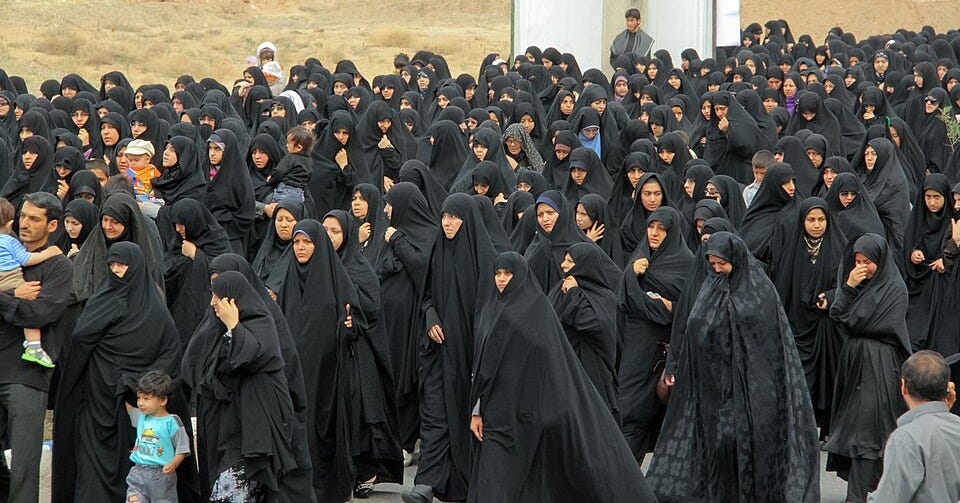
Christopher Hitchens once remarked that the only cure for world poverty is the empowerment of women. But it does far more than that. A nation whose women are enslaved cannot have any moral center. A boy who grows up seeing his mother and sisters treated like dogs, and who comes to embrace the system that treats them so, can never fully be a good man. The horror of it breaks women’s minds, but poisons the souls of the men who maintain it. In the end, no one is truly free. Women and men alike, and children too, are chewed up by it, mauled by savagery. When I was an undergrad, one of the textbooks we studied was the anthology Reconstructing Gender by Estelle Disch, which still sits on my shelf. In it, in an essay titled “Fighting Gender Apartheid Under the Taliban,” author Genevieve Howe describes not just a “gender apartheid,” but “a virtual ban on women.” In a 1998 report, Physicians for Human Rights went further, calling it a “war on women.” And that’s exactly what it is.
The final battle
Iran has entered the new year facing the most serious internal challenge to clerical rule in my lifetime. What began as protests over economic collapse—rampant inflation, currency depreciation, and unemployment—has rapidly evolved into a nationwide political uprising. The protests have spread across all provinces, with their chants no longer confined to economic grievances. Now the most common slogans are “This is the final battle” and “Death to the dictator.” Inshallah.
The state’s response was predictably swift and brutal. Security forces, including the Islamic Revolutionary Guard Corps, have used live ammunition, mass arrests, and intimidation to suppress demonstrations. “I saw it with my own eyes,” said one man. “They fired directly into lines of protesters, and people fell where they stood.” A young woman from Tehran said, “Security forces only killed and killed and killed.” She added, “In war, both sides have weapons. Here, people only chant and get killed.” CBS News reports that sources inside the country say “at least 12,000, and possibly as many as 20,000 people have been killed.”
Iran's Next Arrow

Last night, after two decades of gridlocked nuclear negotiations, the United States broke the spine of Iran’s nuclear infrastructure, ordering B‑2 Spirit stealth bombers loaded with Tomahawk cruise missiles to unleash 14 heavy bunker-buster bombs on the country’s most fortif…
One of the victims was Hessam Khodayarifard, 22, who was shot dead in the city of Kuhdasht on New Year’s Eve. Authorities initially refused to hand over his body, and when mourners at his funeral began chanting anti-government slogans, troops moved in on the grieving family with force. Another victim was Shayan Asadollahi, 28, a barber in the town of Azna who was returning home from a demonstration when several Revolutionary Guard pickup trucks pulled up on them and opened fire. Shayan was hit in the gut and bled out. He was his family’s sole provider. Three hours south in the city of Lordegan, Sajjad Valamanesh, 20, was shot during a protest. Then the Revolutionary Guard called the family and forced the boy’s father to give an interview on state media in which he called for an official crackdown on “rioters,” which he only did because officials said otherwise they wouldn’t release Sajjad’s body for burial. This is the horror of life in Iran. But how did it come to this?
A brief history
Modern Iranian politics is best understood not as a series of disconnected crises, but as a single arc shaped by three figures—the Shah, the revolutionary cleric who replaced him, and the man who still rules today.
Iran’s current leader, Ali Khamenei, has served as Supreme Leader since 1989. Under his rule, the Islamic Republic evolved from a fervent ideological state into a hardened security regime. Power rests with clerical institutions, the Islamic Revolutionary Guard Corps (IRGC), and an extensive surveillance and repression apparatus. The protests of 2009, 2019, 2022–23, and 2025–26 have made clear that the system survives not through consent of the governed, but by force.
Khamenei inherited a state created by Ruhollah Khomeini, the architect of the 1979 Islamic Revolution and Iran’s first Supreme Leader. Khomeini returned from exile amid mass demonstrations against the monarchy and rapidly transformed a broad, ideologically diverse uprising into a clerical dictatorship. His defining contribution was the doctrine of Velayat-e Faqih—the “Guardianship of the Jurist”—which placed ultimate authority in the hands of Islamic jurists rather than the electorate. Under his watch, liberals, leftists, monarchists, journalists, and religious minorities were arrested, tortured, and executed. The 1979 seizure of the U.S. Embassy and the ensuing hostage crisis hardened Iran’s posture toward the West. By the time he died in 1989, the revolution had devoured its rivals and institutionalized Islamofascism.
The man overthrown in 1979 was Mohammad Reza Pahlavi, Iran’s last Shah. His reign, beginning in 1941, combined rapid modernization with authoritarianism. The Shah pursued ambitious reforms such as land redistribution, expanded education, women’s legal rights, and industrialization—while suppressing opposition through a powerful security service known as SAVAK. To supporters, he was a modernizer dragging Iran into the twentieth century. To critics, he was a corrupt autocrat ruling at the pleasure of foreign powers. He modernized Iran’s economy and society, but refused to liberalize its politics, creating a growing class of educated citizens with no lawful avenue for dissent.
The United States became entangled in Iran’s fate in 1953, when it helped engineer the overthrow of Prime Minister Mohammad Mossadegh after he nationalized Iran’s oil industry. That intervention crushed Iran’s most promising experiment with parliamentary democracy and restored the Shah as a dominant ruler. In the short term, the coup secured Western access to oil and ensured a friendly government during the Cold War. In the long term, it poisoned Iranian political culture. The Shah came to be seen as an American-backed dictator. The very language of democracy was discredited as a foreign instrument. The ultimate result was that the people became revolutionaries who rallied behind Khomeini largely because he was vocally anti-American. He called America the Great Satan and became known for his slogan, which pro-Palestinians often chant: Marg bar Amrika. Death to America.
A global poison
In addition to brutalizing the people of Iran, the regime destabilizes the entire region and, in certain ways, the world. Since the 1980s, Tehran has pursued regional influence through proxy warfare, funding and arming militant groups across the Middle East. It is Iran that supports Hezbollah in Lebanon, Hamas and Palestinian Islamic Jihad, Shiite militias in Iraq and Syria, and the Houthis in Yemen.
In 1979, Iranian students, backed by the post-revolutionary regime, seized the American embassy and held 52 U.S. diplomats and citizens hostage for 444 days. In 1983, Hezbollah carried out a suicide truck bombing on the U.S. embassy and Marine barracks in Beirut, killing hundreds, all with IRGC support. In 1984, a Hezbollah car bomb, supported and directed by Iran, killed 23 people outside the U.S. embassy annex in Beirut. In 1985, Hezbollah carried out a series of coordinated bombings in Paris, again sponsored by Iran.
In 1992, a truck bomb exploded at the Israeli embassy in Buenos Aires, killing 29 people and injuring 240. The blast was claimed by an Islamic Jihad faction linked to Hezbollah. Argentine courts and investigators identified Iranian involvement through proxy operatives. In 1994, a massive car bomb destroyed the Argentine Israelite Mutual Association (AMIA) Jewish community center in Buenos Aires, killing 85 people and injuring hundreds. Argentine prosecutors formally accused the Iranian government of directing the attack through Hezbollah operatives. In 1996, Hamas suicide bombings on buses along Jaffa Road killed dozens. The operatives had been trained, armed, or funded by Iran. Also that year, a truck bomb exploded near a housing complex used by U.S. Air Force personnel in Dhahran, Saudi Arabia, killing 19 U.S. servicemembers and injuring hundreds. A U.S. federal court later found that Iran financed and directed the attack through the Hezbollah al-Hejaz group.
Confronting Iran with Ramesh Sepehrrad

Ramesh Sepehrrad is an Iranian-American international relations and conflict resolutions expert who is also the advisory board chair of the Organization of Iranian American Communities (OIAC), a D.C.-based non-profit with 40 chapters nationwide. She is also an adjunct professor of Middle East studies at the School of Public and International Affairs at …
And that’s just the highlight reel for two decades. The violence has never stopped. In addition to backing Hamas and therefore having blood on its hands for October 7, Iran also organized and carried out at least two terrorist attacks within Australia in 2024. The first occurred on October 20, when arsonists attacked a kosher restaurant in Sydney. The second took place on December 6, when arsonists firebombed the Adass Israel Synagogue in Melbourne. To top it all off, Iran maintains a Hezbollah presence in Latin America through Venezuela, terrorizing people there too, though the capture of Maduro might weaken this network. Suffice it to say, the end of this evil regime would be a blessing to the world. So then why isn’t it the biggest news story of the day?
Media betrayal
The people of Iran are fighting a truly vile enemy, one that is a global poison to us all, and they have been fighting for longer than I’ve been alive. Finally, however, it seems they could be breaking through. Maybe this really will be their final battle. Even if they do win, that doesn’t guarantee democracy will follow. But if Iran does move toward elections, it could be one of the greatest political shifts in our lifetime. So you’d think the media would be all over the story. Well, not exactly. Writing for Honest Reporting, Rachel O’Donoghue reports on how the protests “have exposed the dishonesty, laziness, and moral cowardice of much of the Western media.” She adds:
For nearly two weeks, the Western media either buried the story or, worse, reframed it using the regime’s own talking points . . .
From The New York Times to the BBC, coverage was sparse and evasive. When the protests were mentioned at all, their explicitly anti-regime nature was often omitted. Demonstrations were reframed as vague cost-of-living protests, despite protesters chanting openly for the end of clerical rule . . .
Worse still, when journalists were challenged about their lack of coverage, several offered excuses that bordered on the absurd.
BBC World Affairs Editor John Simpson claimed that social media footage must be carefully verified before reputable outlets could use it—a striking assertion given the same outlets’ willingness to publish unverified material from Gaza for months.

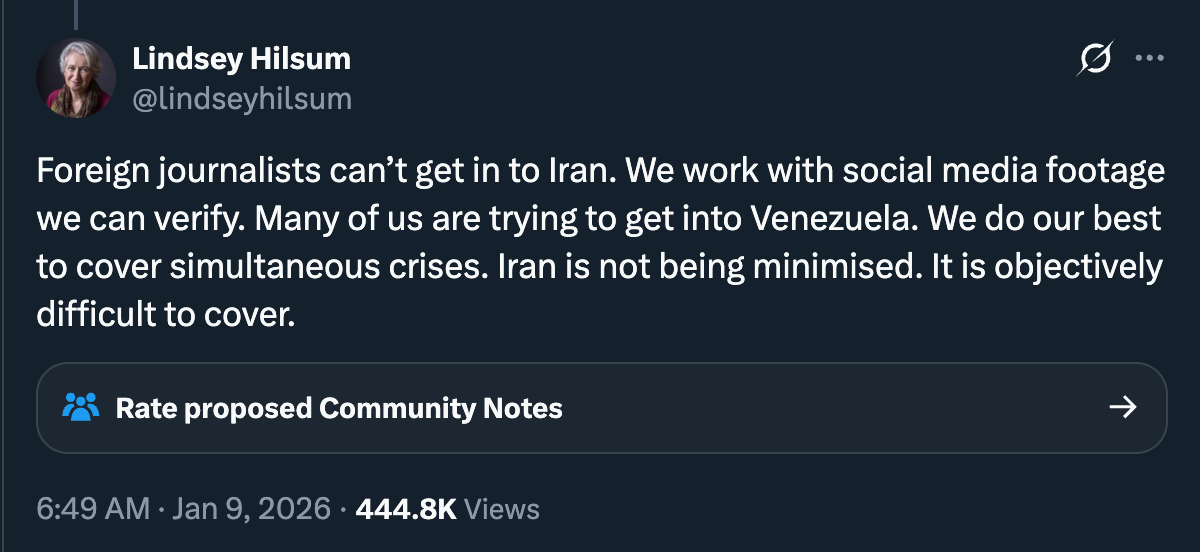
Channel 4 International Editor Lindsey Hilsum echoed the line, arguing that Iran is objectively difficult to cover because foreign journalists cannot enter the country.
We were expected to forget that these same journalists spent years publishing casualty figures, video footage, and testimony from a Hamas-run enclave, often without meaningful verification, attribution, or editorial caution.
When criticism became impossible to ignore, coverage did finally increase.
But instead of centering Iranian protesters and the regime’s brutality, many outlets simply pivoted to laundering Tehran’s propaganda.
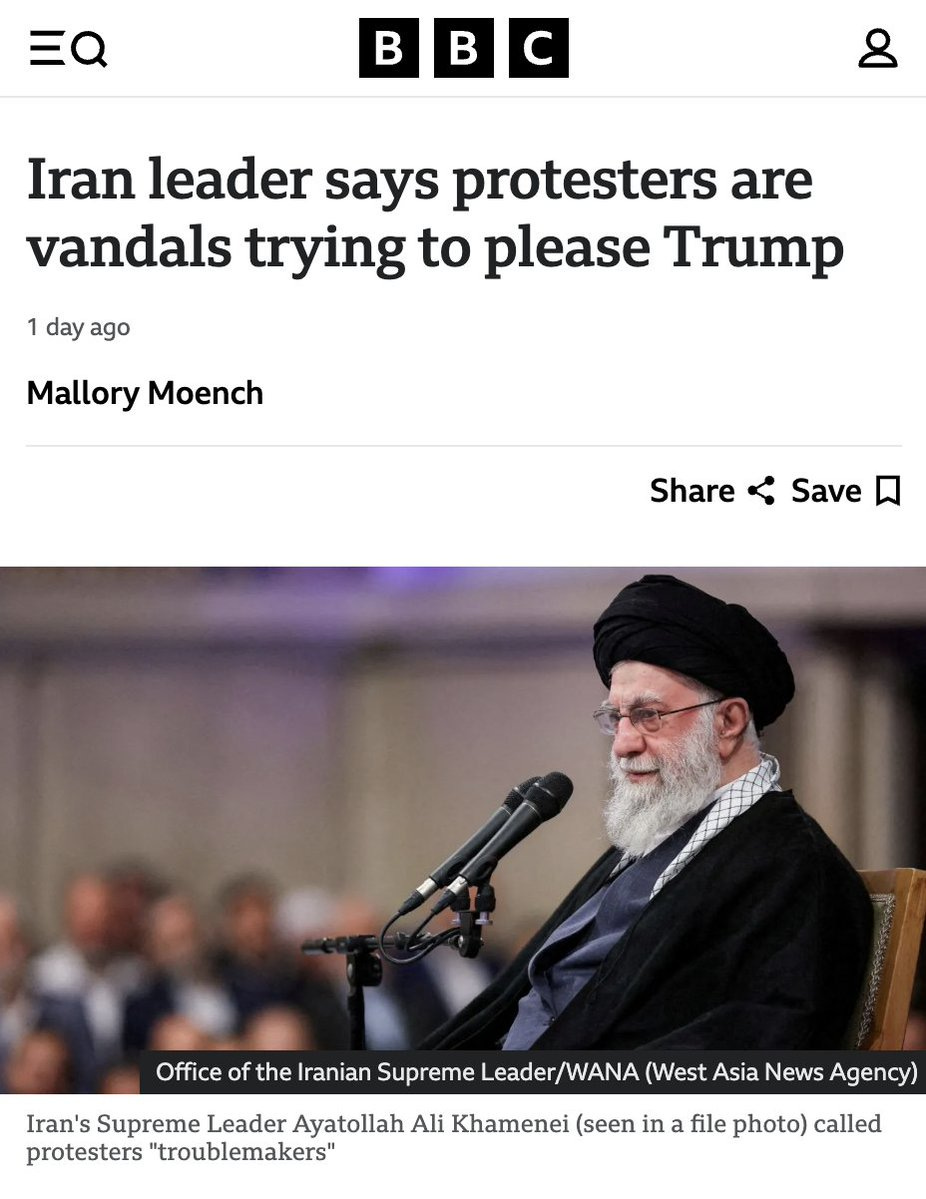
The BBC and NBC News ran headlines amplifying Khamenei’s claim that protesters were vandals trying to please Trump.
Sky News led with Iranian state media allegations blaming Israel and the United States for the violence.


CNN, even while acknowledging deaths, repeatedly emphasized its inability to independently verify activist reports—a caveat that might carry weight if the network had not spent the past two years publishing Hamas-run casualty figures from Gaza with minimal skepticism or attribution.
In short: when Islamists speak, they are treated as sources. When Iranians speak, they are reduced to claims.
How Iran saved civilization
On December 14, 1959, the Shah Mohammad Reza Pahlavi held a luncheon in honor of President Dwight D. Eisenhower, who thanked the Shah by raising a toast to him and to the Iranian people, in which he said:
The American people have the greatest respect and admiration for the Iranian people. Your kings, from Cyrus and Darius, are known among those famous monarchs who have advanced the cause of humanity. Your scientists have contributed to the foundations on which we have built our industrial society. Your philosophers and poets have enriched the culture of the West. The fortitude of the Iranian people in the face of invaders, and their resoluteness in maintaining their nation through the centuries, have won admiration throughout the world.
Therefore, I propose a toast to the Shahinshah. May he continue to give wise leadership to his people. May God prosper him and them in their work of peace.
Your Majesty, your good health.
Iran is one of the greatest civilizations in human history. Cyrus the Great and his successors created the first true world empire, governing diverse peoples under a policy of religious tolerance and an administrative template that influenced every subsequent empire from Alexander to Rome. Iran is also home to the first major monotheistic religion, Zoroastrianism, which introduced concepts such as the cosmic struggle between good and evil, individual moral choice, final judgment, heaven and hell, and a coming savior. These ideas profoundly shaped Judaism, Christianity, Islam, and became foundational to Western religious thought.
Persian architecture has left its mark on the world too. The Persian walled garden, known as pairidaeza, is the origin of the word “paradise,” and Persian architecture, from Persepolis to Isfahan’s mosques, established principles of symmetry and the integration of water that influenced buildings from the Taj Mahal in India to the Alhambra in Spain. The blessed people of Iran have done no less than shape the way humanity governs, believes, and dreams.
When I was 15 years old, I read Thomas Cahill’s How the Irish Saved Civilization, which makes a specific claim. Namely, that Irish monks preserved Latin texts during the chaos following Rome’s fall, then reintroduced classical learning to continental Europe. It’s a charming thesis, though medievalists often note it overstates Irish uniqueness. Byzantium, for instance, never lost the Greek classics. But the Persian claim rests on broader and more consequential ground. When the Abbasid Caliphate established Baghdad in the eighth century, it was Persian scholars, along with Syriac Christians, who undertook a systematic effort to translate Greek philosophical and scientific texts into Arabic. This wasn’t haphazard monastic copying, like in Ireland, but a state-sponsored intellectual project. And it changed everything.
Works by Aristotle, Plato, Galen, Euclid, and Ptolemy that had been lost or neglected in the Latin West were not only translated, but commented upon, and synthesized. While the Irish project was essentially curatorial, the Persian contribution went further. Avicenna didn’t merely preserve Aristotle. He developed Aristotelian philosophy in ways that later shaped Aquinas. Al-Khwarizmi didn’t just translate Indian mathematics. He needed a method to resolve inheritance disputes and land surveying. The Quran specifies precise fractional shares for various heirs, and when multiple heirs with competing claims existed, he calculated each share by developing and solving linear and quadratic equations. Existing arithmetic wasn’t up to the task, so he simply created algebra.
When 12th century European scholars began translating Arabic texts into Latin, primarily in Toledo and Sicily, they were recovering Greek knowledge filtered through Persian and Arab commentary. Avicenna’s Canon and Averroes’s Aristotelian commentaries became curriculum staples in European universities. The Renaissance rediscovery of antiquity depended substantially on this Arabic-Persian bridge. The Irish contribution, though valuable, was geographically limited and lasted a few centuries while the Persian contribution sustained itself for over a millennium and extended from Spain to India.
That’s not all. The Persian polymath Avicenna (Ibn Sina) compiled his thoughts on medical science in the year 1025 in his Canon of Medicine, which remained the standard medical textbook in European universities until the 1700s. His philosophical synthesis of Aristotelian and Neoplatonic thought shaped both Islamic and Christian scholasticism, where his most influential contribution was his distinction between essence and existence. In Aristotelian thought, things have essences—what makes a horse a horse, a triangle a triangle. But Aristotle didn’t really address why things exist. Avicenna argued that for everything except God, essence and existence are separate. You can understand what a horse, or a unicorn, is without knowing whether any horses or unicorns actually exist. This led to his proof for God’s existence, in which he said things can exist or not, but God must exist because God is existence, or wajib al-wujud, the Necessary Being whose essence is existence itself. If this sounds simple to you, you are failing to understand it. But that’s an essay for another time.
Enter Trump
President Donald Trump has responded publicly and unusually forcefully to events in Iran. He seems to uniquely recognize the scale of the threat we face. He has warned the Iranian regime against massacring protesters and suggested that violent repression could provoke severe consequences, including military or economic escalation. Reporting indicates that Trump-aligned policymakers have discussed a range of options from symbolic support for protesters to direct coercive measures.
He’s not bluffing either. In his first term, Trump eliminated Qassem Soleimani, commander of Iran’s Quds force. In his second term, he ordered the attack on the Fordow, Natanz, and Isfahan nuclear facilities. The ominously named Operation Midnight Hammer was a U.S. overnight strike in late June aimed at crippling Iran’s nuclear program at its most hardened points, notably the deeply buried Fordow facility, along with Natanz and infrastructure near Isfahan, using long-range B-2 stealth bombers flying nonstop from the United States.
Arash Azizi on what Iranians want

Arash Azizi is a writer and historian whose commentary has been published in The New York Times, New York Review of Books, The Washington Post, Newsweek, BBC, Haaretz, The Daily Beast, Guardian, Vanity Fair, The Nation, Al-Jazeera, and more.
The operation was historically significant for the first-ever combat use of the GBU-57 Massive Ordnance Penetrator, a bunker-buster designed to destroy underground facilities previously considered unreachable by conventional weapons. The GBU-57 slams into the earth with incredible velocity and burrows deep before detonating. It doesn’t explode its target, but causes it to collapse and implode on itself. At the same time, U.S. Navy submarines launched Tomahawk cruise missiles at surface targets. Israeli President Isaac Herzog thanked America and said the mission advanced security for “the free world,” which is undoubtedly true. Democratic Representative Alexandria Ocasio-Cortez said it was “clearly grounds for impeachment.”
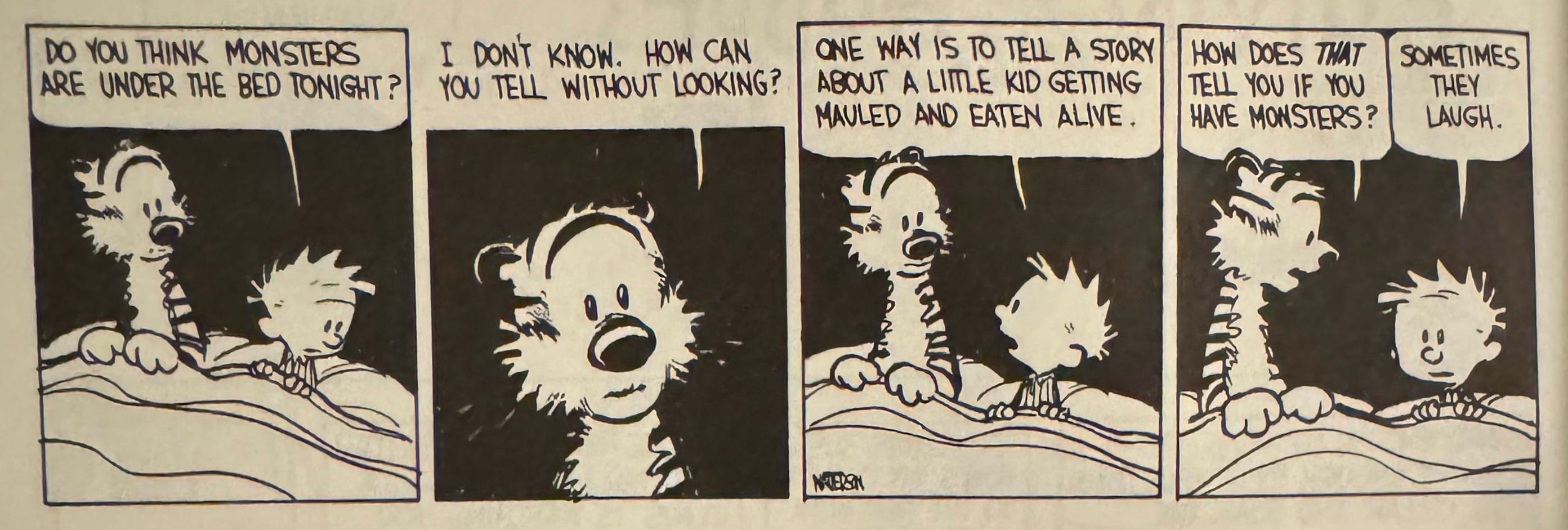
Sometimes they laugh
That reaction by AOC is perhaps predictable. But if we’re looking around the room at reactions to what’s happening in Iran, or what the United States has done to address this threat, the story gets darker still. The Western media isn’t the only one being silent. In The Wall Street Journal, editor-at-large Gerard Baker writes in his essay “Iran Cracks Down. Where Are the Western Protests?”:
Where are the protests in the West? Specifically, where are all those defenders of persecuted Muslims who have been so active on the streets of New York, London, Sydney, Rome and elsewhere the past two years? Where are the demands for justice and freedom for the downtrodden victims of a brutally repressive state?
What is so different about the cause they have been espousing in their demonstrations over Gaza and the cause of the millions of innocent coreligionists 1,000 miles to their east? Those kaffiyeh-wearing, banner-waving, slogan-chanting activists say they were moved to protest, sometimes violently and unlawfully, by the plight of Muslims dispossessed of their lands and livelihoods, immiserated, starved, beaten and murdered by a savage regime.
In Iran, this has been happening for decades. More than three million Iranians have been driven from their homeland in the 47 years of the mullahs’ rule. People have been forced into prisons (literal ones—not the metaphorical “open-air prison” of Gaza) or into exile in foreign lands, their homes and property stolen, their loved ones punished and frequently murdered.
Where, indeed? Maybe they’d find the time to hit the street if their brutal oppressors wore yarmulkes instead of turbans. But their soulless silence isn’t even the half of it. Leftists, the same ones who would be first on the chopping block—literally—are the same to chant “Death to America” and “Hands off Iran.” These depraved psychopaths do not chant, “Hands off Iranian women.” The head of the Democratic Socialists of America’s international committee posted, “Long live Ayatollah Khomeini & the Islamic Republic of Iran.” The socialist influencer Hasan Piker has mocked the dead and, laughing, called their murder “poetry.”
The fight is far from over. Many in Iran still support the current regime. The protesters face an uphill battle. And even if they do succeed, there’s no guarantee that what comes next will be liberation. Many of the fighters themselves are just another flavor of radical Islam. But I pray for the people, for the women, for all the lions of Iran, and for their noble cause. And I listen for silence and laughter, and make a promise to myself to never forget where it came from.
I'm really not sure why this substack doesn't have 100x the engagement that it does.
Was a long time ago. Can’t recall the source or the precise phrasing of a comment that stuck w me and sadly continues to resonate. Was an observation of the self proclaimed peace activists.
They’re not peace activists. They’ve taken a side. It’s the other one.
Radical is an interesting word with different ways to define it. I enjoy the more romantic definition of bucking the corrupt the entrenched the coerced the naked emperor but there’s the darker flip side. Cuts both ways.
What happened at universities is they reached a critical mass of conformity of zombie radicalism more cultish than intellectual.
This happened because arguably the most radical experiment in human history centered around individual freedom and rule of law and property rights for the masses proceeds forward while also grinding to a halt from a critical mass of people large majority of whom are clear beneficiaries but ignorant of what came before ignorant of worlds they glamorize and longing for experiments shallowly and impossibly packaged that have already failed. Along with a blacker minority which includes aspiring fascists and fools who should be careful what they wish for.