

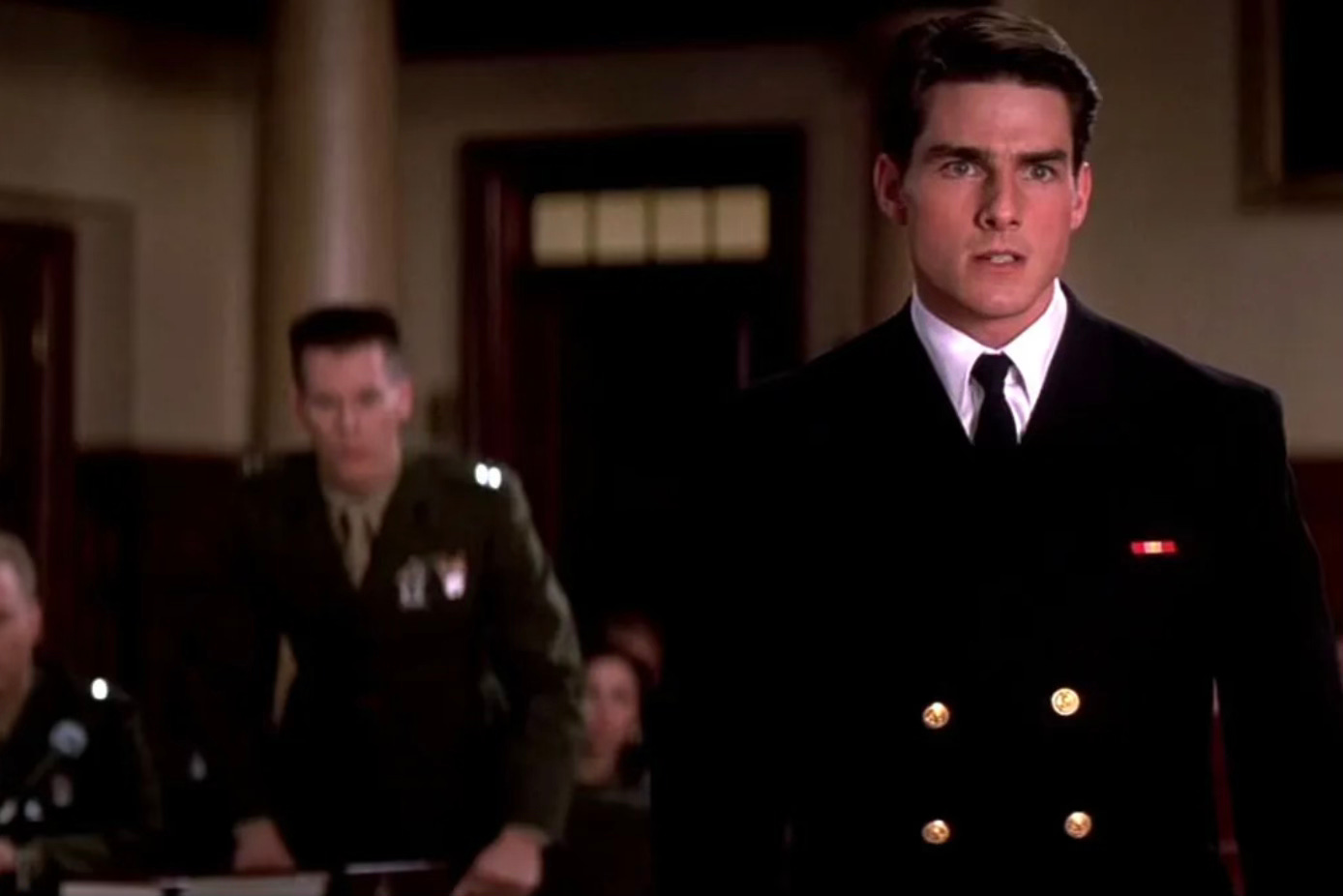
You can’t handle the truth! Son, we live in a world that has walls, and those walls have to be guarded by men with guns. Who’s gonna do it? You? You, Lieutenant Weinberg? I have a greater responsibility than you can possibly fathom. You weep for Santiago and you curse the Marines. You have that luxury. You have the luxury of not knowing what I know. That Santiago’s death, while tragic, probably saved lives. And my existence, while grotesque and incomprehensible to you, saves lives! You don’t want the truth, because deep down in places you don’t talk about at parties, you want me on that wall. You need me on that wall. We use words like “honor,” “code,” “loyalty.” We use these words as the backbone of a life spent defending something. You use them as a punchline! I have neither the time nor the inclination to explain myself to a man who rises and sleeps under the blanket of the very freedom that I provide, and then questions the manner in which I provide it! I would rather you just said “thank you” and went on your way. Otherwise, I suggest you pick up a weapon, and stand a post. Either way, I don’t give a damn what you think you are entitled to!
– Colonel Nathan R. Jessup, A Few Good Men
In Rob Reiner’s classic 1992 courtroom drama A Few Good Men, the villain—played by Jack Nicholson—is Col. Jessup, the commanding officer at Guantánamo Bay who orders an illegal Code Red that leads to the death of Private William Santiago. Jessup justifies his actions as necessary to maintain discipline and national security, but the film exposes how that mindset crosses into abuse of power and moral corruption. The famous courtroom climax, quoted above, makes this explicit. Jessup did order the Code Red, he finally reveals to Tom Cruise’s character, and while he sees himself as a protector doing what civilians can’t, the law—and the film—judge him accountable.
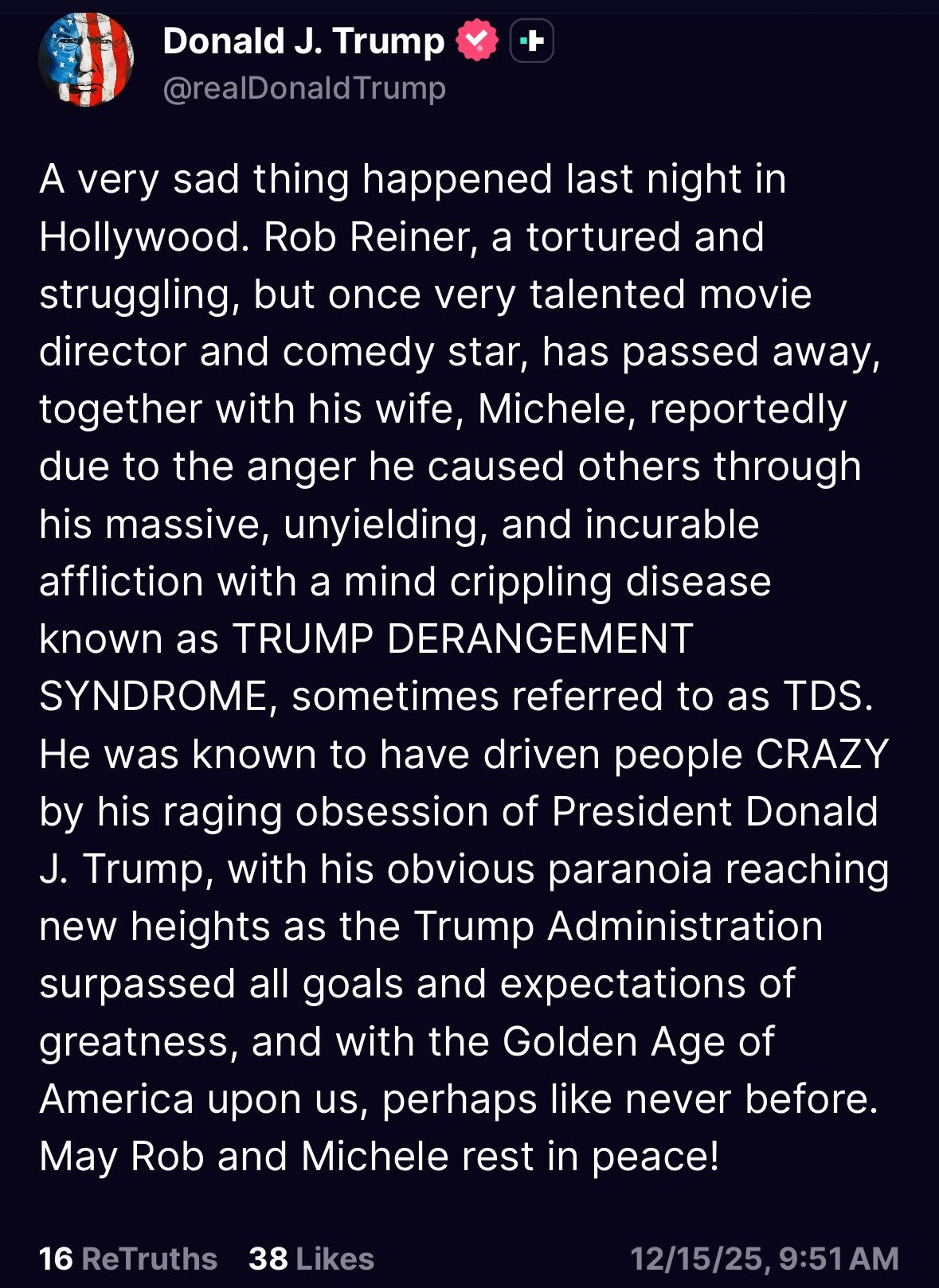
Last night at his Brentwood home in Los Angeles, Reiner and his wife Michele were found stabbed to death by their daughter Romy. As someone who grew up on Reiner’s films, this hits home. And as a father to a daughter myself, that scene is devastating to imagine. But also, as background for the argument I’m about to make, it’s important to note that in addition to making some of the greatest movies of all time—Stand By Me, The Princess Bride, When Harry Met Sally…—Reiner was also very politically outspoken. In fact, he was arguably the most outspoken anti-Trump critic in all of Hollywood, which is quite an accomplishment given the stiff competition in that category. He has said Trump is “mentally unfit” to be president. He has referred to the president as “dictator Trump.” He has called Trump a “fascist.” He has compared Trump to “Hitler, David Koresh, Jim Jones.” And so, upon hearing the horrific news today, Trump responded with all the grace and tact of a snuff film.
When Charlie Kirk was assassinated, some conservatives became so outraged that they tried to get people fired over private social media posts. They tried to destroy people’s lives over jokes, or simply because they had reposted Kirk’s own words. And suddenly, we got a taste of cancel culture in the other direction. It was gross to see, but it’s worth noting that the moral valence is not entirely even here. In one case, people were demanding respect for a man who had been slaughtered for having an opinion. The gross leftist laughter and justification was utterly despicable and an affront to the most essential of American values—the idea that you can say what you want you think without being murdered for it. But back when the tables were reversed, people’s lives were cracked open or destroyed because they’d mispronounced a name, used an inappropriate term, or argued a point that offended the left. It’s the difference between not wanting to work next to someone who is biologically literate enough to know the difference between men and women, and not wanting to work next to someone who laughs when people are slaughtered for that literacy.
Charlie Kirk was a good man

Charlie Kirk, co‑founder of Turning Point USA, was shot dead at a “Prove Me Wrong” event at Utah Valley University earlier today. He had been speaking to students as part of his “American Comeback Tour” when he was shot in the throat. President Trump confirmed Kirk’s death soon after. Kirk had built his reputation by taking conservative arguments direct…
And yes, in Kirk’s case, the left bears distal moral responsibility for creating the permission structure to punch a Nazi. Or kill one. By normalizing the language of calling everyone you dislike a Nazi, then shrugging or even laughing when those alleged Nazis are murdered, you help create an environment in which murder becomes an acceptable solution to political disagreement. You also become a disgusting person in the process. Now, this is not to say that you shouldn’t have the right to call people Nazis. But having the right doesn’t therefore mean you should actually do it. One reason for this is because if you call everyone a Nazi, and everything racist, these words lose power. And we do not want these words, of all words, to lose power. But also, because as you water these words down, more and more people are going to openly embrace them, one example being Nick Fuentes. And then you get people who will go out and literally gun down innocent individuals because now they believe the rhetoric you’ve been spreading, which often includes some lie about a fabricated genocide at the hands of these so-called “Nazis.” There’s the imaginary trans genocide, the imaginary black genocide, the imaginary Gazan genocide. It’s funny, because the left tells us all the time that words have power, “impact over intent,” even “silence is violence,” and so on. How soon they “forget.”
What this ultimately boils down to is rather simple. If you oppose political violence only when it targets people who share your views, but excuse or rationalize it when it’s aimed at people you dislike, you are not a principled person. You’re just tribal. If you think Charlie Kirk should not have been murdered merely because you don’t want conservatives to be killed, but you believe it’s acceptable to kill progressives, you are a moral fraud. No one should be killed for holding an opinion. That’s the only defensible position here. And this brings us back to Trump, publicly taking pathetic and petty shots at Reiner less than 24 hours after his death. Not praising the death outright. Not saying he “deserved it.” But refusing to show even basic restraint or human decency in the moment. And making that moment, as Trump always does, about himself and his petty grievances rather than Reiner, his work, or his family.
What’s striking is how familiar this is. If anyone on the left had said the same thing about Kirk—this exact tone, this exact level of contempt—it would have triggered a firestorm on the right. In fact, people were punished for far less. Yet many of the same people who found remarks about Kirk utterly repulsive will come to Trump’s defense here. This should be clarifying for the rest of us. You may support Trump because he opposes policies you find destructive, or because you see him as a blunt but necessary instrument against the abuses of the left, despite his flaws. But let this be a reminder of what those flaws actually are.
Yes, the right is correct to criticize the left’s pearl-clutching, woke authoritarianism, and Stalinistic policing of speech. But the over-correction to this has been to embrace offensive speech as a pushback. This is a problem because the left was not entirely wrong to react with disgust to Trump’s locker-room talk when he ran for president the first time. Nor to recoil at his casual cruelty. Dismissing that reaction as mere fragility, or “being a snowflake,” misses something real. The truth the left gets right, however selectively, is that Trump speaks about people with such easy contempt, seemingly indifferent to the harm he causes, that it necessarily says something about the kind of person he is, and the kind of leader he can be. When someone dies and this is how he responds, it’s a stark reminder of that unavoidable fact.
Trump is no Leonidas. He is not a statesman, an intellectual, or a moral exemplar. He is petty, incurious, and governed by grievance. If he possesses intelligence, it is of a nature that seems most gifted in its ability to hide itself. If you count yourself a fan not just of his politics but of his character, yet you were outraged when people laughed at Kirk’s death, then simply ask yourself how you might’ve felt to hear AOC write something like what Trump wrote above, but about Kirk. Many of his supporters will still defend him even here, even on these terms, and that should trouble us. Too many have forgotten what true decency looks like in public life. But it ain’t this.
In A Few Good Men, the title comes from the notion that a small number of disciplined, morally serious people are entrusted with guarding everyone else. I believe in this, even though it’s the principle by which Jessup defends his actions. What Jessup misses is the moral asymmetry between responsibility and impunity, and the central role that decency toward others plays in this. Jessup believes that because he bears the burden of guarding the wall, ordinary moral obligations no longer apply to him. But the entire legitimacy of entrusting a few good men with extraordinary power rests not just on their effectiveness, but on how they treat those beneath them. Decency isn’t a luxury, but proof that the power we bestow hasn’t curdled into cruelty.
A system survives only if those few men remain capable of seeing others—especially the weak, the subordinate, the accused—not as obstacles or abstractions, the way a fascist or Stalinist might, but as human beings owed basic respect. The wall matters, and we must hold it strong, but so does the refusal to become the kind of person who thinks cruelty is the price of order. Because it only takes a few bad men, armed with power and stripped of decency, to bring that wall down. I am not saying we cannot be ferocious killers. But as Reiner understood, the blade of justice must be properly sheathed within a righteous order and basic sense of human decency, otherwise you’re just a six-fingered freak who likes to bully people.
There used to be respect for the dead. Particularly if they were murdered. Particularly if they were just now murdered. Not to forget that one of his children apparently did it.
There used to be respect.
To spit on someone's fresh grave is beyond all apologetics . It's a degenerate generation.
President Trump was wrong to make these comments. They are tacky and disrespectful. It does not matter if these remarks were or were not comparable to those made about Charlie Kirk's assassination, I expect more from my president than from an online rabble of feebleminded bigots. It says more about Trump than about the Reiners. I am used to the President's lack of decorum and tendency to say things that normal people never would, and yet I was shocked at this. I know the President has an oversized ego and has a tendency to make things about himself, but this is beyond the pale. There is no defending this. It is disgraceful and he should be ashamed of himself.