

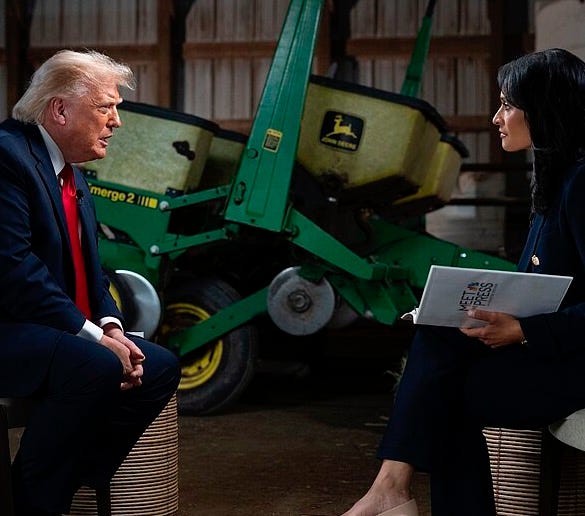
After NBC’s Kristen Welker said President Trump’s endorsement of candidates this primary cycle got “mixed results,” Trump took to social media to ask, “How can anyone be allowed to say this,” threatened, “Because of this purposeful inaccuracy, she will be reported to the FCC for rebuke or punishment,” further saying, “The Press is a Disgrace to our Nation, and I hope that Chairman Brendan Carr, and the fine people of his Commission, will take this Threat to our Country very seriously,” and adding that he actually has a “99% SUCCESS Rate.”
Let’s begin by addressing his claim that Welker is lying. Of the 313 congressional and state candidates Trump endorsed, 96% won, but of the 12 that lost, nine were in the past few weeks, forming a cluster that does make it look like his record is taking a hit. So in a way, they’re both kinda right. He’s right about the record, while she’s right about the recent trend. Now, more importantly, let’s recognize that this story is bigger than Welker or NBC. Or even Trump, for that matter. Or any of this. The media is under enormous pressure these days. There are people who actually think reporting on the Jason Arday story is tantamount to murder, and that we should enact prior restraint on the press to prevent such “hate journalism.”

There is also the story of reporter Catherine Herridge, formerly of Fox News, who is being ordered to reveal her source, and had been paying $800 a day for refusing to do so (until a judge paused that fine), related to a story she reported about a suspected Chinese spy, who teaches at a U.S. university, all because the suspect herself subpoenaed Herridge for the name of the source. Or cast a glance over at our own White House, where the supposed leader of the free world, and self-proclaimed defender of free speech, is simultaneously waging war against ABC, NBC, CBS, AP, NYT, WSJ, BBC, the Atlantic, Bloomberg, NPR, PBS, VoA, RFE, RFA, MBN, and even its own military paper, Stars and Stripes. Not to mention the Pentagon’s access restrictions against WaPo, CNN, Politico, Reuters, the Hill, the War Zone, Newsmax, and others.
Now, you may be thinking, “So what? The media had it coming. They’re a bunch of woke liars.” And, yes, mainstream media has been overtaken by progressive orthodoxy, to the point that we now regularly see blatant falsehoods and egregious spin from our biggest and “best” papers (also, thanks partly to social media, many of us are more media savvy than ever before and therefore better at spotting mistakes, sloppy journalism, or just plain wokeslop). I agree this is a problem. It’s one of the reasons so many people prefer to get their news and analysis from independent journalists and writers on Substack, like myself. But the solution to this problem is not to lean into censorship, or sit idly by as others call for it. We must instead defend this rare and precious right. Remember, the idea of a fair and balanced press is relatively new, and easily lost. Throughout American history, the media was overwhelmingly biased, financed by political parties, openly propagandistic, and packed with rumors and lies. But then, the invention of the telegraph made precise, factual reporting easier. At the same time, market forces pressured papers to be more balanced so as not to alienate half their readers. Also, reporters became blue-collar workers rather than political operatives. So in a sense, you could say capitalism saved American journalism by driving tech innovation, incentivizing nonpartisanship, and turning from hacks and propagandists to salaried craftsmen reporters.
Unfortunately, that blue-collar industry has now been heavily replaced by woke Ivy League grads from wealthy families, the precision of the telegraph has been replaced by the noise of social media, and new market forces actually make extremist messaging more profitable as market fragmentation leads to narrowcasting. But there’s reason for hope. Social media gives us citizen journalists who report things others won’t. Fragmentation gives us independent writing at places like Substack. And places like The New Yorker may still be staffed with racist elites, but that seems to be pushing audiences in a healthier direction. Namely, away from such outlets. The New Yorker’s editor-in-chief, David Remnick, did amazing work turning the magazine into a home for serious international reporting, then spent the credibility this amassed by having the pages of his magazine regularly vomit woke racism at its readers. And so, people are waking up. And this is good.

But what is not good is this anti-journalism sentiment. It is no deeper in thought or firmer in standing than anti-science rhetoric, anti-speech rhetoric, or more broadly, anti-intellectualism. Trump is not just merely pushing back on bad reporting. He’s part of a larger trend that seeks to erode the very purpose of even having a free press in the first place. What is the purpose? It’s certainly not open debate or public education. It is, of course, wonderful that the press offers a public forum for debate. It is also virtually a sacred societal good that the press nourishes the public mind with facts about current affairs (to the extent that they still do so). But, as Supreme Court Justice Potter Stewart famously argued, these things are not the primary purpose of a free press. Otherwise, we wouldn’t need to explicitly carve out space for journalism in the Press Clause of the First Amendment. Today, Stewart is mostly remembered for his famous remark on obscenity, from the case Jacobellis v. Ohio: “I know it when I see it.” But he should rather be more fondly remembered for his 1975 essay “Or of the Press,” in which he argued that the Press Clause exists to protect an institutional press.
That means an autonomous Fourth Estate, not just “a kind of Hyde Park Corner for the community,” which we might think of today as X, or “a neutral conduit of information,” which today is arguably AI far more than it is the press itself (and even that isn’t neutral). But instead, Stewart said, the true telos of the press is to stand as a check on government power, a leash on abuses no less firm than the Speech Clause itself, and often more. As the British management cybernetician Stafford Beer once said, “The purpose of a system is what it does,” and what Trump is doing is dismantling the institutional role of the press over bad reporting, or in some cases, merely for reporting he dislikes. That is like trying to dismantle free speech because sometimes people say stupid things, or because sometimes you hear opinions you dislike. You do not cure bad speech by ending speech. But also, ask yourself, what is the purpose of doing such a thing? Why silence the only organized private business that enjoys explicit constitutional protection in order to check government power and abuse? What is the purpose of this system? And while you consider the thought, maybe also take notice of the fact that it’s a fairly woke and authoritarian impulse to try to silence reporting, or deport people, or have them fired, for saying things you don’t want to hear or that you politically oppose. Or, perhaps just as often, for saying things you don’t want anyone else to know.
As for deporting people because of their opinions, a federal judge ruled Friday that the Trump administration’s efforts in this regard are, as my Bahamian mother would put it, “a pile of foolishness.” The Foundation for Individual Rights and Expression recently challenged the administration’s efforts to deport Mahmoud Khalil and Rümeysa Öztürk for their pro-Palestinian speech. The decision, which is the first in the country to squarely rule on the constitutionality of the issue, will likely have far-reaching impact in court decisions nationwide. This is good news. As Stewart understood, the press serves a function that is vital to our democracy. Like the DMV or the IRS, folks don’t have a lot of love for the American press these days. But also like those agencies, the press still serves an important function. We cannot forget this. You don’t have to like the press in order to believe in it.
You also don't need to believe "the press" to know how much we need it. I only take news from Substackers but i don't gobble credulously. I sip, throw salt over the shoulder and seek alternative views. I strain at news gnats to form opinion of current events.
Is Mahmoud Khalil being deported for "speech" or is he being deported for being the ringleader of a hate mob of permanent "activists" who were violating the rights of Jewish students at Columbia (menacing and harassment) and for helping create an ugly environment of intimidation?
Chanting "Globalize the Intifada" more or less means: attack any Jew/Zionist wherever you find them, certainly making Columbia less than a safe space and opening it up to civil rights violations, which they subsequently admitted.
His is an interesting wedge case and a perfect example of the paradox of tolerance. If you read the writings of the org he led, CUAD (Columbia University Apartheid Divest) sounds like a Hamas PR Dept: they loved 10/7 and want more, lionize every "martyr" killed by the IDF no matter how many murders they committed, and are anti-Israel and anti-America to the point of derangement.
This for me raised 2 questions: 1) Would we tolerate a foreigner on a visa coming to our universities if he aimed this level of vitriol and hostility against any other minority group? and 2) why would you come to a foreign country, devote your time there to denouncing this country in the most florid terms, then play victim of oppression when the country you hate decides to pull your visa? (I would deport him just for being an entitled jackass:))
I'm just not sure this is a speech issue. Jew hate is a particularly potent form of social poison, it has already warped our politics and discourse, so does someone from elsewhere have the RIGHT to push it here sans consequence? Don't we have enough of our own and no need to import more? Does a sane country allow this based on the idea of "free speech" (however toxic) or does a sane country deport people here on visas who violate the rights of our citizens and who weaponize our freedoms against us?
I almost sort of see both sides, but I will admit a bias: CUAD is an obvious hate org, none of this would have been tolerated if the target were blacks or gays, and Khalil is a poster boy for radical ingratitude who demands a level of sympathy and charity he's never once extended to Jews.
Where do we draw the line on tolerating the intolerant? is always a hard question to answer.
Thanks