

The good name of the Southern Poverty Law Center is now mud. America’s most famous anti-hate group was indicted by a federal grand jury last week for allegedly funneling more than $3 million over the course of a decade to the very hate groups it claims to fight — including the KKK, the American Nazi Party, and the organizers of the Charlottesville Unite the Right rally. SPLC paid informants inside these groups for a whopping 40 years, although the indictment focuses only on the past 10 years when they allegedly used shell companies, fake names, and wire fraud to dupe donors out of their money. One informant received over $1 million in payments. The SPLC also cut $270,000 in checks to an informant who was in the planning chat for the Charlottesville rally. The SPLC paid him to take part in the chat, paid someone to manage transportation for the rally, then after Heather Heyer was murdered at the event, they sent a fundraising email to everyone with the subject line, “This Is Why We Fight.” As FBI Director Kash Patel said, “They lied to their donors, vowing to dismantle violent extremist groups, and actually turned around and paid the leaders of these very extremist groups — even utilizing the funds to have these groups facilitate the commission of state and federal crimes.”
So today, let’s consider the moral poverty of the Southern Poverty Law Center.
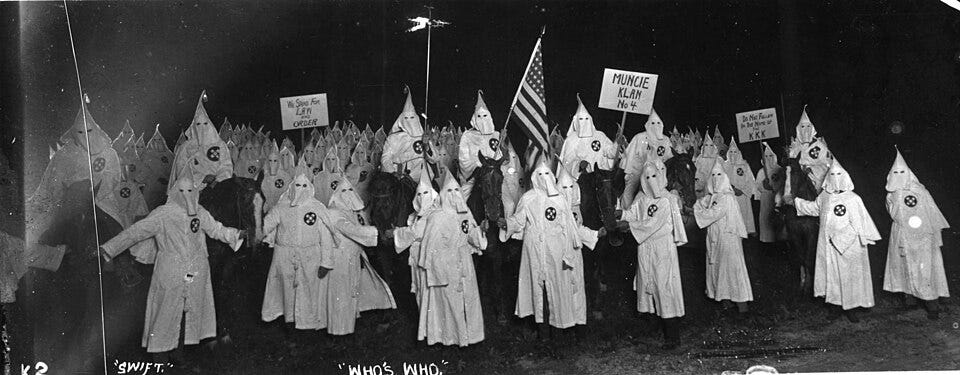
Founded in 1971 by Alabama lawyers Morris Dees and Joe Levin, the SPLC began as a small legal clinic willing to take the cases nobody else in the South would touch. Dees, the son of an Alabama farmer who had seen racial injustice up close, sold a successful publishing business to pursue civil rights law. Early on, the SPLC desegregated recreational facilities, reapportioned the Alabama legislature, and integrated the state troopers. The cases that built its reputation were genuinely landmark. In 1981, the SPLC ended a Klan terror campaign against Vietnamese fishermen in Texas and created its Klanwatch project that same year to monitor organized hate activity nationwide. In 1987, after Klan members lynched 19-year-old Michael Donald on a Mobile street, Dees pursued a civil judgment against the United Klans of America, not just the individual killers, and won $7 million, bankrupting the organization and forcing the sale of its national headquarters. A few years later, after White Aryan Resistance members murdered Ethiopian graduate student Mulugeta Seraw in Portland, Dees won a $12.5 million judgment against the group, again targeting the institution rather than only the perpetrators. These victories established a legal template whereby the SPLC used civil liability to bankrupt hate groups rather than waiting for criminal prosecution. In the process, they drove some of the most dangerous white supremacist organizations in the country out of existence.
But what the SPLC does today is quite different from what built its reputation. The shift, critics say, is from courtroom combat against violent groups to the broader and far more lucrative business of culture war combat. The centerpiece of this shift is the SPLC’s hate map, an annual list of hate groups and anti-government organizations that journalists, tech platforms, corporations, and government agencies have widely treated as an authoritative reference. The problem is, the map has steadily expanded to include not just violent neo-Nazis and Klan chapters but mainstream conservatives and religious groups. The SPLC has smeared people like Charlie Kirk as hateful extremists. The Alliance Defending Freedom, a religious-liberty law firm that has won multiple cases before the Supreme Court, is listed as a hate group for several reasons, one of them being that they oppose men who identify as transgender from competing in women’s sports. I’m no fan of the group, which also opposes same-sex marriage, but it’s repulsive to me to include their rational opposition to trans athletes as a reason why they qualify as a hate group. And that’s fairly illustrative of why people have come to dislike the SPLC in recent years, despite its noble origins, because it is seen as yet another institution like The New York Times, Harvard, or the ACLU, once towering in their greatness, now utterly compromised and a sore to our society, an embarrassing wing of the progressive campaign to subvert America in the direction of left-wing politics, slandering mainstream conservatives and Christians along the way as hateful and extremist, defending leftist terrorist groups like Antifa, applying as its metric of justice the Marxist racial and genital algebra that has become our modern-day phrenology, all while traditional American values and positions on marriage, immigration, and gender get demonized.
Meanwhile, the consequences of being listed as a hate group by the SPLC are not trivial. It can destroy a nonprofit’s ability to raise money through donor-advised funds, damage its relationships with corporations, or even expose its staff to physical danger. But as anyone who has spent 20 seconds on Bluesky knows, lumping principled conservatives in with racial supremacists is not a mistake. It’s the actual point. It creates a chilling effect on conservative opinions and, though guilt by association, nudges public opinion the other way. As Cornell law professor William Jacobson has observed, “Time and again, I see the SPLC using the reputation it gained decades ago fighting the Klan as a tool to bludgeon mainstream politically conservative opponents. For groups that do not threaten violence, the use of SPLC ‘hate group’ or ‘extremist’ designations frequently are exploited as an excuse to silence speech and speakers. It taints not only the group or person, but others who associate with them.”
The SPLC will even target people who oppose extremism and hate, the very thing they themselves claim to do, if that person opposes the wrong kind of extremism and hate. Lately on the left, for example, opposition to Muslim extremism can get an otherwise liberal voter labeled as a far-right bigot. And so, in 2016, the SPLC labeled Maajid Nawaz, a Muslim who runs the counter-extremism think tank Quilliam, an “anti-Muslim extremist.” Yes, they called a Muslim intellectual “anti-Muslim.” They also put him on the same list as the Klan. And only after years of pressure did the SPLC settle a defamation lawsuit with Nawaz for $3.375 million and issue a public apology, an apology they later removed. In 2019, more than two dozen employees sent letters to leadership describing a culture of sexual harassment and racism under founder Morris Dees, who apparently liked to target young women. Dees was fired that March, but the irony was punishing, given that the SPLC had spent decades prosecuting others for precisely the kind of workplace misconduct that was rampant within its own walls.
But if that hypocrisy was a scandal, the current instance could be fatal. Beneath it, however, lies a much larger question. Namely, are they propping up their own opposition in order to have a reason to exist? In other words, is white supremacy such a small problem in America that the leading anti-hate group has to literally fund hate to stay in business? A glance at the data suggests this isn’t true. Indeed, reported hate crime incidents have been running near historic highs. The FBI counted 11,862 cases in 2023 and 11,679 in 2024, the second-highest year on record since data collection began in 1991. Black Americans remain the most targeted racial group, Jewish Americans the most targeted religious group, and every election cycle tends to produce an uptick. But here’s the thing, what counts as a “hate crime incident” can be quite broad, and getting broader all the time. So this might actually be a picture of increasing sensitivity rather than of increasing hatred in our society.
And yes, when we check a more relevant metric — lethal extremist violence — it tells a different story. According to the Anti-Defamation League’s annual tracking, extremist killings fell from 35 in 2021 to 28 in 2022, 20 in 2023, and 13 in 2024. But 13 to 20 deaths per year across the entire country, while individually tragic, represents a vanishingly small fraction of America’s roughly 20,000 annual homicides. So yeah, maybe an organization like the SPLC, with nearly $800 million in assets and $170 million in annual revenue, sustained by donor appeals warning of an imminent white supremacist dystopia, has an obvious structural incentive to keep the threat looking existential even as the body count from organized hate violence is collapsing. And apparently, that’s exactly what they did.
When I profiled the Nazi hunter and Iraq combat veteran Kris Goldsmith for The Free Press, one of the things I wanted to do in that piece was paint a picture of white supremacy in America. I wanted to illustrate how dire the problem had become, and why we needed people like Kris to address the problem. It’s a sensible way to approach a story like that. The only problem was, America doesn’t really have a white supremacy problem. Ours is not a white supremacist nation and only very stupid people, the untraveled, or cultural Marxists think otherwise. Indeed, ours is arguably the least racist nation that exists or has ever existed. Organizations like the SPLC, that not only feed on the notion that we are deeply racist people, but are willing to sell us that lie at our own expense, are not on the side of the good. In the end, I made my profile about Kris and the good work he was doing, his honorable reasons for doing it, and the difference he was making in individual lives.
To be fair to the SPLC, they did something irreplaceable in the 1980s and 1990s. They found a new way to dismantle white supremacists groups and genuinely made America a safer place for minorities. But somewhere along the way, it seems this scrappy legal practice became a massive fundraising enterprise that needs the threat of hatred to feel vivid in order to remain solvent. Even if we dismiss the current scandal, that doesn’t erase all the years the SPLC spent hounding conservative voices, or the egregious mission creep from fighting extremists to fighting right-wingers and just calling them extremists. Or, for that matter, the way that they have contributed to a culture in which we now simply call our political enemies Nazis rather than attempt to engage them. So yes, they did lots of good work, but they also spent decades contributing to the moral poverty of our culture.
The "they" who administered the SPLC in the 1980s and the 1990s are entirely different people than the "they" of today.
That's how this game is played. When something builds a good reputation, a certain sort co-opts it and demands eternal undeserved respect based on the reputation that the new leaders never earned.
Is this then the nature of all liberal doctrine? Any success of your program will define its end. And if you don't want it to end, you need to refine the issue or redefine the issue. It's like someone who continues to get nose jobs until there is nothing left on their face.