

“Christmas market in Brussels turns into an Islamic hell,” Dutch politician Geert Wilders recently said on social media, sharing a video of Palestinian protesters storming through the local Christmas market, screaming pro-Hamas slogans in Arabic, beating drums, waving torches, throwing smoke bombs, and intimidating families amid an otherwise tranquil evening. Palestinians have the right to protest under Article 26 of the Belgian Constitution, but disrupting a public event like this is not included in that right. As I wrote in response to someone else posting the video:
What narcissists. No one can celebrate anything, even in their home country, without this lot making it about themselves. The Dublin Regulation, which says asylums must stay in the first EU country they reach, is dead. But also, Belgians very much brought this on themselves.
Moreover, beneath Wilders’ inflammatory rhetoric lies a genuine question Western nations have yet to answer honestly: What happens when, out of suicidal empathy, you welcome populations shaped by generations of violence and racist hatred?
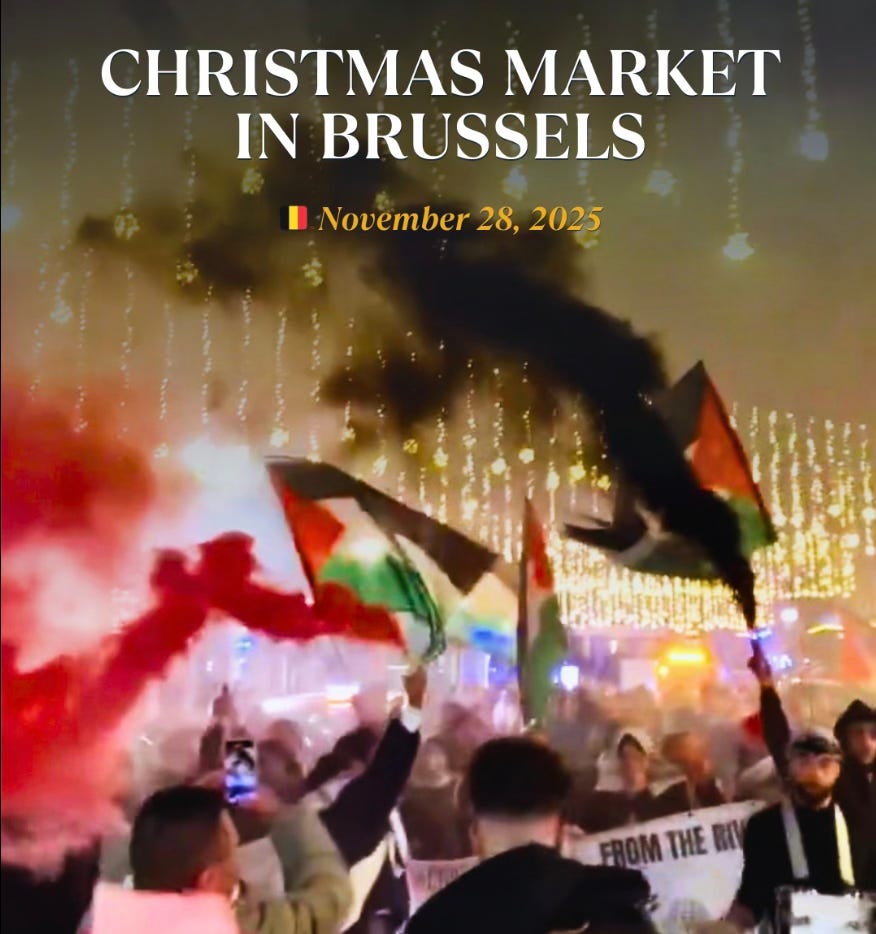
Predictably, when The Brussels Times reported the story, they framed it as “far-right politician targets Gaza protest,” rather than Hamas supporters target peaceful Christmas market, and made a point of adding that Wilders is “well-known for racist rhetoric,” without saying what Palestinians, or even Hamas, are well-known for doing. And then they ended the article there. They did not include that Wilders has said, “I don’t hate Muslims. I hate Islam.” Nor did they make any mention of the fact that in 2016, an Islamist extremist drove his truck into a Christmas market in Berlin, killing 12 and injuring dozens. Or that in 2018, an Islamist extremist opened fire and stabbed people at the Christmas market in Strasbourg. Or that last year, an ex-Muslim from Saudi Arabia killed six people and injured 323 others when he drove his SUV into a crowd at the Christmas market in Magdeburg.
Nor, if we look only at Belgium, did the paper mention anything about the 2016 Brussels airport and subway bombings, which left 32 dead and over 300 injured. Or the 2016 Charleroi attack, in which a man stabbed two police officers and screamed “Allahu Akbar” before being shot dead. Or the 2016 Brussels attack, in which a man stabbed two officers, in the throat and in the stomach. The Guardian described the attacker—a Senegalese man with alleged ties to jihadists in Syria, who ran for election in Belgium with an Islamist party, and whose brother is also a terrorist—as “a 43-year-old Belgian man.” Nor did the paper mention the 2017 Brussels knife attack on two soldiers by an Islamist terrorist. Nor the 2023 attack in Brussels in which an Islamist terrorist opened fire on Swedish football fans, killing two. No, all you need to know, apparently, is that the person who shared the video is known as a racist.
Ironic, given Belgian public opinion regarding the war in Gaza. Multiple surveys conducted in 2024 and 2025 show widespread criticism of Israeli military policy and strong support for Palestinian human rights. An International Solidarity Barometer survey found over 70% of Belgians supported an immediate ceasefire, while a majority favored stronger EU actions to end what they consider Israel’s illegal occupation. Additionally, recent data from the Asylum Information Database (AIDA) and the European Council on Refugees and Exiles (ECRE) highlights a major development in Belgium’s 2024 asylum landscape: Palestinians became the largest single nationality in terms of asylum applications and accepted refugees. Belgians want to be the good guys who open their arms to refugees, and this is a noble thing. Truly. But they clearly haven’t done their homework. This isn’t going to end well, and Europe as a whole seems determined to learn this simple lesson in the hardest and most painful way possible. Let’s consider the historical record.
The ugly truth of Palestinian violence

Over the weekend, I found myself debating the Israeli-Palestinian conflict with an award-winning war correspondent who has been covering the issue for almost 40 years. Although I’m not going to divulge the person’s name or their comments, what follows are my own remarks.
Jordan, poor thing, made the mistake of imagining it could play host to a revolutionary movement without eventually becoming its hostage. After 1948, and again after 1967, Jordan absorbed hundreds of thousands of Palestinian refugees. King Hussein, like a well-meaning and good-hearted Belgian, opened his borders to fellow Arabs in crisis, a decision rooted in both humanitarian impulse and pan-Arab solidarity. But within two decades, the relationship had fractured catastrophically. By the late 1960s, the PLO had metastasized inside Jordan’s refugee camps like a tumor. Its factions ran checkpoints, taxed commerce, and behaved as if Amman were merely a suburb of their future state, with Hussein reduced to some hapless landlord too polite to evict these parasites. Hijackings, extortion, and street battles escalated. Palestinians roved the city, slaughtering innocents, including children. In September 1970, as the massacring continued and Palestinians even tried to overthrow the government outright, Hussein finally stepped in. In what came to be known as Black September, the Jordanian Army smashed the insurgency and the PLO’s roving terrorist bands were expelled to Lebanon.
Lebanon’s tragedy followed the same script but with more sects, more guns, and far less state capacity. Palestinian refugees had lived there since 1948, but after their expulsion from Jordan, the PLO arrived as a ready-made parallel government, complete with its own army and foreign policy goals. Namely, the eradication of Israel and murder of all Jews worldwide. From the early 1970s on, Palestinian terrorists used southern Lebanon as artillery range against Israel, effectively inviting retaliation that the Lebanese state was too weak to prevent or deter. The PLO entrenched itself in West Beirut and in the camps, behaving less like guests and more like colonial administrators of a collapsing state. Their militias—with their kidnappings, shellings, and massacres—became a major catalyst for what would become the Lebanese Civil War. By 1982, Israel’s invasion forced the PLO to evacuate to Tunis, but Lebanon was already broken and burning. The war would rage on for 15 years.
The Case for Colonizing Gaza

The problem in Palestinian society is not Hamas. It is not the establishment of the State of Israel or any of the conflicts that have been waged as a result. The problem in Palestinian society is not a consequence of the conditions under which Gazans live, which are not remotely as bad as you may think on
Kuwait’s experience is the simplest and most brutal illustration of what happens when hospitality meets political romanticism. For decades, Palestinians had enjoyed privileged positions in Kuwait—professional jobs, good salaries, broad public trust—until Saddam Hussein invaded the country in 1990, visiting unspeakable evil upon the locals, and yet the traitorous Palestinians, led by Yasser Arafat, publicly backed the invader against the people who had been so kind as to give Palestinians a home. When Kuwait was liberated in 1991, the reaction was predictable. The emirate expelled the vast majority of its Palestinian residents. You supported the monster who slaughtered our people, was the logic, so you have no future here.
In Iraq under Saddam Hussein, Palestinians were treated as honored political mascots, propaganda pieces for the Ba’ath Party’s pan-Arab dreams. They received subsidized housing, salaries, and a protected status denied to many actual Iraqis. They were first-class citizens while the native-born of the land were treated as lesser. This built a reservoir of resentment among ordinary Iraqis who saw Palestinians as pampered outsiders. When the U.S. toppled Saddam in 2003 and the Iraqi state collapsed into sectarian score-settling, Palestinians paid for decades of Ba’athist special treatment. Militia groups, mostly Shi’a, targeted Palestinian neighborhoods with kidnappings, torture, and killings for collaborating with the murderous old regime. Thousands fled to the Syrian and Jordanian borders, where they languished in desert camps because by then, almost no Arab state wanted them.
The Problem of Palestinian Culture

Gaza is the world’s largest open-air prison, where people are crowded in smothering slums and the economy is so crippled by blockade and bombardment that inhabitants live like dogs, where life is brutish and short and what few years people can steal are stamped by the trauma of a genocidal and illegal occupation, where everyone is forced to endure such …
Now turn the page to Egypt. Cairo has spent decades proclaiming eternal solidarity with Palestine while simultaneously enforcing one of the harshest border regimes in the region. And why is it that they want no Palestinians anywhere near them? Because they know the Palestinians better than anyone. After 1948, Gaza came under Egyptian military administration. But Egypt pointedly refused to grant its Palestinian inhabitants citizenship, rights, or meaningful integration. The Palestinians remained a convenient political symbol, sure, but never a population to absorb. After Israel withdrew from Gaza in 2005, and Hamas seized control in 2007, Egypt hardened further. Cairo viewed Hamas, rightly, as an offshoot of the Muslim Brotherhood, its own domestic existential enemy. The Rafah border opened and closed according to Egyptian security priorities, not humanitarian appeals. Egypt’s treatment of Palestinians has nothing to do with compassion or cruelty. It is simply the reflex of a sovereign state that refuses to inject ideological poison into its political bloodstream.
The Gulf states perfected a uniquely antiseptic model of Palestinian management. Allow them in as workers—engineers, teachers, accountants—pay them well, and make absolutely certain none of them become citizens or political actors. In Saudi Arabia, Qatar, the UAE, and Bahrain, Palestinians have enjoyed relative prosperity but zero permanence. They are a people without a home, and for this they blame Israel, but it is largely by their own hand, specifically their pathological violence. The Kuwaiti expulsion of 1991—triggered by the PLO’s suicidal support for Saddam’s invasion—became the Gulf’s cautionary tale. Jordan nearly died learning this lesson. Lebanon took the lesson even harder, and paid with 15 years of civil war. The Gulf states looked at Jordan and Lebanon and drew the simplest possible conclusion: Absolutely not.
The Nazi Roots of Palestinianism

David Volodzko talks with Alexander von Sternberg about Amin al-Husseini, the Nazi godfather of Palestinian nationalism, his early life, his embrace of Nazism, his efforts to send Jewish children to death camps, his legacy since then, and his place in the Palestinian movement today.
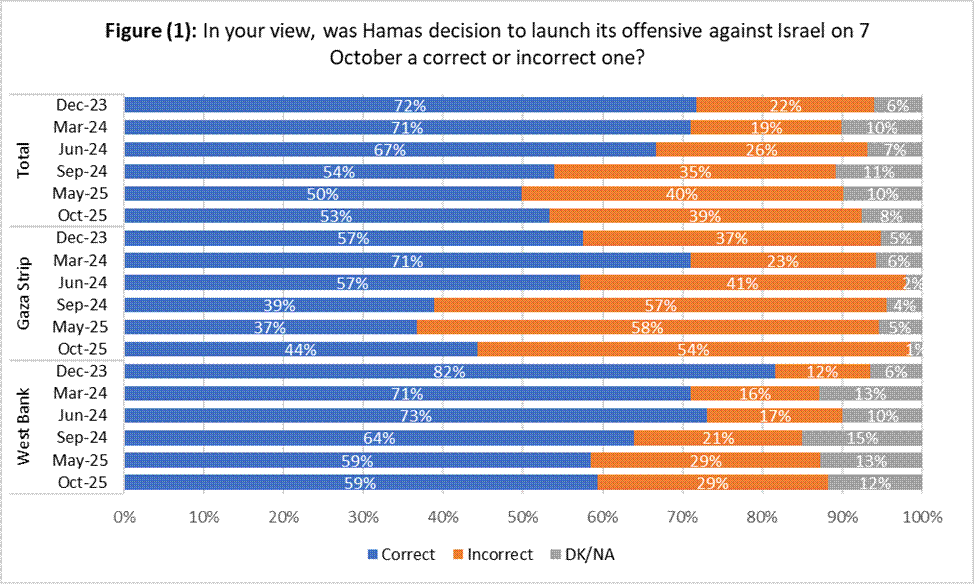
Things are no better among Palestinians today. Recent polling by the Palestinian Center for Policy and Survey Research (PSR) paints a profoundly dark, and tragic, picture of public opinion. In the months after the October 7 attack on Israel, early polls showed overwhelming support for the assault. By mid-2024, attitudes began to shift, especially in Gaza, while in the West Bank a majority continued to call the racist slaughter “correct.” According to the most recent PSR survey, conducted in late October, about 53% of Palestinians overall still consider the attack justified.
Meanwhile, international reviews of textbooks used by the Palestinian Authority (PA) have repeatedly identified deeply antisemitic content and the glorification of violence. According to watchdog analyses by IMPACT-se, antisemitic material remains pervasive across school grades — and new “abridged curricula” in Gaza replicate previous problems rather than reform them. In other words, they continue to brainwash their children with their particular brand of hyper-violent racist hatred, and no degree of military defeat seems capable of pushing them off this path.
None of these issues are served by sweeping generalizations or stigmatization of all Palestinians. I myself have Palestinian friends. Individuals must be judged individually. Nevertheless, European nations welcoming them in with open arms are now reaping the predictable consequences, then doing mental gymnastics to convince themselves these things are not related, and that anyone saying otherwise is a bigot.
Europe cannot continue to ignore the lessons of Jordan, Lebanon, Kuwait, Israel, and half a dozen other countries while expecting different results. Its people need an honest reckoning rather than wishful thinking. And the alternative is clear: continued attacks, growing far-right movements, collapsing social trust, and perhaps ultimately violence at a much larger scale than Europe has seen thus far. Belgium and its neighbors can do better than both naive welcoming and xenophobic rejection. But only if they’re willing to learn from history and invest seriously in solutions that protect both refugee rights and public safety. So far, I don’t see that happening.
Again, the Palestinian protesters at the Christmas market had every right to demonstrate for Gaza. But they had no right to disrupt a public gathering or intimidate families. The Belgian families that were frightened and fled, as well as any Palestinians seeking a better life in Europe, both deserve better than political leaders who pretend difficult questions don’t exist. And Belgians have every right to welcome refugees while also demanding integration, security, and that people seeking to destroy their culture be eliminated from it. Those are not contradictory impulses, but necessary complements.
Why is Geert Wilders description "inflammatory"? Isn't this term in itself inflammatory and nefarious if Wilders is describing reality?
Muslims keep beating us over the head with their raw, medieval emotions, their demanded honour, their believed unique right not to be offended, their perceived right to act violently because whatever criticism of them was voiced- or even just a description of their actions- is " inflammatory". We, the condemned non-believers are at fault , for observing, thinking ,speaking , describing, and they have the right to be " inflamed". This is tyranny, a foretaste of the totalitarianism that begins with thought control .Their abusive self-victimisation and manufactured " Islamophobia " false accusations must end. Or we must tell them we don't care, we don't appreciate lawlessness, and they should be jailed.
I’m pessimistic, but an Islamist takeover is likely to happen to some west European country. My guess would be the Netherlands or Belgium.