

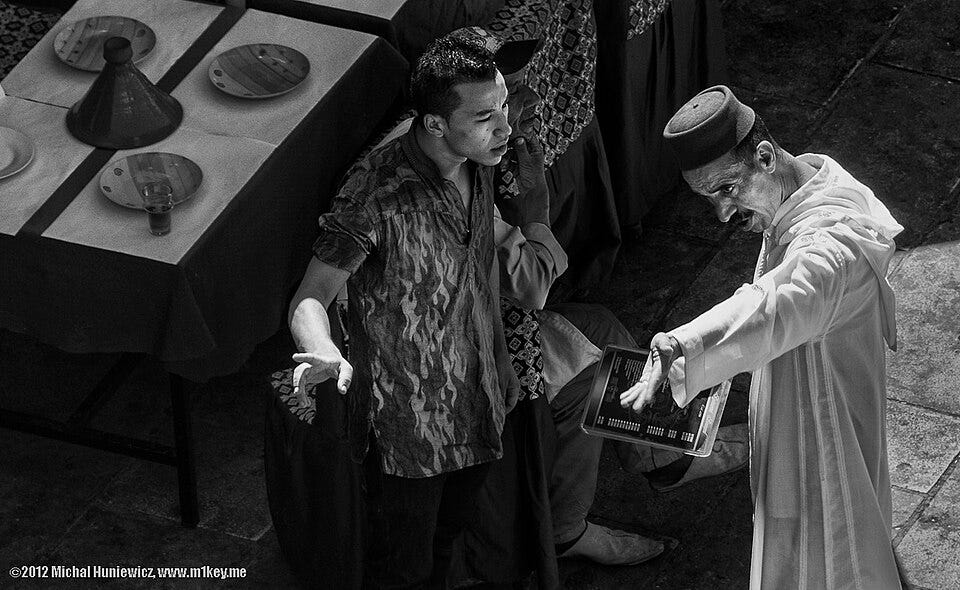
Michal Huniewicz says in Fez, Morocco, where he took the photograph above, he met a young man named Rachid and had the following exchange:
Michal: What do you do, do you have a job?
Rachid: No, I don’t have a job. I have education but no job.
Michal: Why not?
Rachid: It’s the government, they don’t do anything.
Michal: What is the ruling party?
Rachid: The Islamic party.
Michal: Who did you vote for?
Rachid: The Islamic party.
Michal: What other parties are there?
Rachid: I don’t know.
The Obituary
My favorite story about the philosopher Jürgen Habermas is the time he got punched in the face for not knowing about the Beatles. It was 1970, and after breaking out only six years before, the Fab Four had made it big in the States, shifted from surface pop to reflective rock, dropped what many still consider the greatest album of all time, and were already in their White Album late period. There wasn’t a man, woman, or child left in the Western world who didn’t know the names of John, Paul, George, and Ringo. Except, of course, Habermas. It was absurd because the Beatles were the greatest force in mass culture and Habermas was the greatest philosopher of mass culture. The man had written half a million words on the public sphere yet somehow managed to miss the biggest thing in it.
The guy who punched him was Peter Handke, an avant-garde writer who won acclaim for Offending the Audience, an “anti-play” so experimental it ate its own tail, forgot to be about anything, and ended up being about the fact that it’s a play. A little later, Handke lost all that acclaim when he expressed public support for Slobodan Milošević, and even spoke at the genocidal dictator’s funeral in 2006. The Nobel Committee, to its credit, waited a full 13 years before awarding Handke the Prize in Literature. It became the most controversial decision they ever made. Not even Elfriede Jelinek, with all her unreadable poetry, comes close. Salman Rushdie said at the time Handke was “complicit with evil on a grand scale” (and Rushdie taught at Cambridge). But when I think of Handke, I think of a pretentious cheerleader for genocide who clocked someone because he didn’t have the “correct” opinion, and damn if that doesn’t feel like a glimpse of the coming world.
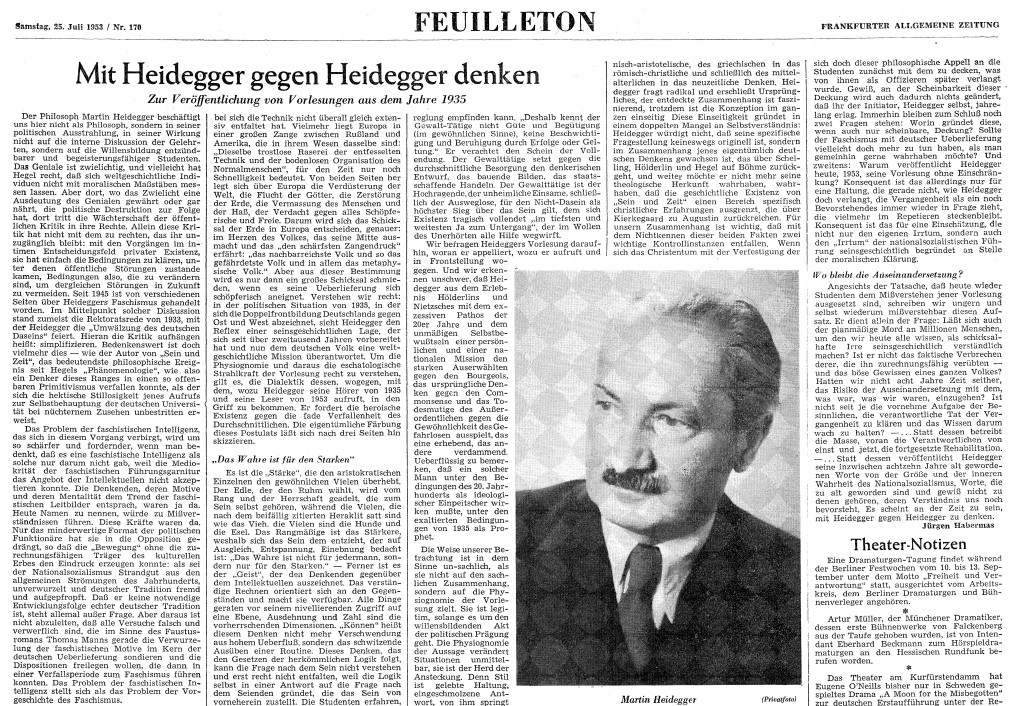
Germany today, and much of Europe for that matter, has become the world of Handke when it should have become the world of Habermas. Habermas wasn’t the kind of person who would pretend to read a book he hadn’t read in order to sound smart. Or know the most famous band in the world. Habermas did not virtue-signal. My other favorite story about him is that, as a journalist in 1953, Habermas wrote a savage attack to the editors of the right-wing daily Frankfurter Allgemeine Zeitung, expressing outrage at their decision to publish philosopher Martin Heidegger’s 1935 lectures Introduction to Metaphysics, in which Heidegger talked about the “inner truth and greatness” of Nazism. I disagree with Habermas on wanting the lectures unpublished, but he deserves credit for standing by his principles and going against Heidegger, who was still at the time greatly revered in German academia.
Radical America and the False Messiah

In the first few minutes of Judas and the Black Messiah, Martin Sheen delivers a speech as J. Edgar Hoover in which he warns about a coming “black messiah.”
Habermas also wins my respect for defending a complete separation between Heidegger’s philosophy and his politics, meaning he was good faith enough to recognize that even his moral enemies, men he regarded as evil, might be worth listening to when it came to certain topics. That kind of epistemic charity is fundamental to being a serious intellectual, but it’s also a damn rare thing. In fact, Habermas himself felt this only applied when someone was, by his own estimation, correct. When they were wrong, as Heidegger was about politics, he believed their views on such matters could safely be censored. So despite his good-faith analysis, he was basically mad that Frankfurter Allgemeine had platformed a Nazi. Still, the principle Habermas was working from was a good one, namely that philosophy has to confront moral responsibility, not just abstract thought, and that it matters who you are, not just what you say — and not what you say you are either.
This is a radical proposition de hominem that says we should take people as they truly are, if not demand it, just as one insists upon the laws of chess as a prerequisite for any game. His devotion to authentic expression is why he had no energy for pretending to care what other people think is cool, whether it was a trending band, a trending ideology, or a trending identity. Nor did he have any energy for the illiberal left with all its endless purity testing and virtue-signaling. In fact, Habermas was early to identify the authoritarian streak in campus activism, especially their moral absolutism and intolerance toward dissent. He alienated student protesters by calling out their Linksfaschismus, or “left-fascism,” most famously during a debate he had with the communist writer and student activist Rudi Dutschke, who said they were living in the ideal time for students to engage in “direct action.”
But Habermas cautioned Dutschke to consider the consequences and pressed Dutschke to clarify whether he supported the use of violence. When Dutschke refused, Habermas accused him of Linksfaschismus. But consider, how often do we see leftist professors today condemn radical student activists for failing to stand against political violence? How often, on the contrary, do we see leftist professors call for political violence themselves, as we saw in the wake of October 7 or the killing of Charlie Kirk? Habermas single-handedly tilted German intellectualism in the direction of open discourse, and one has to wonder how much worse things would be there today if not for his legacy.
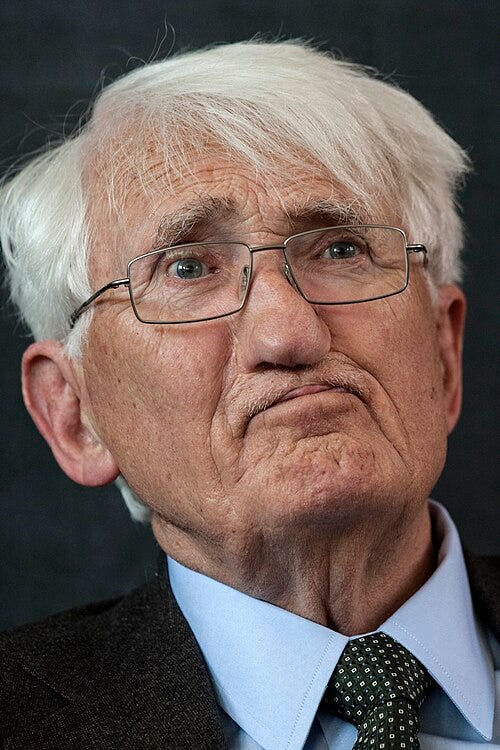
Last month, on March 14, Habermas died in southern Germany at the age of 96. The 2011 winter edition of The Stanford Encyclopedia of Philosophy described Habermas “as one of the most influential philosophers in the world.” And he was. The past century has given us some incredible voices in philosophy. People like John Rawls on justice, Michel Foucault on power, and Ludwig Wittgenstein on language. Surely, we must add to the list Habermas on communication. Here was, it seemed, the last man in Europe who still believed we can talk things out. Here too was one of the last intellectuals from an era in European history when speaking more freely was still possible. And so, in a way, he was perhaps also Europe’s last public intellectual.
Working through the past
Remember the CBS 60 Minutes segment about Germany’s online speech police, the one from February 2025, in which three German prosecutors practically bragged about door-smashing raids over internet trolling? One of the prosecutors matter-of-factly said even reposting fake quotes is now a crime in Germany. The segment went viral, I think, largely thanks to the comical look of disbelief on correspondent Sharyn Alfonsi’s face and the way it contrasted with the smiles these three creepy Germans, totally oblivious to how slimy they come off, especially to an American audience, or how off-putting it was to see Germans gloat about being the internet Nazis.
But it wasn’t off-putting for the simple and obvious reason, which is that the same country that gave us literal Nazis is now giving us digital ones. Rather, it was the irony that they ended up in this farcical position precisely because they are bending over backwards trying not to be Nazis, passing laws to prevent hate speech in the mistaken belief that if they censor name-calling and online bullying that they can prevent another Holocaust. But this is a dangerous misunderstanding of censorship. And of Nazism. How have Germans forgotten the Weimar fallacy? That’s the false belief that the Nazis rose to power because people were too tolerant of extremist speech, as if censorship could have stopped Nazi rule when in fact the Weimar Republic censored speech, banned newspapers, and prosecuted Nazis. But not only did this tactic fail, it blew up in their faces, making the Nazis look like underdogs that the regime didn’t want you to know about, which only gave them propaganda power.
Another reason it’s so unfortunate to see Germans behaving this way is not because of their dark history, but rather because of their noble history as free speech defenders. Just consider the journalist and pacifist Carl von Ossietzky, who exposed illegal German rearmament, was prosecuted, imprisoned, and later received the Nobel Peace Prize for his “defense of freedom of speech.” Or the White Rose group, whose members literally risked death to distribute anti-Nazi leaflets in Munich. Or the 1949 Basic Law, Article 5, which says every person has the right to freely express their opinions and adds, “There shall be no censorship.”
Or the famous Spiegel affair of 1962, when Der Spiegel published a story about the nation’s defense forces and several Spiegel staffers were detained on charges of treason. In the end, they were released without trial and Franz Josef Strauss, the federal minister of defense, lost his job. It was post-war West German democracy’s first test of press freedom, and they passed. Or the scandal involving Kommune 1. Or, at long last, the great Habermas himself, philosopher of communication and champion of public debate.
But again, Germany today is not the Germany of Habermas. It is the Germany of Handke. The country’s longstanding laws against “insult” (Beleidigung) are in stark contrast to the freedoms we enjoy in the United States, and have resulted in a litany of scandalous news reports, including a police investigation for saying a politician looks like Pinocchio, a pre-dawn raid for calling a politician a “dick,” a home search for calling a politician an “idiot,” a total of 45 home raids in a single month for sexist comments online, and a seven-month suspended sentence for a journalist posting a cartoon of a politician. I have interviewed CJ Hopkins about his experiences with this censorship regime, and in a recent edition of the FIREwire, a weekly digest in which I summarize news and events related to free speech, we included this item:
Germany probes historian for criticizing … Hitler
German writer Rainer Zitelmann is under criminal investigation in Berlin after retweeting a Ukrainian post comparing Vladimir Putin to Adolf Hitler.
But it wasn’t the Putin attack that got him into trouble — it was the fact that the post included a swastika, even though he used it as an insult, because it potentially violates Section 86a of Germany’s criminal code, which bans Nazi symbols.
Germans have a word — Vergangenheitsbewältigung — for coming to terms with their Nazi history. It means “working through the past.” But the irony is that they “work through the past” by avoiding and silencing commentary on the topic. So they’re not actually working through much at all. And, in trying to avoid repeating the same sins, Germany has struck a Faustian bargain, hoping to achieve something noble (the end of racism, apparently), but ultimately doing terrible things along the way. Maybe this is the result of a totalizing tendency in German culture, a desire for specificity that lends itself to building comprehensive systems, which is why the Germans and the Japanese both excel at the precision manufacturing of cutlery and camera lenses, but also why they both have histories of totalitarianism. And you see this totalizing streak in German philosophy too. Kant, Hegel, Marx, Nietzsche, even Habermas in his way, all sought to capture the entire universe in the folds of their thinking. British philosophers, by contrast, like Wittgenstein or Russell, tend to be suspicious of grand towers of abstraction. And this tendency produces a wrinkle in the culture, in that Germans think big but act small.
Hegel believed history itself is rational and moving toward perfection, or what he called Gesamtstaat, a perfected whole society. Marx thought we could aim for perfection too. That’s the German tendency to think big. But to get there, Germans like to meticulously nitpick people into line rather than pull back and let bygones be bygones. That’s the tendency to act small. The Nazis used to call this Gleichschaltung, or “coordination,” which meant bringing everything into alignment with the regime’s ideology. Every institution, organization, and aspect of life had to be “coordinated” into the totalizing system. And this fundamental impulse survives today in the form of the German state micromanaging the shit out of people.
And so you have this tension between the rebel and the hall monitor, between the Nietzschean spirit of radical individualism and the Hegelian desire to police one’s way to Valhalla. Two souls, alas, reside in Germany’s breast. But I think Habermas came closest to reconciling these two, because it’s really only in the public sphere of debate where one finds reward for both the boldness of the Self and the precision of the State, where both the Übermensch and the pedant get to shoot their shot.
Between facts and norms
In the end, the old professor’s real gift, if you ask me, wasn’t his defense of open argument. It was his faith in mankind. Habermas came out of the Frankfurt School, that postwar German tradition of cultural Marxists who saw that the global communist revolution wasn’t coming, so they blamed culture for pacifying the people and sought to subvert it. But Habermas rejected the pessimism of his mentors, Theodor Adorno and Max Horkheimer, who believed modern mass society was bleakly, perhaps permanently, defeated by capitalist manipulation. As Herbert Marcuse would later write, people had become one-dimensional men who could only think in consumerist terms. Habermas agreed, but he believed free and equal persons might still talk their way to a more legitimate social order. And that’s where he has my attention, even if he is a Marxist.
In 1962, Habermas shook the academic world with his book The Structural Transformation of the Public Sphere, which made the term “public sphere” academic lingua franca. His argument was simple. In early modern Europe, a new kind of space had emerged with salons and coffeehouses, where private individuals of all classes came together where they shared stories, told jokes, and hashed out matters of common concern. Habermas believed this “public sphere” carried a democratizing promise. He also believed this promise had already rotted under the pressures of mass media and money. That’s where he and Marcuse were on the same page. But whereas Marcuse, much like Vladimir Lenin, had no faith in the people’s ability to choose what was best for themselves and so wanted to manipulate and subvert the culture, Habermas instead wanted to openly and transparently debate his way to a better society. So he was a utopian thinker but there, again, you also see his faith in humanity. He argued that speech matters because, in the end, reason is our only way out — and because democracy requires public justification. Free speech, in other words, is not just the right to say what you think. It’s the right to participate in forming what the public thinks.
In his 1981 work The Theory of Communicative Action, Habermas argued that there are two ways to use speech. One is to get what you want, or strategic action. The other is to reach mutual understanding with another person, or communicative action. The whole point of free speech, for Habermas, was to protect the second kind because that kind of mutual understanding was how you obtained the consent of the governed. In his 1992 book Between Facts and Norms, he argued that even societal norms only hold legitimacy if the people they affect can agree to them through open argument. In his view, communicative action was the very engine of democracy.
It’s true that he saw little value in speech that did not further a political goal. I disagree with him there. It’s also true that he parted with the American understanding of freedom of expression because he looked at speech through a Marxist lens and saw anything oppressive as illegitimate. I definitely disagree with him there. But in general, he believed that democracy thrives in the space between two present and fully engaged people, debating in good faith. And I think that’s a beautiful way to look at it. I also think what drew me to his work was always his humanity rather than his logic. He had a radical faith in the people and in what we can accomplish if we just sit together and connect. In the end, perhaps the real tragedy is that he had more faith in us than we seem to have in ourselves.
I suppose it is fitting that you called him Europe's last public intellectual, because he belongs to that Enlightenment tradition called critical theory steeped in Hegelian dialectics, whose "fumisterie" as we would say in French can be seen in the idiotic ramblings that come out of the mouths of today's elites, especially European, who are busy digging the Enlightenment's grave. All of German sociology was divided between Habermas and Luhmann. The former was always making public pronouncements, offering the left-wing ideologues he sometimes chided the pablum with which they justified their onslaught on what was finest in western civilization: notions like capitalism had become the colonization of everyday life, which Foucault, another talented littérateur, translated into his specious claim that power was the driving force of modern life, turning every instance of liberation into another form of domination. Which would explain how homosexuals today, and certainly those who claim to be their spokesmen, come to align themselves with regimes like Iran's who hang gays form construction cranes. Why not, if gay liberation was fake and the important thing is to ferret out and then glorify every manifestation of victimhood redesigned as potential resistance to power? Luhmann, on the other hand, was a modest but brilliant sociologist who had no tolerance for dialectics, but instead put difference at the heart of his epistemology and built upon Parsons' insights into modern society to show us the paradoxes that lie at the heart of modernity and pose challenges to its reproduction. Luhmann did not sign petitions, nor claim to know what power should be doing, but he did show us how modernity worked and the dilemmas it brought to the forefront which confronted governments, corporations, lovers, lawyers, etc. Luhmann's sociology was truly revolutionary in that for the first time it sought to make the enterprise a scientific discipline, rooted in observation and the dilemmas of observing, including the dictum that we come to know that we cannot see what we cannot see. Unlike Hegel and the tradition Hegel inspired, he never claimed to know the end of history nor posit emancipation or decolonization as the purpose of sociological inquiry. Fittingly, those who crossed over from Habermas to Luhmann never crossed back. But even many of Luhmann's students found it difficult to jettison the normative bent bequeathed by Habermas and his critical theory tradition. Today we are experiencing the bitter fruits of this tradition as we watch all that we cherish, and which probably Habermas himself cherished, go down the tubes.
A superb obituary of Habermas and one that certainly makes me reconsider him. Thank you.