

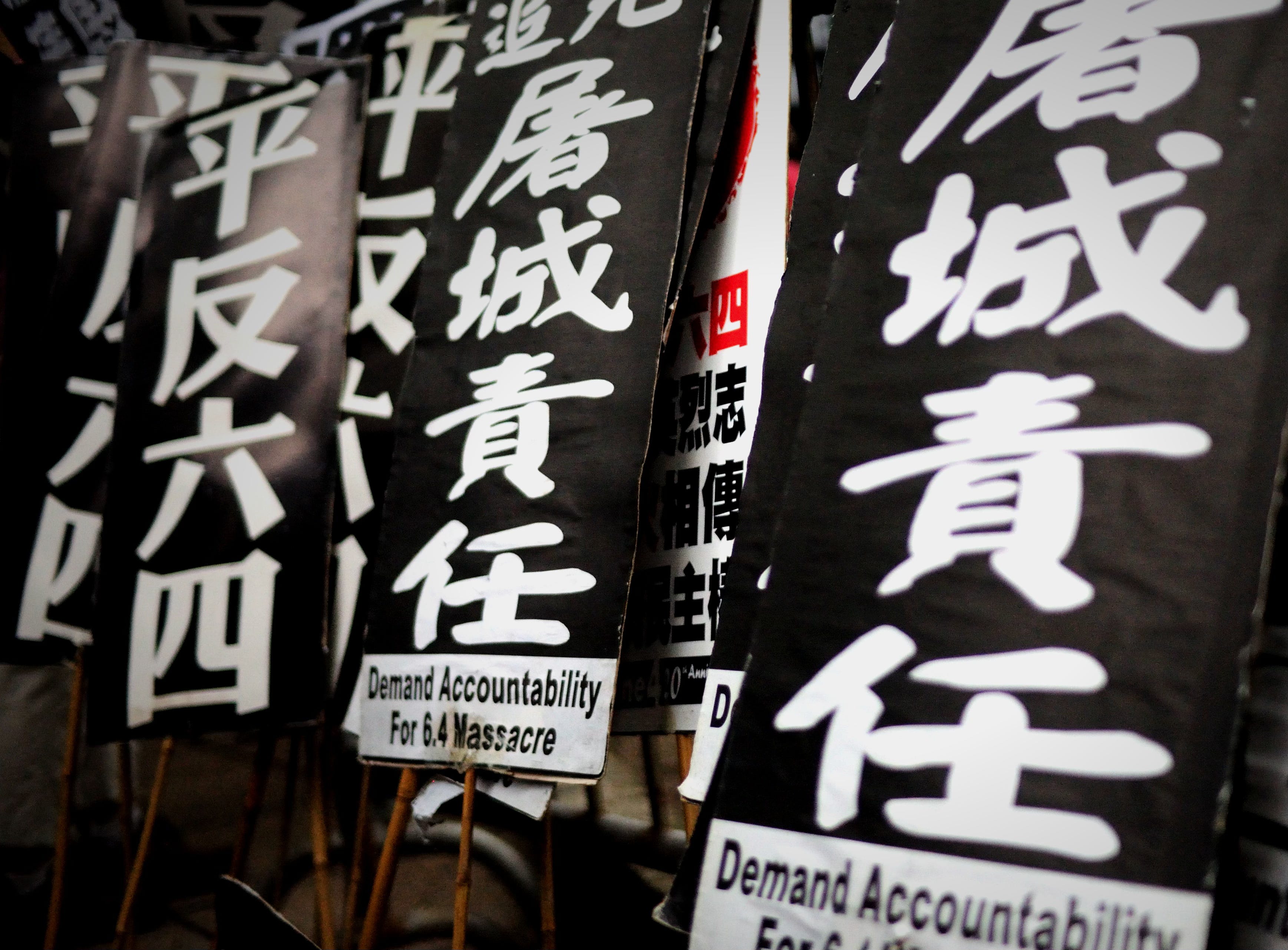
This week, the Chinese Communist Party convicted two people for the crime of remembering that 37 years ago, it slaughtered hundreds of innocents simply for saying out loud that they longed to be free.
Beijing has carried out many evils under communist rule. It killed more people under Mao than any dictator in human history, starved tens of millions, murdered those who spoke against it, harvested organs from minorities, forced abortions at gunpoint, threw religious minorities into concentration camps, and enslaved over 50 million people in the laogai system. And yet, the decision this week might actually be one of the most insidiously evil things the Party has ever done.
In the context of Holocaust education, we are constantly reminded of the philosopher George Santayana’s quote, from his 1905 book The Life of Reason, “Those who cannot remember the past are condemned to repeat it.” We are taught these famous words as an ominous warning. But for Beijing, they express the promise of success.
Grandma Wong
Every year on the 4th, Alexandra Wong packs an umbrella, but not for rain. For years on this day, she has walked, alone, toward the green expanse of Victoria Park where, for decades now, tens of thousands of her friends and neighbors gather by candlelight, often in the calm after a battering storm, to remember the students who stood up for freedom and were gunned down in Beijing in 1989. Now 70 years old, Wong has been taking part in democracy protests for at least 14 years. She was a regular fixture during the Umbrella Movement in 2014, where people affectionately took to calling her “Grandma Wong.”
As a young woman, Wong had studied accounting and music. Growing up, she wasn’t particularly interested in politics, but she did feel patriotic for mainland China. Both her parents were mainlanders, but had fled to Hong Kong when Japan invaded China during World War II. When she turned 30, she moved to Vienna, where she studied singing. But shortly after her return to Hong Kong, she saw the news. Military forces in Beijing had opened fire on students for demanding democracy. Reports varied, but some said over 1,000 innocent people were killed. “I felt really sad when I saw the bloody scenes on television,” she later told CNN. But she was also inspired. “The bloodiness and chaos stuck with me, so did the protesters’ reluctance to leave.”
She spent a decade of her life in Austria, Hawaii, volunteering for a nonprofit in mainland China. “Gradually, I started to compare these places with Hong Kong: Why in some places people live so happily, and places like the countryside on the mainland are so miserable?” In 2006, she bought a home on the mainland, a 312-square-foot flat in Shenzhen that she could never have afforded had it been in Hong Kong. It was a steal at twice the price. But something was off. “The longer I lived in Shenzhen,” she said, “the more I felt something was not right with the mainland.” She moved back to Hong Kong, where she began to speak out about her beliefs. “I want to tell the middle-aged and old people to come out, stand with the young people together,” she said. “I must take care of the young people.”
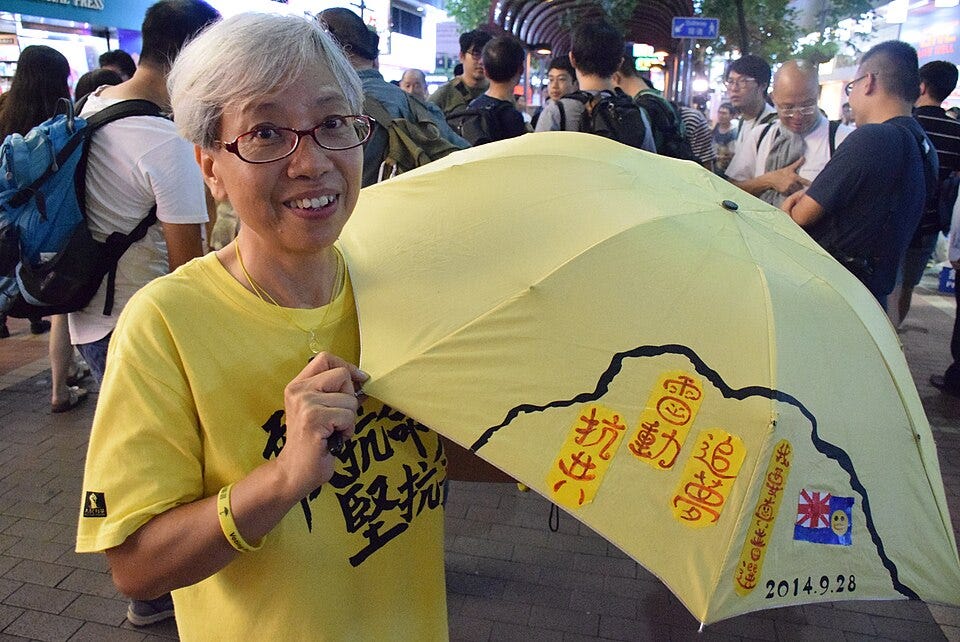
In 2019, Grandma Wong was disappeared. When she returned to Hong Kong the following year, she said she had been subjected to political indoctrination. Then, in 2020, Beijing banned vigils in memory of the Tiananmen massacre. In 2020, after security forces broke up a protest she was taking part in, Grandma Wong was removed from the scene on a stretcher, and treated at Tuen Mun Hospital. In 2021, she was arrested while marching in memory of the Tiananmen massacre. She was arrested again in 2022, and separately, while protesting in mainland China, was knocked to the ground by a young man who disagreed with her opinion, and had to be taken to Queen Mary Hospital for treatment. She was arrested in 2023 too, also for marching in memory of those killed at Tiananmen. And she was reportedly arrested in 2024, again for joining a Tiananmen anniversary march.
I am overwhelmed by such undaunted courage. Any one of those altercations could have ended up with Wong permanently disabled, or dead. Yet she never stopped, and through it all, she fought in the name of young people. That’s why, every year, without fail, she quietly made her way to Victoria Park, knowing the evening could very well end with her in handcuffs, or worse, all so that she could light a candle in memory of the students at Tiananmen, and spare a moment to remember them.
