

One of the greatest lines in American literature is when Huckleberry Finn says, “All right, then, I’ll go to hell.” The barefoot, motherless son of the town drunk, Huck is a racist Missouri scamp who can barely read or do math, and is so ignorant that he is surprised to learn Moses, the lawgiver of Israel, is not still alive. Unsurprisingly, as we drift down the Mighty Mississippi in the company of this kid, we find that he has been taught to believe in the intellectual leprosy that says black people are less human, and even as he travels with the escaped slave Jim, befriends him, sees his love for his family, and comes to care for him, Huck cannot shake the belief that helping him escape is a sin. Near the end of the book, Jim is sold for forty measly bucks. Huck then writes a letter to Jim’s owner, revealing his whereabouts, but he cannot bring himself to betray his friend, so he rips up the letter and resolves to “steal Jim out of slavery,” even though he still believes choosing Jim’s humanity will send him straight to hell.
What makes this such a powerful moment in American literature is that for the sake of a friend, Huck rebels not only against white Southern society, but against God himself. The threat of perdition then hangs over the last third of the book, which feels to me as much about the stories that eclipse the better angels of our nature as it is about the bonds of fellowship. The moment Huck says he’d rather burn, and voluntarily chooses to walk into an eternal prison of fire, he emancipates himself from mental slavery, to quote Bob Marley, whereas Jim is dragged off and denied even the dignity of that choice, for the evils of antebellum Southern slavery offer no such moral stage for the soliloquy of a black man.
Huck, though redeemed, demonstrates that even in rejecting the system, he is still a beneficiary of it. This moment hits brutally hard, or it would, except the story keeps rolling on, like Old Man River, and by the end of it all, Huck and Jim are reunited, and the reader is left laughing again. It’s too clean and happy an ending for me, and Huck’s redemption arc is too ethically pretty. Many folks know the line by Hemingway, from Green Hills of Africa, that goes, “All modern American literature comes from one book by Mark Twain called Huckleberry Finn.” But fewer know the next sentence, which says, “If you read it you must stop where the Nigger Jim is stolen from the boys. That is the real end. The rest is just cheating.”
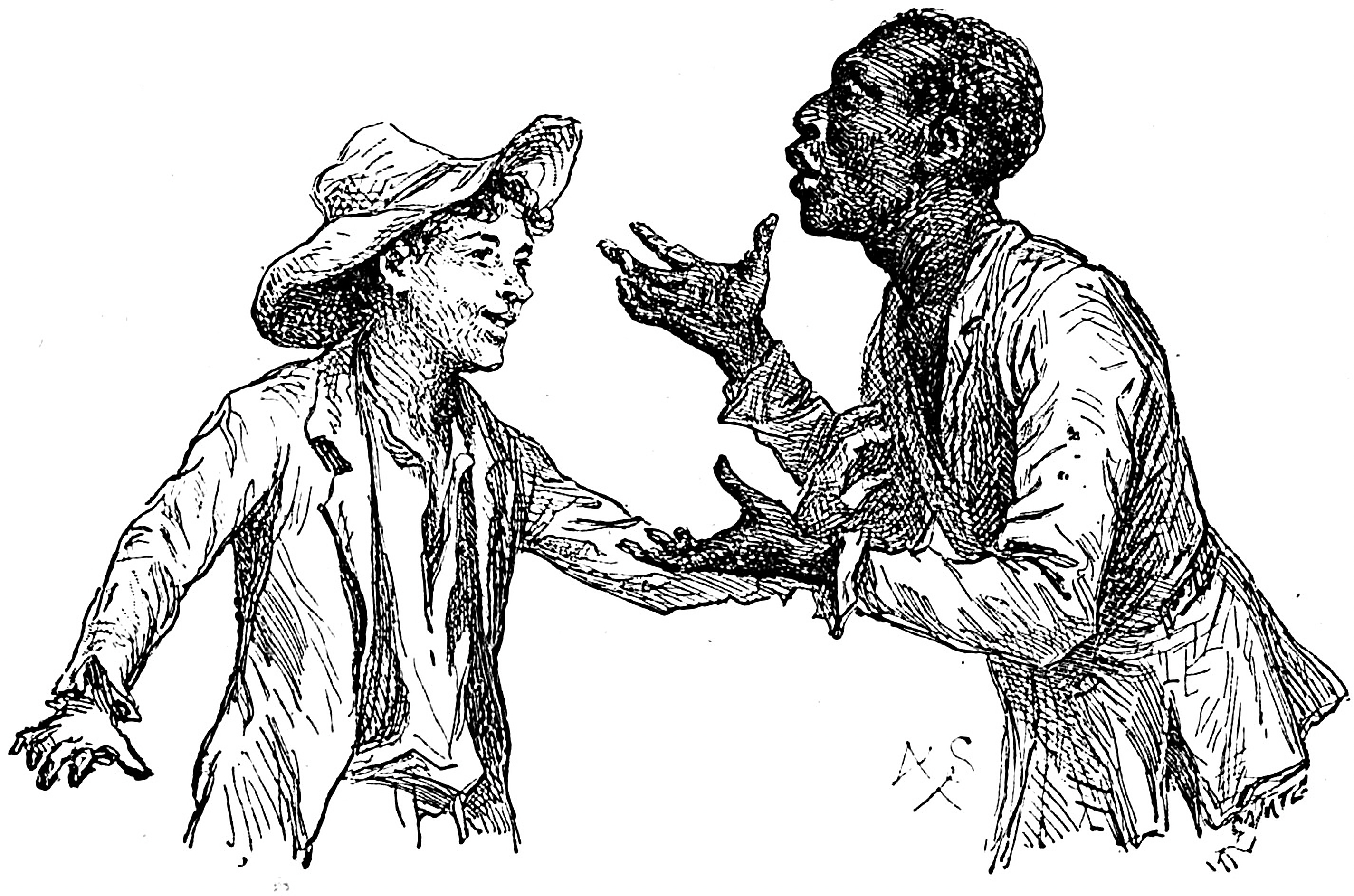
The true force of that great American novel is getting to watch a black man, who society refuses to recognize as fully human, awaken in a white child his own humanity, and getting to watch that child learn to think for himself. Huck rejects the social script on race, and it takes a revolution of his own soul to do so, as it would take a revolution of the American soul to do the same. In both cases, the guiding hand on the wheel was black, and in both cases, the greatest obstacle was a social script. Skip ahead 68 years and we find a similar experience in the pages of Ralph Ellison’s Invisible Man, in which he keeps discovering everyone has a preset script for him, one based on the received “wisdom” about race, and one that ignores his humanity, hence the title of the novel. At the start, the unnamed narrator thinks he’s been invited to give a speech to the town’s leading citizens. Instead, he and other black boys are forced to fight blindfolded in a boxing ring for the amusement of a bunch of drunken white savages. In the end, beaten and bloodied, the narrator still delivers his prepared remarks, clinging to the hollow belief that a respectable negro will be accepted by such barbaric whites, even after he has seen clean through the filthy lie of respectable white society. Huck rejects the racial script of his society, but Jim can’t, and Ellison’s narrator won’t. Though legally free, he is mentally bound by his belief in a story about race.
The third book that comes to mind when thinking of this topic is Toni Morrison’s The Bluest Eye, the most painful of the three, in which we read about a little black girl, only 11 years of age, who learns to see herself as ugly because she doesn’t have the blue eyes of Shirley Temple. Here, the racial script of society is darker than ever, because at least Ellison’s narrator saw through the sickness, whereas young Pecola Breedlove is pulled fully inside the lie, which even consumes her sense of self. If you read across the chronology of black literature, you will become witness to a horrible reality. Namely, that as black Americans became more free, black writers told stories about racial scripts that were ever more deeply embedded, consuming, and clever. In all these stories, race functions as a script so forceful and blunt, it becomes blinding. There’s probably an undergraduate essay somewhere in this, about the use of blindness and sight in both Ellison and Morrison, but what troubles me is that now we find ourselves in an age when the racial script of our society has evolved yet again, becoming more clever, and digging its claws deeper.
The new script says that race does not exist, that it’s all just an illusion, and that any recognizable gaps in performance are merely the result of white supremacy. Now, as a result, an entire generation of young black boys and girls, born free, are being raised in the mental slavery of believing that the White Man still lords over them in every corner of reality, and that the locus of control over their lives is forever external to their own will. Black Americans have never been more empowered, and yet not since slavery have they felt so powerless. We have replaced an unscientific belief in race with an unscientific denial of race, and declared it a solution. But every correction is an over-correction. The blindness of race denialism sees racism even in the concept of race itself. Nor is this the noble belief put forward by Martin Luther King Jr., who said that we should all strive to live in a society where race has no real social weight. That, I would say, is the only rational solution to any of this. But race denialism is something else entirely.
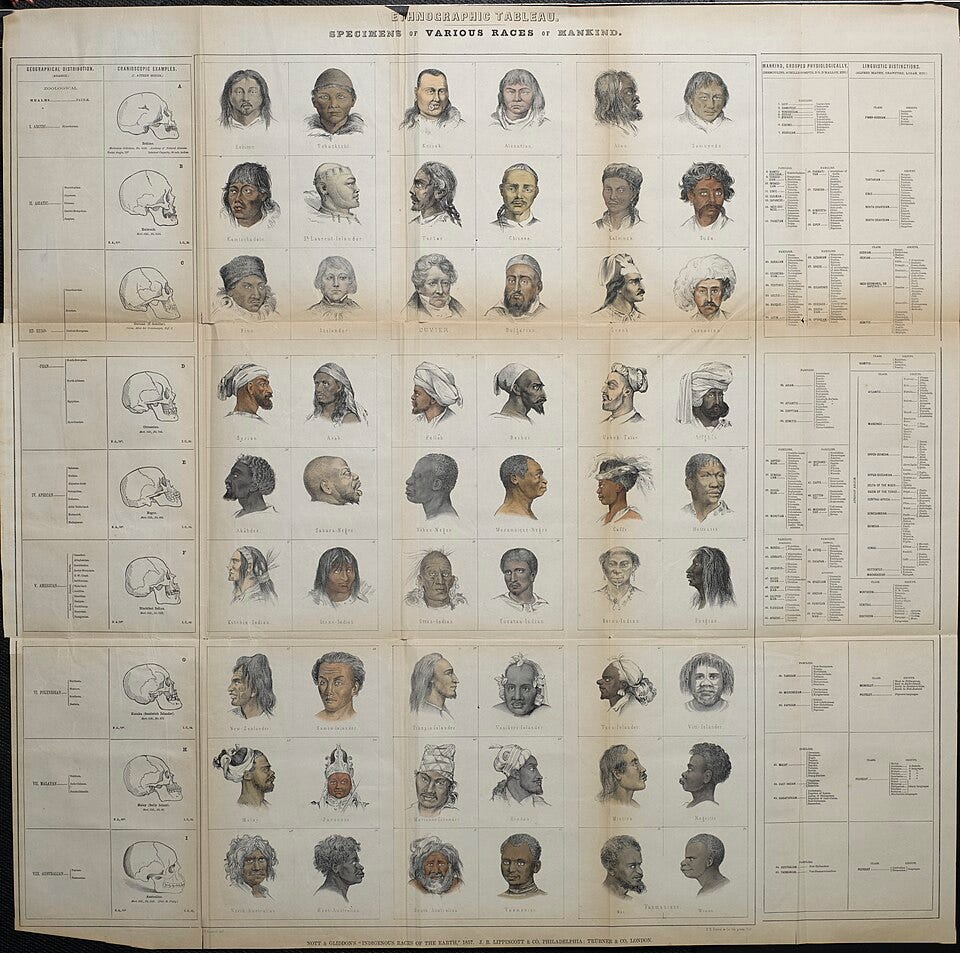
Early race “scientists” used monstrously stupid methods such as phrenology, craniometry, and anthropometry. They rejected evolution and the idea that different races have one shared human ancestry. They imagined races as different species. They believed in a sort of racial spiritualism that said all whites are smarter than all blacks, and more moral too, as if each race carries a mystical essence, such that a white imbecile who cannot even tie his shoelaces is somehow more clever than a black neurologist. But some of these more primitive formulations of race had a kernel of understanding. Consider the botanist Richard Bradley’s Philosophical Account of the Works of Nature, published in 1721, in which he attempted to describe the various racial categories, naming “five Sorts of Men,” including “the White Men, which are Europeans, that have Beards,” as well as “the Malatoes” and “the Blacks,” and others. Even Bradley, writing 300 years ago, knew that “Difference is enough to shew us their Distinctions,” but “as to their Knowledge, I suppose there would not be any great Difference,” and if they had the same environment, he added, “they would vary no more in Understanding than Children of the same House.”
A century before Darwin, Bradley recognized the role of environment in the shaping of such groups and their various understandings. But these crude, almost superstitious efforts to understand human populations were later blended with a misunderstanding of Darwinism, producing the kind of unscientific racism practiced by the Nazis. And because the Nazis practiced it, race science was stamped as inherently untrue and immoral. The problem is, what the Nazis practiced had nothing to do with science. Rather than using the scientific method to test their ideas about race, they began with conclusions based on nationalist myths and cherry-picked data to support what they wanted to believe. After these Dark Ages of racial understanding, we flipped the script, but now that the Western world has walked the opposite path, and our knowledge of human populations is actually scientific, rooted not in bigoted mumbo-jumbo but in evolutionary biology and behavioral genetics, it has become clear that we are simply fooling ourselves in the other direction, and that the race denialists are cherry-picking their data too.
Last night, I saw a debate between Nathan Cofnas, the researcher who exposed Jason Arday as a fraud, Glenn Loury, and John McWhorter. I have written about the Arday scandal, and about claims that he was lynched by the media, but now the conversation has tilted toward Cofnas himself, who is a race realist or, as he puts it, a “hereditarian.” Cofnas was talking to Loury and McWhorter about race and IQ, explaining that the average IQ of a black American tests at about 85, whereas the average IQ of a white American is about 100 — a gap whose causes remain intensely disputed. Cofnas did not discuss counter-arguments such as the Flynn effect, stereotype threat, test-bias literature, or geneticists who reject the hereditarian reading of the same data. But reasons aside, the testing gap is real, and this is a deeply unsettling point since the cutoff for mental retardation was originally 85, until it was lowered to around 70 in 1973. As Minnesota’s state disability council explains, “The main reasons for dropping the borderline category were its racial implications (racial minority groups were over-represented in the borderline group) and a growing uneasiness about the effects of labeling.”
Cofnas, as I understand him, argues that we shouldn’t lower standards, admissions rates, disability thresholds, or anything else. Rather, he advocates for leaving facts as we find them and presenting them no matter how ugly they may be. We cannot decide to avoid the topic, he claims, because people will have the conversation either way, indeed they already are, and so he believes it’s incumbent upon us to ensure that Nazis are not the only ones moderating the discussion. As you can imagine, this has generated intense backlash against not only his position, but Cofnas himself. This is hardly surprising. If you look up the term “race realism” on Wikipedia, you’ll find that it’s treated as synonymous with “scientific racism” and “biological racism,” as if it’s simply a fact that believing in the biological reality of race is itself racist.
Cofnas believes that unless and until we accept race as a fact, and also that some gaps in performance are the result of natural differences in IQ, then the progressive left will forever howl at the existence of those gaps, claiming they are the result of racism, as Ibram Kendi famously has. After all, blacks were historically and horrifically oppressed, so if we rule out natural causes as a possible explanation for performance gaps, indeed if we say it’s racist to even suggest that the gaps might be natural in nature, what else can explain them but bigotry? For Cofnas, that is the genesis of woke ideology, and he believes that wokeness will be with us until we confront these truths.
It’s worth noting that the origins of race denialism are just as absurd as the origins of race realism. Early critics of race realism were anthropologist Franz Boas, who also gave us cultural relativism, and biologist Lancelot Hogben, a socialist who believed in the sameness of all people for political rather than scientific reasons, and who understandably rejected anything tied to race after witnessing South African racial policies up close. In other words, Hogben rejected race as a category for the same reason the West has done so: motivated reasoning after witnessing the evils of racism. These ideas eventually evolved into what is now known as social constructivism, which denies all categories of human beings, claiming they are all social constructs. This idea says there are no gender differences, that gender has no biological basis, and so men can be women and women can be men. It says that there is really no such thing as disability, just differently abled people, and that being unable to see or walk is actually a kind of gift. You can even find parents who hold this view posting reveal parties, like gender reveal parties, except what they are celebrating is the disability of their child. Still another version of this belief is cultural relativism, which says all cultures are morally the same, as if Somalia or Pakistan are just as fit for human thriving as Switzerland or South Korea. Another sub-genre of this ideology says that childhood is a fictional category, and you can find people who want to deconstruct this category, removing parental rights and giving children the ability to decide things for themselves, as well as removing consent laws so that children are legally eligible for sex, and “minor-attracted persons” are no longer persecuted.

So what are we to do with all this? When it comes to race and IQ, McWhorter would rather not have the conversation at all, as he isn’t convinced there is much value in it. I’ve heard Coleman Hughes and Sam Harris make the same point. Loury disagrees that we shouldn’t look, or at least, he feels that Cofnas has every right to look at any subject in science, guided only by his curiosity. I agree. As for the question of whether race exists, McWhorter puts it best:
Race does exist. I’m sorry. But there are aspects of somebody’s genetic makeup where if you did not know what race (as in, the races that we perceive) they belong to, you could tell. And so, race is not a meaningless concept even though there are intermediate cases. Just because categories are fuzzy doesn’t mean that categories don’t exist. There is race.
If you need some data, consider that in 2005, Tang et al. took people from four groups — white, black, Asian, Latino — and read each person’s DNA at 326 spots. A computer sorted everyone into four piles based on the DNA alone, without being told anyone’s race, and the piles matched how people described themselves almost perfectly. Only five out of 3,636 people were sorted into a different pile than the race they’d reported. In 2022, Gichoya et al. found that AI trained on medical imaging — e.g. chest radiographs, mammograms, spinal films, hand radiographs — could infer a patient’s self-reported race with 0.8-0.99 area under the curve. For reference, 0.5 is a coin flip and 1.0 is perfect. Researchers corrupted, noised, blurred, and filtered the images, reduced them to 4x4 pixels, even blocked off whole sections, but the models still got the right answers. What are the categories these computers recovered from DNA and medical imaging? If you think the categories don’t really exist, that would make what these computers did an amazing magic trick. Or, as McWhorter says, race is real and what the tests show is that it is obviously a biologically meaningful category that even machines can detect.

But my concern is less about any of that and more about whether we can at least have open conversations about socially meaningful topics like race and human intelligence, ones that are driven by data rather than politics or emotion. In What Is Race?, Quayshawn Spencer argues for biological racial realism, rejecting essentialist categories while acknowledging that patterns of genetic ancestry clearly line up with common racial labels. Spencer and McWhorter are right, old-school race essentialism was wrong, but race denialism is wrong too. I also share some of McWhorter’s concern and hesitation when it comes to the debate over race and IQ. I personally find the data on race and IQ interesting, as well as troubling in its implications, and I take the point that this debate is already being had, and that if we don’t talk about it, the last people we want talking about it are going to be the ones in charge of the conversation. But also, there are incredible risks that come with opening up the chat, as such a discussion will require an enormous amount of understanding and sensitivity on the part of race realists, as well as curiosity and tolerance for discomfort on the other side. I’m not convinced we’re there yet, and I’ve got several apps on my phone that give me proof of this nearly every single day.
In his memoir, Self-Portrait in Black and White: Unlearning Race, published in 2019, Thomas Chatterton Williams writes about the goal of unlearning categories of race. He is after a world where those categories stop organizing our lives. I think that’s the right attitude. But I also think we’re probably not going to get there until we can at least accept certain realities about human populations. And that means accepting performance gaps between races. The solution to this problem is simply to stop caring about race, and the degree to which races are represented when compared to their prevalence in the general population. We should fight bigotry, and pour resources into helping oppressed communities, but beyond that, we should embrace meritocracy.
Above all, we should abandon the social scripts about race that trap people in their comfortable catechisms. Whether it’s the belief that race is real, or a phantom, each ideology runs the risk of sparing its believers the labor of looking harder. We also have to be braver about truth. And that goes for both sides of the political spectrum. I mean truths about our racist history, but also truths about racial differences in behavior. I mean truths about racism today, but also truths about the nature of race itself. Once we mature to that degree, I will agree with McWhorter and Williams that there is nothing of great value in the conversation. Or to put it another way, the value was in learning to get past the concept. And if that attitude lands me somewhere the polite consensus calls hell, all right, then. I’ll go.
Thanks for this thoughtful article with a lot of background.
Discussion of the elements and underlying causes of physical and psychological average differences between races should be profoundly interesting and useful for multiracial societies on any scale, from a school or workplace up to international level, as it informs what policies will be most helpful - or least corrosive, at a minimum.
Unfortunately the antiracist over-reach from the 1970s onwards dismissed such research and policy making, in favour of very expensive moves in the wrong direction (affirmative action etc). These policies, ironically enough, in addition to not working, actually have very racist messages for individual black people embedded in them, that they are only ever going to succeed if white people make things easy for them, due to their lower intelligence, or whatever. Nice work.
Cofnas believes that facing the realities of race, and average race differences, has the potential to liberate everyone from fifty years of unhelpful thinking and action. It’s a very positive direction to head in.
Meritocracy as a "solution" to racial disparities in ability presents its own set of issues. Blacks are overrepresented—present at rates higher than their presence in the general population—in many sports where participation/victory is selected based on merit/objective standard; basketball and marathon running come immediately to mind.
Nathan Cofnas has been vilified for studying Harvard's own student admission data, supplied in connection with the recent (SFFA vs. Harvard, 2023) Supreme Court decision striking down racial preferences, and coming to the conclusion that, without those preferences and in light of the high standards required of its professors, almost NO blacks would quality to become Harvard faculty members. Cofnas insists that grim prospect must be understood and accepted by those, like the author, who preach meritocracy as panacea in settling issues presented by the fact of racial differences.
Cofnas suggests that some fields where "representation" is more critically important than merit, such as political appointments and corporate governance, could be dealt with using some version of a quota system (had the Supreme Court not banned their use for such purposes). Cofnas is a deep and subtle thinker; neither Glenn Loury nor John McWhorter gave him the opportunity to fully express himself; Coleman Hughes ("Conversations with Coleman" on YouTube) did much better. There, Cofnas recommends that the discussion of racial differences and mechanisms to deal with them be effectively restricted to high-level academics and other professionals rather than thrown into public view as a matter for consideration, debate, and action.