


One of the most influential Christians who ever lived despised Jews, considered gay love a demonic perversion, viewed women as inferior to men, saw demons constantly, thought Satan could be defeated with a well-timed fart, and had his greatest spiritual epiphany not while preaching the faith or praying for counsel, but while evacuating his bowels. On the other hand, Martin Luther reformed Christianity, remade Western civilization itself in the process, and possibly gave us the Christmas tree.
According to legend, the Apostle of Germany — or the German Heretic, depending on one’s view — famously hammered his 95 theses to the wooden door of a church in Wittenberg in 1517. The Church was then in the practice of selling “indulgences.” The idea was, if you were sorry for your sins and you showed this through repentance, confession, prayer, and taking part in Church life by helping fund its operations, then the Church could lessen your time in purgatory. But to Luther, this was tantamount to slapping an entrance fee on heaven.
And he had a point. The Church at the time was incredibly corrupt. The papacy was not just a spiritual guide but a territorial power involved in wars and dynastic schemes. Popes and bishops gave jobs, lands, and favors to relatives. Many high-ranking churchmen lived like princes. Some bishops held multiple offices and collected income while barely visiting their dioceses. And priests were supposed to be celibate, but mistresses were as common as cathedral pigeons.
But the good Church was not uniformly rotten. Many priests, monks, nuns, and ordinary believers were deeply sincere and did much good. For over 1,000 years, Christian art and Western art were synonymous. Music theory largely developed in ecclesiastical contexts through Gregorian chant. The Church preserved and developed Ancient Greek and Roman philosophy through scholasticism, especially via figures like Thomas Aquinas and Augustine of Hippo. The first European universities — in Bologna, Paris, and Oxford — grew out of cathedral schools and operated under Church charters. Physics and astronomy emerged from efforts to understand God’s works. The Church developed canon law that became one of the most sophisticated legal systems in Europe, influencing modern jurisprudence. Monasteries preserved chronicles and pioneered systematic historical writing. In short, Western art, music, education, science, law, and history all owe a great debt to the Christian faith.
And as far as the corruption went, it was especially bad at the very top and in the financial machinery of the institution, but that’s about it. Still, by the time Luther picked up his hammer in 1517, the Church had become a spiritual institution that was run a little too much like a political empire, a bank, and a family business. So Luther did have a point, and the sale of indulgences was corrupt, even if his criticism was bad faith. I say that because his attack would have sounded to a Catholic at the time like arguing that if you join a charity marathon, train for months, run the race, and raise donations, that you only got healthier because people gave money.
Even so, Luther powerfully argued in his 95 theses that you cannot buy God’s forgiveness, that true repentance is a lifelong process and not a financial transaction, that the Pope doesn’t get to decide otherwise, and that Christians should probably give their money to the poor instead. But although Luther is most famous for this argument and the Reformation it sparked, I would argue that the most important thing he ever did was democratize the faith by translating Scripture from the Latin of priests and lords to the German of the common people, as well as by rejecting the idea that any one bishop should hold authority over the entire Church, not even the bishop of Rome. Although that second point is not terribly surprising given that he believed the Pope was the Antichrist.
Like some Prometheus, Luther brought the fire of the gospel to the German people, but if salvation means becoming spiritually whole, enlightened, united with God, or “ascending to heaven,” then it fundamentally concerns what a person is and not merely what they believe. This is why I reject Luther’s view that salvation has nothing to do with being wise or doing good deeds. That was the brilliant insight he had while taking a shit. But wisdom is necessary. Truth is the only way to enlightenment, indeed attaining the highest form of truth is itself what enlightenment means. And once you achieve a certain level of wisdom, good deeds come naturally because a wise person is not going to go around doing stupid or harmful things.
Good deeds are the expression of a transformed character. If someone is cruel, dishonest, or violent, what sense would it make to call them spiritually saved simply because a particular set of words happened to pass through their waking mind? This is roughly the intuition behind much of Aristotle’s virtue ethics, Socrates’ emphasis on wisdom, many forms of Buddhism, much of Catholic and Orthodox Christianity, and numerous other religious and philosophical traditions. It’s also common sense.
The counterargument from Luther would be, “You’re confusing the result of salvation with the cause of salvation. Wisdom and virtue are important, but they flow from salvation. They don’t earn it.” But I don’t find this convincing. If you murder your wife and children, I find it insane to claim that you are still spiritually saved in any meaningful sense simply because you felt bad after and you happen to believe Roman soldiers once executed a Jewish rebel in the Middle East who then came back to life.
If Judaism is a faith tailor-made for people with OCD and Catholicism is cut out for people with depression, Protestantism might be the faith for people whose lives are defined by reactance. That’s when people will react even in ways that are harmful to themselves because they don’t like being told what to do, and several major thinkers have argued that Protestantism is the primary cause of Western individualism (though they disagree on whether this was actually a good thing).
In The Protestant Ethic and the Spirit of Capitalism, Max Weber famously argued that Protestantism, especially Calvinism, encouraged individualism in a way that promoted capitalism. Alexis de Tocqueville also tied Protestant culture to American individualism and skepticism of hierarchy. But one of the strongest academic statements of this thesis comes from Louis Dumont who, in Essays on Individualism, argues that Christianity, and especially the Protestant faith, helped create the modern concept of the autonomous individual. In The Unintended Reformation, Catholic historian Brad Gregory says rejecting a central religious authority on all things is what led us down a path to secular inquiry, whereas religious fragmentation led us to moral plurality and eventually subjectivism and then relativism, all of which moved the locus of ontology from God to the Self and from the church to the lab.
But my friend Elijah Snyder argues that the emphasis on the belief of the individual in Protestantism, rather than on the community, has had unintended and profoundly negative consequences. The biggest downside has been that Western society has evolved into a fragmented and consumerist evangelical culture that often feels shallow, dogmatic, and spiritually unhealthy. This has led some to seek traditions more aligned with the teachings of the early Church. Some call this “apostolic Christianity,” after what was taught by the apostles in the first century. Or “primitive Christianity.” Or, if you prefer something more poetic, you might borrow a line from the Epistle of Jude to refer to yours as the faith once delivered.
Snyder recently spoke with me about all this, as well as the death of American Protestantism, evangelicalism along with it, and what comes after.
What is your educational background and area of expertise?
The truth is I’m a college dropout, and I want to be very careful to note my lack of formal training in theology, church history, sociology, or any of the other topics we’ve been discussing. I don’t claim to speak for Orthodox Christians or academic scholars of the Bible, or really anyone else at all. I can only share observations I’ve made in my personal journey of faith, which has involved a lot of wandering over the last few years, and perhaps would resonate with any of your readers engaging with this very strange era of modern Christianity.
How have early Christian ideas of heaven, hell, and salvation changed over time?
The modern concept of hell that most Americans are familiar with is known as “Eternal Conscious Torment” (E.C.T.), which is sort of self-explanatory. People tend to think of hell as a literal place where you are tortured in a fire forever as punishment for your sins. To be clear, this is not a new idea, and versions of it have existed through most of Christian history. What has changed, however, is the degree to which this concept is viewed as the official standard of Christianity as a whole.
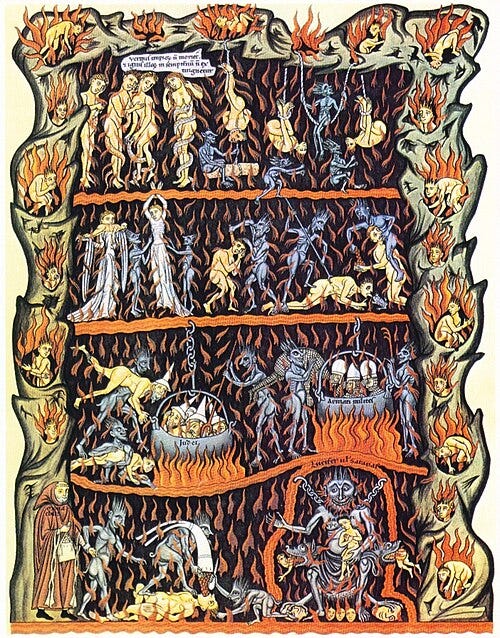
In the early days of Christianity, intellectual diversity flourished in specific matters of theology. There were broad mysterious concepts that most Christians shared, but the specific interpretations of these concepts could vary, and often did. Eastern Orthodoxy has preserved this culture, preferring to allow a sense of mystery around the finer details of metaphysics and the afterlife, and allowing for different schools of thought. Hell is a great example of the preference for mystery in ancient Christianity. Most Christians have always espoused a belief in eternal life, but how it works was up for discussion in the early Church, and still is, where early Church traditions have held up.
Specifically on the issue of hell, two of the alternate points of view that emerged included universalism (everybody eventually ends up in heaven, restored to God), as well as annihilationism, which is the belief that the wicked will simply cease to exist. There are other questions worth exploring as well: Is the fire meant to punish, or to purify? How can it be a place of utter darkness and simultaneously a lake of fire?
The model that I find most compelling is the one developed by Eastern Orthodox theologians like Maximus the Confessor and Isaac the Syrian. These incredible thinkers taught that hell was not a literal place, but a state of being in which a person is suffering endlessly because of their continued resistance to God’s love, which is pictured as a consuming fire. Both sinner and saint are surrounded by God’s love, experiencing His divine presence. To the ego-driven, power-hungry, selfish man who would rather “reign in hell than serve in heaven,” the presence of God feels like torture. God’s love comes to transform us and lead us to a higher mode of existence, to become infinitely loving, humble, beautiful creatures. The truth is, however, not everybody wants to be enlightened. Some souls could spend eternity always wanting more, always striving after their delusions, never able to experience joy and satisfaction because of their own stubborn pride. In the words of C.S. Lewis, “the doors of hell are locked from the inside.”

As time went on, the Western Church began to coalesce around a more systematic understanding of theology, with clearly defined correct and incorrect answers to centuries-old mysteries. This led to the current state of Western Christianity, where E.C.T. is viewed as beyond discussion for most Roman Catholics and Protestants. Even in seeker-sensitive modern evangelical churches, while hell might not be a popular sermon topic, the theological positions tend to align with this Roman Catholic vision of punitive never-ending torture, and many modern Christians are unaware that more nuanced positions ever existed within traditional Christendom. Any Christian who views Eternal Conscious Torment as foundational to their faith might do well to investigate Eastern Christianity and some of the theological nuance that has been preserved in those traditions.
Jesus never preached the hell most people imagine today. The idea of a literal inferno emerged gradually over centuries. Tertullian, who coined the term “Trinity,” helped push Christianity toward a more literal understanding of hell in the 200s, Augustine gave it rhetorical force in the 400s, and Dante furnished it with cultural heft in the 1300s. But it didn’t become a household Christian belief until about the time of Luther. It’s important to remember that ECT is a dumbed-down bastardization — the result of taking a metaphor literally. Similarly, God is not actually a physical man with a beard and toe nails who sits on an actual throne on top of a cloud. ECT mistakes symbolic depictions of the soul’s alienation from God for a geographical torture chamber. But this is wrong. If someone says a man is a bull, it means he’s strong, not that he has horns and a tail. Buddha essentially taught metacognitive training methods, but by the time those lessons reached Japan, Buddhists were believing in literal testicle demons.
Why are so many Protestants disillusioned with their tradition, yet unwilling to return to Catholicism?
Protestantism is, at its core, defined by a distaste for centralized authority and control. The Reformation only lasted several years before splintering into competing sects with different points of view on everything from baptism to communion and church governance. This is both the beauty and the downfall of Protestantism — it’s a free market where you are able to walk away from one tradition and find another that better aligns with your values and inclinations. No two Protestant denominations are the same, and frequently the local churches can differ from location to location even within the same denominational network. The theological emphasis is on one’s personal relationship with God, and people are encouraged to read the Bible constantly, interpreting for themselves and forming their own conclusions about what is true. Questioning the organization theologically is granted, even invited, on most issues. There is much about this that is highly commendable. Protestants think for themselves and are not easily drawn into a corrupt authoritarian system.
However, in an age where capitalism and technology have increasingly isolated people from all forms of community and human connection, a growing demand has emerged for something bigger than oneself and one’s “personal relationship with God.” Many Protestants are becoming aware of the need for shared rituals, long-standing tradition, and unifying structure. The giant LED screens and hipster outfits that define the modern evangelical church experience have become clichéd and cringey, and by comparison, ancient traditional Christianity feels more authentic and reverent. This has led to a record-breaking increase in conversions to Catholicism in the Western world, driven largely by discontented Protestants who are seeking something more substantial, more beautiful, and more time-tested.
About 33% of former Protestants say they left their religion because it was out of date, 44% felt their spiritual needs were not being met, and 66% said they “just gradually drifted away,” according to a Pew poll from late last year.
That said, for many Protestant wanderers, the Roman Catholic Church is still a bridge too far. Dogmas like papal infallibility require an uncomfortable degree of unquestioning submission to authority. The Pope holds the unilateral power to speak for God, and it’s fair to wonder if one day the Roman Catholic God might become a raving progressive advocating an extreme social justice agenda. After all, this has already happened across major historical denominations like the Anglican Communion. Add to this dubious concentration of centralized authority the long sordid history of corruption, simony, sexual abuse, and other scandals within the Pope’s jurisdiction. Just because one is tired of hyper-modern Protestantism does not mean they are prepared to shut off all critical thinking and embrace the absolute monarchy of a manifestly imperfect bishop in Rome.
Why does Orthodoxy seem to attract some people coming out of evangelical or Protestant backgrounds?
I often explain the difference this way: aesthetically, Orthodoxy looks more similar to Catholicism than Protestantism, but theologically Protestantism is far closer to the Roman Catholics than the Orthodox. Orthodoxy has the beautiful art and architecture, the global unity, and the solemn pageantry of Catholic (meaning traditional Christian) faith. One can be forgiven for assuming this means they would be more theologically in line with the Catholics. However, the opposite is true.
Protestants and Catholics — let’s group them as Western Christians — agree on a literal fiery hell where people are tortured forever. Orthodox Christians have a nuanced and diverse conversation about the afterlife. Western Christians teach that sin is a legal offense against a clear system of rules, and that Jesus’ painful torture and death on the cross was a punitive satisfaction of God’s justice. Think of it as paying reparations in Catholicism, or in Protestantism it can even have to do with satisfying God’s anger and wrath. Orthodox Christians believe that sin is something more like a sickness, with symptoms in our behavior, and that Christ came as a doctor and a rescuer to heal us of our sin and liberate us from its oppression. In fact, St. Athanasius actually teaches that “God became man, so that man could become god.” We are not merely forgiven for a crime; we are transformed into our truest self, our ultimate purpose: to share in God’s own divine nature.
These are only a couple major examples, but the rabbit hole goes deep. I think that people leaving evangelicalism feel that they are able to retain their faith in Jesus, and their faithfulness to Christian belief, while exploring a far more healthy and profound way of understanding Him. Too many of us are traumatized by a guilt-based system of do’s and don’ts and a concept of salvation that is more of an insurance policy against God’s anger than an expression of His love. We don’t want the same skewed theology with a more majestic building. We want to participate in the greatest story ever told. I feel like I have discovered the original recipe for something I have loved all my life, but never quite made sense of. When I go to church now it’s meditative, peaceful, and challenging — the world does not often put us in a position to slow down, be present, and engage with the miracle of life.
Orthodoxy also has an incredibly strange decentralized leadership structure. While there is a hierarchy of honor and respect, with leadership and unity around some fundamental dogma, technically every bishop is considered an equal — all 941 of them. Each bishop has jurisdiction over a geographical area and its churches. This results in a sort of hyper-conservative gridlock. Not much has changed in Orthodox practice over 2,000 years, and that’s because it would require a strong majority of the 941 bishops agreeing on the same thing. The last ecumenical council where this occurred was in 787 AD. So there is no concern about a rogue papacy forcing the church in a direction either reactionary or progressive.
How did growing up in a Pentecostal sect shape your understanding of religion, authority, and belonging?
The obscure, dying sect I grew up in had mostly normal Pentecostal theology, like you might find at any number of local modern American churches, but the leadership culture and internal norms have evolved to create a toxic cult-like environment of obligatory conformity and control. Growing up I was constantly reinforced in my unquestioning, unwavering obedience to a man who spoke for God. Being deeply scrupulous by nature and loving Jesus since I was a kid, I fell head over heels in love with the vision of our little group for many years of my life, including the entirety of my 20s. I became a pastor for a season, and made great sacrifices of money and time to further their agenda.
When I reached my 30s I began to really explore the implications of everything that I had learned in ministry, marriage, business leadership, and life. This led to something of a crisis in my faith when I realized the extent to which my group’s culture was completely degrading into a cesspool of ego, resentment, exploitation, and manipulation. It’s not that I simply ended up in a toxic church — it’s that the ideas I was raised with from the cradle seemed to be a structural part of the brainwashing that allowed these people to control my entire way of life and exploit my resources. I realized then that I had put my faith in a God who was another man’s sock puppet — and not even a particularly compelling man, but a virtual nobody ruling over their own little religious kingdom. I had to reexamine my faith itself.
In the long run I reconciled my struggle with faith, in part through Orthodoxy, and in part through reading Eckhart Tolle and smoking weed. However, I retain a deep suspicion around religious leadership that I will take to my grave. I chose to participate in an institutional structure with flawed leaders, and I do so knowing that I will be authentic about my perspective, no matter what they expect of me. Independent critical thinking is unfortunately not encouraged in most religious contexts, but in Orthodoxy I feel safe having a separate sense of my own personal perspective than the official Church narrative.
What is the evangelical or faith deconstruction movement really reacting against?
This is a tough one, because I don’t think there’s any one answer that speaks for the present movement of evangelicals publicly deconstructing. In some cases it’s a reaction against rampant abuse, nepotism, and fraud in the evangelical world. Many people have been hurt in some particular way, whether by organized shunning, sexual assault, or any number of other localized scandals. Some were propagandized from their childhood years against the scientific community in the name of defending Biblical accuracy on issues like evolution. Others are sickened by the way massive numbers of evangelicals have wholeheartedly committed to a MAGA movement that seems antithetical to the actual commands of Christ.


For me it’s a mixture. The above issues never seem to be confronted by evangelical leadership in a way that seems appropriately accountable for their complicity. Modern American evangelicalism has morphed into a perverse church industrial complex where consumerism and celebrity culture hold the reins of the movement. Additionally, my own intellectual development as a believer has led me to believe the Reformation was something like a revolution — an inevitable consequence of Catholic corruption being overcorrected against — and I feel that the revolution has come full circle to the point where Protestantism is doing more harm than good.
Why are so many millennials and Gen Z Americans leaving evangelical Christianity?
The internet has remade pop culture into a thing that sorts for authenticity and engagement rather than polish or production value. Giant screens and fog machines may have impressed Gen Xers in the 90s looking for an emotionally satisfying experience at church, and celebrity pastors certainly have discovered a gold mine in terms of exploitation. However, the local Orthodox parish is not trying to market to you, or pretend to be something it’s not.
Your local Orthodox priest is serving the divine liturgy according to the way it was written well over a millennium ago, and there is no coffee shop in the front lobby. In that way, it feels dramatically more authentic and uncompromising as an experience. I suspect millennials and Gen Z perceive the American Orthodox movement as something organic and real, in contrast with a Protestantism that seems to be torn between progressive woke posturing and 30-year-old pastors wearing Air Jordans and selling bespoke t-shirts.
How is the rise of the religiously unaffiliated connected to the crisis within American Protestantism?
Protestantism is very much focused on what the individual believes in a metaphysical sense, and on faithfulness to any number of dogmas depending on how the local congregation interprets the scripture. People who identify as “spiritual but not religious” are wanting to connect to God without feeling like they must force some sort of mental conformity to fit in. Orthodoxy is far from “spiritual but not religious,” but the reverent, open-minded way of discussing theological issues seems to resonate with people who are suspicious of organized religion.
I’ve made statements considered heretical to my Orthodox friends, and instead of clutching their pearls and trotting out the apologetics, they seem nonreactive and embracing of the difficult, deep questions about their faith. I can’t speak for everybody, but there are a number of people in my parish who have come from backgrounds in Eastern philosophy, New Age spirituality, and academia. For people uncomfortable with making a lot of dogmatic doctrinal commitments, Orthodoxy is a safe place to explore Christianity without feeling the need to be a Republican, avoid using swear words, perform an emotional display of worship, or conform to any number of other American religious cultural norms.
Why do outsiders often fail to grasp how powerful evangelicalism still is as a cultural and political force?
Probably because evangelicalism is a subculture with its own unique lingo and expectations. I could list pages of names that would mean nothing to you unless you grew up in an evangelical church. Not just pastors and authors, but movies, music artists, non-profits, style trends — it’s really its own little world. It just so happens that it’s a big enough world to swing a Republican primary, or support an alternative halftime show during the Super Bowl. If you find evangelical ideas concerning or repugnant, you must understand that there are tens of millions of people in this country for whom they are the most normal thing in the world.
What are people actually searching for when they leave modern evangelicalism?
For me, it was permission to be religious while expressing myself authentically. I don’t believe in talking snakes. I don’t believe that God will torture the majority of the world’s population in a fire for eternity. I don’t believe the apologetic arguments trotted out in debates about God usually make a whole lot of sense. I don’t like the sense that if I drop an f-bomb or get a little drunk at the barbecue that I’ll be alienated and treated with suspicion or condescension. Evangelicals may feel I’m being unfair here, but I find the culture of evangelicalism intellectually repressive and stifling. However, I think in general almost everyone leaves evangelicalism seeking some sort of authentic engagement with the big questions of life — one that does not have predetermined answers in a systematic theology.
What do you think the future of Christianity in America looks like?
I don’t think that the American Orthodox movement is going to maintain this pace forever. As much as my ego would like to believe we’ll take over, the truth is that not everybody finds it as delightful as I do. Evangelicalism is not going anywhere, but a greater percentage of people will be non-religious, Orthodox, or Catholic in the future. Some modern churches will probably dial back the megachurch model and embrace more tradition. One evangelical pastor named John Mark Comer has been quite successful at integrating ancient Christian theology into his very modern context. I think the biggest difference might be political.
Evangelical Christians tend to be extremely pro-Zionism, and the ancient forms of Christianity have always been deeply suspicious of Israel for theological reasons. I suspect the political field competing for Christian support will diversify, and you will see more diversity of perspective and language when people speak about God on the public stage. Ultimately I hope the future of American Christianity looks more humble — we need to approach the non-believer with respect, kindness, and charity. Christianity was meant to be a universal religion of mercy, not a means of separating oneself as special and different from others. If you believe that you should love your neighbor, care for the poor in their needs, admit when you are wrong, and seek to forgive those who have hurt you, you are as Orthodox as anyone could be. In the words of St. John, “Everyone who loves has been born of God and knows God. Whoever does not love does not know God, because God is love.”

As one who grew up in an evangelical church, earned an M.Div. from an evangelical seminary, left the ministry, but have not abandoned my faith, I have a somewhat different view of things than most might. What is conveniently referred to as Protestantism includes a very wide and rich variety of expressions of faith. I am uncomfortable with the manner in which they are often lumped together as if they can be adequately characterized by simply not being in the Catholic or Orthodox traditions. Luther's revolt against Rome was as much political as religious, or he would not have enjoyed the protection of powerful rulers such as Fredrick III, and would not have ignited the revolt against Rome. To ignore the others who evolved religious traditions that are in many ways reactions against practices, policies, and traditions of the Roman Catholic church, such as Calvinists and Anabaptists, is giving Luther more credit than he deserves. The Episcopalians (Anglicans) were created for political reasons by Henry VIII ostensibly for reasons less lofty than Luther's. Yet all these groups, from the Orthodox and the various forms of Catholics (Roman Catholics are not the only Catholics), to the Protestants - Liturgical, Baptistic, Evangelical, Pentecostal, and others - all share core beliefs that Lewis described as Mere Christianity. Hell, though a (non-standardized) shared belief, is not a core belief, even among all the Evangelicals.
I feel as though discussions of the impact of Protestantism, particularly critical analyses, often use an idealized alternate possible history (where Luther and Calvin never created their churches and new religious traditions) for evaluation. Would there really not have been a rise of individualism? No Enlightenment? (And therefore no basis for the American Revolution and Constitution?) Is this not magnifying issues one may not appreciate while ignoring the rest of the complex web of religious and social developments that are, at least peripherally, connected to the Reformation and the subsequent rise of Protestantism? Is this as unjust as using the Roman Church's treatment of Galileo as proof that it is anti-science while ignoring the scientific contributions of Roman Catholics such as Augustinian Friar Mendel and Jesuit scholars?
There are valid criticisms of evangelicalism, not the least of which is preaching "cheap grace", what I call "transactional salvation", the recent rise in some circles of the "gospel of prosperity", and entertainment-focused megachurches (sometimes referred to irreverently as "Six Flags Over Jesus"). In the same vein one could criticize Roman Catholics for "magical theology" which can invalidate baptisms because the word "we" was substituted for "I" in the ritual (the wrong magic words were used). A case could be made that the Orthodox and Catholic churches promote a mild form of idolatry in the devotion and prayers offered to icons, saints, and Mary. (I confess to being something of an iconoclast.) Personally I find Orthodox worship impressive and moving, but also something of a spiritual spectator sport and ultimately unsatisfying for a constant spiritual diet.
I have friends who have abandoned corporate worship, and some have rejected the faith in which they had grown up. Most of them feel betrayed by a local congregation or a denominational body. Most have a legitimate basis for feelings of betrayal. (I know that is a harsh word, but the stories I have been told justify its use.) The interesting fact is that, though most were Evangelicals (because numbers), they include former Roman Catholics and Orthodox as well. The most common thread is that they were made to feel unwelcome, or shamed for asking the wrong questions, or were the victims of malicious gossip. Yes, even the former Orthodox. I am glad you have found a home in a congregation where you feel welcomed and can explore and grow in knowledge and faith - where there are no thought police or confusion regarding the distinction between sin and some social convention peculiar to certain classes within middle America.
I feel every tradition and church within Christianity has strengths and weaknesses. Some congregations are nurturing while others are toxic, and probably most are somewhere in-between. I try to take Orthodox, Roman Catholics, and Protestants the way I take anyone else - one at a time and prayerfully, understanding that we are all in the process of becoming who we will be. Some people just require more patience than others.
I personally have no issue with the trajectory of individualism and think that it has brought us to a place that, while perhaps spiritually unfulfilling for some (many?), has become materially and especially intellectually fulfilling for more. While I obviously can't speak for everyone, I think it's clear that many people (myself included) have found deep fulfillment that could perhaps be described as spiritual simply from intellectual pursuits (maybe they're the same, at least for some?). Individualism and collectivism both have their benefits and drawbacks, and I think what's happening lately, largely thanks to internet-driven atomization among other things, is that fewer people can accept the trade-offs that come with individualism. I personally believe they haven't considered the trade-offs from collectivism, especially since they have never lived them, and I think they're more motivated by an avoidance or fear of trade-offs in general, but that's neither here nor there. Individualism's trade-offs are being questioned, and that's the reality with which we must cope.
That all being said, Elijah's absolutely speaking my language with regard to the historical trajectory of the individualistic ethos and what has happened in the United States in particular, which is derived from the Enlightenment values that only exist thanks to the individualism and questioning of authority AS a value, encouraged by the Reformation. Where I might part company with him, or at least have a different interpretation, is that I think the Protestant faith hasn't gone anywhere, and has instead taken on an increasingly secular aesthetic. It feels passe to talk about social justice/antiracism/"wokeness" being a religion now, but if I'm right to characterize the late 2010s-2020 or 2021 as the most recent explosion of revivalism--a new Great Awakening--then I think what we're seeing now with those not retreating into the toxic socialist-nihilist-Third Worldist mush of left wing populism, is the same kind of settling that always followed American revivalist explosions. The specific concerns of those revivals has always changed, but the character never did except with the seemingly secular aesthetic (which honestly isn't all that new; the revivals of the late 19th century were very secular in many ways).
But again, Elijah's point is sound; the individualism at the core of Protestantism is what brought us to where we are; politically, socially, spiritually. Perhaps the best way to put it is that we would do well to recognize this heritage, even us atheists.